44,95 €
inkl. MwSt.
Sofort per Download lieferbar
22 °P sammeln

Andere Kunden interessierten sich auch für
") The Political Economy of Land and Agrarian Development in Ethiopia (eBook, ePUB)41,95 €
The Political Economy of Land and Agrarian Development in Ethiopia (eBook, ePUB)41,95 €") The Green Fiscal Mechanism and Reform for Low Carbon Development (eBook, ePUB)45,95 €
The Green Fiscal Mechanism and Reform for Low Carbon Development (eBook, ePUB)45,95 €") The Economics of Sustainable Transformation (eBook, ePUB)41,95 €
The Economics of Sustainable Transformation (eBook, ePUB)41,95 €") Development Betrayed (eBook, ePUB)63,95 €
Development Betrayed (eBook, ePUB)63,95 €") Environmental Evaluation and Global Development Institutions (eBook, ePUB)0,00 €
Environmental Evaluation and Global Development Institutions (eBook, ePUB)0,00 €") Beyond the Green Economy (eBook, ePUB)35,95 €
Beyond the Green Economy (eBook, ePUB)35,95 €") Cents and Sustainability (eBook, ePUB)109,95 €
Cents and Sustainability (eBook, ePUB)109,95 €

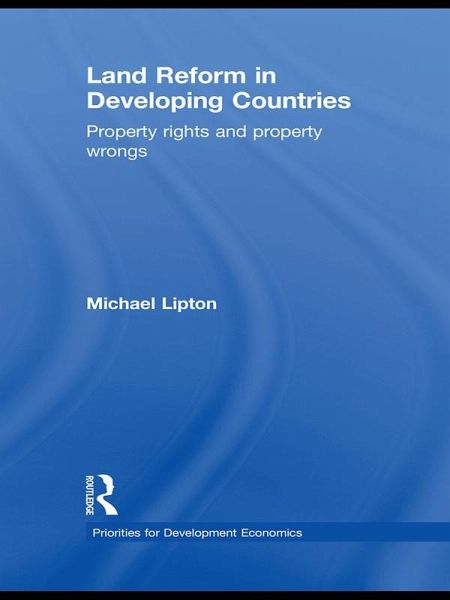
Land reforms are laws that are intended, and likely, to cut poverty by raising the poor's share of land rights. That raises questions about property rights as old as moral philosophy, and issues of efficiency and fairness that dominate policy from Bolivia to Nepal. Classic reforms directly transfer land from rich to poor. However, much else has been marketed as land reform: the restriction of tenancy, but also its de-restriction; collectivisation, but also de-collectivisation; land consolidation, but also land division.
In 1955-2000, genuine land reform affected over a billion people, and almost as many hectares. Is land reform still alive, for example in Bolivia, South Africa and Nepal? Or is it dead and, if so, is this because it has succeeded, or because it has failed? There has been massive research on land reform and this book builds on some surprising findings.
This book will be of great interest to students, researchers and consultants working on agriculture, farm organisation, rural development and poverty reduction, with special emphasis on developing countries.
In 1955-2000, genuine land reform affected over a billion people, and almost as many hectares. Is land reform still alive, for example in Bolivia, South Africa and Nepal? Or is it dead and, if so, is this because it has succeeded, or because it has failed? There has been massive research on land reform and this book builds on some surprising findings.
- Small farms' share in land is rising in most of Asia and Africa.
- This is not driven (as widely claimed) by growth in rural population or farm productivity, but by the relative efficiency of small farms, and in some cases by land reform.
- Whether land reform helps the poor depends not only on land transfers, but at least as much on its effects through employment, non-farm activity, GDP growth and distribution, as well as the village status and power of the poor.
- Avoidance, evasion and even distortion of land reform laws sometimes advance their main aims.
- Liberalisation and its accompaniments (such as supermarkets) can be powerful friends or fatal foes of small farms and land reform.
This book will be of great interest to students, researchers and consultants working on agriculture, farm organisation, rural development and poverty reduction, with special emphasis on developing countries.
Dieser Download kann aus rechtlichen Gründen nur mit Rechnungsadresse in A, B, BG, CY, CZ, D, DK, EW, E, FIN, F, GR, HR, H, IRL, I, LT, L, LR, M, NL, PL, P, R, S, SLO, SK ausgeliefert werden.