Sie sind bereits eingeloggt. Klicken Sie auf 2. tolino select Abo, um fortzufahren.
Bitte loggen Sie sich zunächst in Ihr Kundenkonto ein oder registrieren Sie sich bei bücher.de, um das eBook-Abo tolino select nutzen zu können.
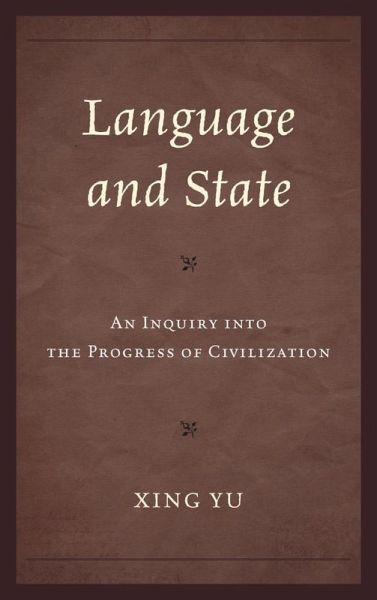
This book argues that a primitive society is formed on the basis of kinship ties while a civilized society is formed on the basis of linguistic communication. When humans communicate with each other through language, they extend the distance of communication. The extension of communication distance helps expand communities. States are gradually formed. This means that as these communities grow, they become too large to be supported only by the ties of kinship. The use of language and the development of linguistic communication underlies the establishment of governments, the introduction of…mehr
This book argues that a primitive society is formed on the basis of kinship ties while a civilized society is formed on the basis of linguistic communication. When humans communicate with each other through language, they extend the distance of communication. The extension of communication distance helps expand communities. States are gradually formed. This means that as these communities grow, they become too large to be supported only by the ties of kinship. The use of language and the development of linguistic communication underlies the establishment of governments, the introduction of laws, the holding of elections, and the flourishing of history, philosophy, literature, art, religion, etc. This book presents a new theory about the importance of language in the growth of the states.
Die Herstellerinformationen sind derzeit nicht verfügbar.
Autorenporträt
Xing Yu is a political scientist who taught at two universities in China in the 1980s and 1990s. He obtained a bachelor's degree in art from Sichuan Foreign Languages Institute in Chongqing, China in 1982, and a master's degree in law from Fudan University in Shanghai, China in 1985. He now works as a freelance writer and translator in British Columbia, Canada.
Inhaltsangabe
Prologue Part One Language and State Formation Introduction Chapter One: People Chapter Two: Community Chapter Three: Nation Chapter Four: State Part Two Language and State Governance Introduction Chapter Five: Appellation Chapter Six: Constitution Chapter Seven: Election Chapter Eight: Representation Chapter Nine: Government Part Three Language and State Spirit Introduction Chapter Ten: History Chapter Eleven: Philosophy Chapter Twelve: Literature and Art Chapter Thirteen: Religion Chapter Fourteen: Law Conclusion Epilogue Bibliography Acknowledgments Index About the Author
Es gelten unsere Allgemeinen Geschäftsbedingungen: www.buecher.de/agb
Impressum
www.buecher.de ist ein Internetauftritt der buecher.de internetstores GmbH
Geschäftsführung: Monica Sawhney | Roland Kölbl | Günter Hilger
Sitz der Gesellschaft: Batheyer Straße 115 - 117, 58099 Hagen
Postanschrift: Bürgermeister-Wegele-Str. 12, 86167 Augsburg
Amtsgericht Hagen HRB 13257
Steuernummer: 321/5800/1497
USt-IdNr: DE450055826