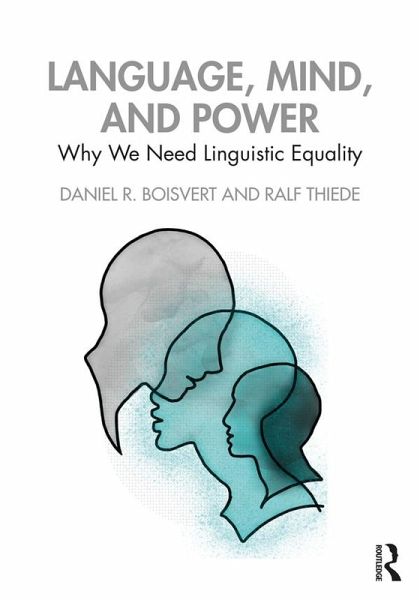
Language, Mind, and Power (eBook, PDF)
Why We Need Linguistic Equality
Alle Infos zum eBook verschenken
Language, Mind, and Power (eBook, PDF)
Why We Need Linguistic Equality
- Format: PDF
- Merkliste
- Auf die Merkliste
- Bewerten Bewerten
- Teilen
- Produkt teilen
- Produkterinnerung
- Produkterinnerung

Hier können Sie sich einloggen

Bitte loggen Sie sich zunächst in Ihr Kundenkonto ein oder registrieren Sie sich bei bücher.de, um das eBook-Abo tolino select nutzen zu können.
Language is a natural resource: Power and vulnerability are associated with access to language, just as to food and water. In this new book, a linguist and philosopher elucidate why language is so powerful, illuminate its very real social and political implications, and make the case for linguistic equality-equality among languages and equality in access to/knowledge of language and its use-as a human right and tool to prevent violence and oppression. Students and instructors will find this accessible, interdisciplinary text invaluable for courses that explore how language reflects power…mehr
- Geräte: PC
- mit Kopierschutz
- eBook Hilfe
Allan MetcalfOK (eBook, PDF)4,99 €
Giselinde KuipersGood Humor, Bad Taste (eBook, PDF)90,95 €
Michael AdamsSlang (eBook, PDF)7,99 €
Daniel R. BoisvertLanguage, Mind, and Power (eBook, ePUB)38,95 €
Critical Multimodal Studies of Popular Discourse (eBook, PDF)46,95 €
Language and Decolonisation (eBook, PDF)42,95 €
Märchenhafter Orient - Projektionen eines Landes der Phantasie (eBook, PDF)59,00 €-
-
-
Dieser Download kann aus rechtlichen Gründen nur mit Rechnungsadresse in A, B, BG, CY, CZ, D, DK, EW, E, FIN, F, GR, HR, H, IRL, I, LT, L, LR, M, NL, PL, P, R, S, SLO, SK ausgeliefert werden.
- Produktdetails
- Verlag: Taylor & Francis eBooks
- Seitenzahl: 202
- Erscheinungstermin: 31. Mai 2020
- Englisch
- ISBN-13: 9781000059496
- Artikelnr.: 59554742
- Verlag: Taylor & Francis eBooks
- Seitenzahl: 202
- Erscheinungstermin: 31. Mai 2020
- Englisch
- ISBN-13: 9781000059496
- Artikelnr.: 59554742
- Herstellerkennzeichnung Die Herstellerinformationen sind derzeit nicht verfügbar.
Ralf Thiede is Associate Professor of Applied Linguistics at the University of North Carolina at Charlotte. His research interests include interfacing formal linguistics and cognition, including brain development. His book Children's Literature, Brain Development, and Language Acquisition appeared with Routledge (2019).
List of Figures
List of Tables
Acknowledgments
Permission
Introduction
A World without Words? Language and linguistic equality
Language, Mind, and Power
Language as a Natural Resource
Depletion and Preservation
PART I
Language and Mind
1 Profile of an Alpha(bet) Predator
Entropy and Cooperation
DNA and Philosophy: Unambiguous Information?
Interpreting Single-signal Communication Systems: Cooperation and co-option
The Cognitive Arms Race: Combinatorial communication systems
Creative Cooperation and Violence: Human language
In a class by itself: A hierarchical combinatorial system
The Neural Architecture of Universal Grammar
Language Between Brains
2 Thinking Animals
Rich Concepts
Brain-states and Reflexes
Concepts of Objects and Events
More Complex Capacities
Remembering and Analyzing
Comparing and Synthesizing
Imagining and Planning
Social Cognition
Conventionalizing and Imitating
Joint Attention and Theory of Mind
Collective Intentionality
3 The Narrating Brain
Cognitive Control through Language
Language-imposed Telic Apperception: Schemata and scripts
The Predictive Power of Narrative Computing
Setting the Parameters of Narrative Computing: Framing
Narrative Cooperative Computing: Story time
PART II
Language and Power
4 Doing Things with Words
Speech Acts
Distinction 1: Types of speech acts
Distinction 2: Types of linguistic purpose
Distinction 3: Performing illocutions directly or indirectly
The Three Distinctions in Action
Conversational Implicature
Sentence Meaning vs. Speaker Meaning
Conventional vs. Conversational Implicature
Contemporary Pragmatics
5 The Language of Cooperation
Three Levels of Linguistic Processing and Cooperation
Level 1: Negotiating syntactic structures and functions
Level 2: Literal interpretation: Negotiated sentence meaning
Level 3: Extended interpretation: Negotiated implicatures
Coming Together: Harnessing the cooperative nature of language
6 The Language of Violence
Genocide and Politicide
Ten Stages of Genocide
Dispositions
Content and Context of Genocidal Language
Sexual Assault
Linguistic Dispositions, Content, and Context
Silencing
7 Clarity from Managed Confusion
Cooperation Towards Understanding
The Need for Managed Confusion
Linguistic Information Management Strategies
Keeping Track of Proforms
Ordering Constituents
Information Management: Chaining Given and New
Clarity as Alignment with Audience Needs: The Example of Definitions
Masters of Managed Confusion: Famous Authors
Language, Logic, Predictability, and Event Model
'Hills Like White Elephants' by Ernest Hemingway
'The International Eisteddfod' by Dylan Thomas
Murder on the Orient Express by Agatha Christie
Oh Say Can You Say by Dr. Seuss
A Collaborative Dance, but the Author Leads
Conclusion
Standards and Shibboleths
Illiteracy and Aliteracy
Contaminated Language
Uncooperative Language
List of Figures
List of Tables
Acknowledgments
Permission
Introduction
A World without Words? Language and linguistic equality
Language, Mind, and Power
Language as a Natural Resource
Depletion and Preservation
PART I
Language and Mind
1 Profile of an Alpha(bet) Predator
Entropy and Cooperation
DNA and Philosophy: Unambiguous Information?
Interpreting Single-signal Communication Systems: Cooperation and co-option
The Cognitive Arms Race: Combinatorial communication systems
Creative Cooperation and Violence: Human language
In a class by itself: A hierarchical combinatorial system
The Neural Architecture of Universal Grammar
Language Between Brains
2 Thinking Animals
Rich Concepts
Brain-states and Reflexes
Concepts of Objects and Events
More Complex Capacities
Remembering and Analyzing
Comparing and Synthesizing
Imagining and Planning
Social Cognition
Conventionalizing and Imitating
Joint Attention and Theory of Mind
Collective Intentionality
3 The Narrating Brain
Cognitive Control through Language
Language-imposed Telic Apperception: Schemata and scripts
The Predictive Power of Narrative Computing
Setting the Parameters of Narrative Computing: Framing
Narrative Cooperative Computing: Story time
PART II
Language and Power
4 Doing Things with Words
Speech Acts
Distinction 1: Types of speech acts
Distinction 2: Types of linguistic purpose
Distinction 3: Performing illocutions directly or indirectly
The Three Distinctions in Action
Conversational Implicature
Sentence Meaning vs. Speaker Meaning
Conventional vs. Conversational Implicature
Contemporary Pragmatics
5 The Language of Cooperation
Three Levels of Linguistic Processing and Cooperation
Level 1: Negotiating syntactic structures and functions
Level 2: Literal interpretation: Negotiated sentence meaning
Level 3: Extended interpretation: Negotiated implicatures
Coming Together: Harnessing the cooperative nature of language
6 The Language of Violence
Genocide and Politicide
Ten Stages of Genocide
Dispositions
Content and Context of Genocidal Language
Sexual Assault
Linguistic Dispositions, Content, and Context
Silencing
7 Clarity from Managed Confusion
Cooperation Towards Understanding
The Need for Managed Confusion
Linguistic Information Management Strategies
Keeping Track of Proforms
Ordering Constituents
Information Management: Chaining Given and New
Clarity as Alignment with Audience Needs: The Example of Definitions
Masters of Managed Confusion: Famous Authors
Language, Logic, Predictability, and Event Model
'Hills Like White Elephants' by Ernest Hemingway
'The International Eisteddfod' by Dylan Thomas
Murder on the Orient Express by Agatha Christie
Oh Say Can You Say by Dr. Seuss
A Collaborative Dance, but the Author Leads
Conclusion
Standards and Shibboleths
Illiteracy and Aliteracy
Contaminated Language
Uncooperative Language