0,00 €
0,00 €
inkl. MwSt.
Sofort per Download lieferbar

0 °P sammeln
0,00 €
Als Download kaufen
0,00 €
inkl. MwSt.
Sofort per Download lieferbar
0 °P sammeln
Jetzt verschenken
Alle Infos zum eBook verschenken
0,00 €
inkl. MwSt.
Sofort per Download lieferbar
Alle Infos zum eBook verschenken
0 °P sammeln

Andere Kunden interessierten sich auch für
") Loanwords in the World's Languages (eBook, PDF)244,95 €
Loanwords in the World's Languages (eBook, PDF)244,95 €") Globalization and the Future of German (eBook, PDF)90,95 €
Globalization and the Future of German (eBook, PDF)90,95 €") Cognitive Linguistics and Translation (eBook, PDF)97,95 €
Cognitive Linguistics and Translation (eBook, PDF)97,95 €") Statistical Techniques for the Study of Language and Language Behaviour (eBook, PDF)84,95 €
Statistical Techniques for the Study of Language and Language Behaviour (eBook, PDF)84,95 €") Actas del XXVI Congreso Internacional de Lingüística y de Filología Románicas. Tome VI (eBook, PDF)52,95 €
Actas del XXVI Congreso Internacional de Lingüística y de Filología Románicas. Tome VI (eBook, PDF)52,95 €") The Americas and the Caribbean (eBook, PDF)35,95 €
The Americas and the Caribbean (eBook, PDF)35,95 €") Actas del XXVI Congreso Internacional de Lingüística y de Filología Románicas. Tome VII (eBook, PDF)52,95 €
Actas del XXVI Congreso Internacional de Lingüística y de Filología Románicas. Tome VII (eBook, PDF)52,95 €





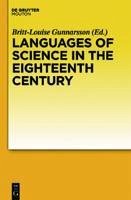
The eighteenth century is an important period both in the history of science and in the history of languages. Interest in science, and especially in the useful sciences, exploded and a new, modern approach to scientific discovery and the accumulation of knowledge emerged. It was during this century, too, that ideas on language and language practice began to change. Latin had been more or less the only written language used for scientific purposes, but gradually the vernaculars became established as fully acceptable alternatives for scientific writing. The period is of interest, moreover, from a genre-historical point of view. Encyclopedias, dictionaries and also correspondence played a key role in the spread of scientific ideas. At the time, writing on scientific matters was not as distinct from fiction, poetry or religious texts as it is today, a fact which also gave a creative liberty to individual writers.
In this volume, seventeen authors explore, from a variety of angles, the construction of a scientific language and discourse. The chapters are thematically organized into four sections, each contributing to our understanding of this dynamic period in the history of science: their themes are the forming of scientific communities, the emergence of new languages of science, the spread of scientific ideas, and the development of scientific writing. A particular focus is placed on the Swedish botanist Carl Linnaeus (1707-1778). From the point of view of the natural sciences, Linnaeus is renowned for his principles for defining genera and species of organisms and his creation of a uniform system for naming them. From the standpoint of this volume, however, he is also of interest as an example of a European scientist of the eighteenth century.
This volume is unique both in its broad linguistic approach - including studies on textlinguistics, stylistics, sociolinguistics, lexicon and nomenclature - and in its combination of language studies, philosophy of language, history and sociology of science. The book covers writing in different European languages: Swedish, German, French, English, Latin, Portuguese, and Russian. With its focus on the history of scientific language and discourse during a dynamic period in Europe, the book promises to contribute to new insights both for readers interested in language history and those with an interest in the history of ideas and thought.
In this volume, seventeen authors explore, from a variety of angles, the construction of a scientific language and discourse. The chapters are thematically organized into four sections, each contributing to our understanding of this dynamic period in the history of science: their themes are the forming of scientific communities, the emergence of new languages of science, the spread of scientific ideas, and the development of scientific writing. A particular focus is placed on the Swedish botanist Carl Linnaeus (1707-1778). From the point of view of the natural sciences, Linnaeus is renowned for his principles for defining genera and species of organisms and his creation of a uniform system for naming them. From the standpoint of this volume, however, he is also of interest as an example of a European scientist of the eighteenth century.
This volume is unique both in its broad linguistic approach - including studies on textlinguistics, stylistics, sociolinguistics, lexicon and nomenclature - and in its combination of language studies, philosophy of language, history and sociology of science. The book covers writing in different European languages: Swedish, German, French, English, Latin, Portuguese, and Russian. With its focus on the history of scientific language and discourse during a dynamic period in Europe, the book promises to contribute to new insights both for readers interested in language history and those with an interest in the history of ideas and thought.
Dieser Download kann aus rechtlichen Gründen nur mit Rechnungsadresse in A, B, BG, CY, CZ, D, DK, EW, E, FIN, F, GR, HR, H, IRL, I, LT, L, LR, M, NL, PL, P, R, S, SLO, SK ausgeliefert werden.