8,60 €
8,60 €
inkl. MwSt.
Sofort per Download lieferbar

0 °P sammeln
8,60 €
Als Download kaufen
8,60 €
inkl. MwSt.
Sofort per Download lieferbar
0 °P sammeln
Jetzt verschenken
Alle Infos zum eBook verschenken
8,60 €
inkl. MwSt.
Sofort per Download lieferbar
Alle Infos zum eBook verschenken
0 °P sammeln

Andere Kunden interessierten sich auch für
") Market Data Engineering for Quants (eBook, ePUB)8,60 €
Market Data Engineering for Quants (eBook, ePUB)8,60 €") From Backtest to Live Execution (eBook, ePUB)8,60 €
From Backtest to Live Execution (eBook, ePUB)8,60 €") GPU-Accelerated Research in Quant Finance (eBook, ePUB)8,60 €
GPU-Accelerated Research in Quant Finance (eBook, ePUB)8,60 €") Event-Driven Trading Systems (eBook, ePUB)8,60 €
Event-Driven Trading Systems (eBook, ePUB)8,60 €") FIX Protocol in Plain English (eBook, ePUB)8,60 €
FIX Protocol in Plain English (eBook, ePUB)8,60 €") Reinforcement Learning for Finance (eBook, ePUB)8,60 €
Reinforcement Learning for Finance (eBook, ePUB)8,60 €") Causal Inference for Traders (eBook, ePUB)8,60 €
Causal Inference for Traders (eBook, ePUB)8,60 €






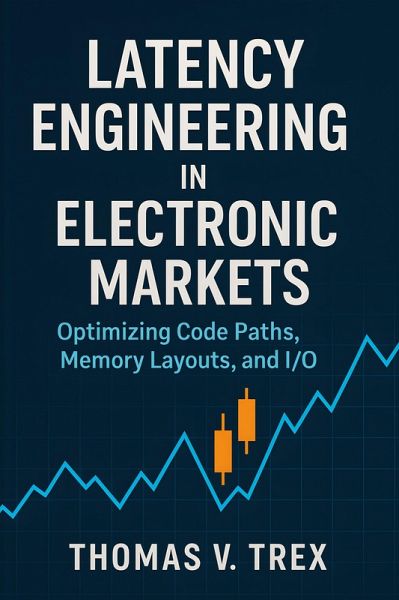
"Latency Engineering in Electronic Markets: Optimizing Code Paths, Memory Layouts, and I/O"
Electronic markets are won and lost in microseconds, yet most trading systems are still built with millisecond-era assumptions. This book is written for practitioners who live on the sharp edge of execution speed: quantitative developers, low-latency engineers, infrastructure specialists, and technically inclined traders who must translate competitive pressure into concrete engineering decisions. It connects trading outcomes-fill probability, slippage, and queue position-to the realities of CPU pipelines, caches, NIC queues, and operating system behavior.
Focusing on end-to-end determinism, the book moves systematically from market microstructure and latency metrics to precise timekeeping, profiling, and microarchitectural tuning. Readers learn how to design cache-resident data structures, engineer hot paths and branchless code, exploit SIMD, and build lock-free queues that behave under burst. The text then drills into NIC architecture, kernel versus kernel-bypass networking, multicast market data, and order-entry tuning, before addressing OS, BIOS, and hardware configuration for stable tail latency. A concluding section ties protocol details, testing methodology, PMU-based observability, and operational safety into a coherent production discipline.
The material assumes strong C/C++ or systems programming experience and familiarity with Linux, but no prior background in ultra-low-latency trading. All concepts are grounded in real-world patterns, with an emphasis on measurable, rep
Electronic markets are won and lost in microseconds, yet most trading systems are still built with millisecond-era assumptions. This book is written for practitioners who live on the sharp edge of execution speed: quantitative developers, low-latency engineers, infrastructure specialists, and technically inclined traders who must translate competitive pressure into concrete engineering decisions. It connects trading outcomes-fill probability, slippage, and queue position-to the realities of CPU pipelines, caches, NIC queues, and operating system behavior.
Focusing on end-to-end determinism, the book moves systematically from market microstructure and latency metrics to precise timekeeping, profiling, and microarchitectural tuning. Readers learn how to design cache-resident data structures, engineer hot paths and branchless code, exploit SIMD, and build lock-free queues that behave under burst. The text then drills into NIC architecture, kernel versus kernel-bypass networking, multicast market data, and order-entry tuning, before addressing OS, BIOS, and hardware configuration for stable tail latency. A concluding section ties protocol details, testing methodology, PMU-based observability, and operational safety into a coherent production discipline.
The material assumes strong C/C++ or systems programming experience and familiarity with Linux, but no prior background in ultra-low-latency trading. All concepts are grounded in real-world patterns, with an emphasis on measurable, rep
Dieser Download kann aus rechtlichen Gründen nur mit Rechnungsadresse in A, B, BG, CY, CZ, D, DK, EW, E, FIN, F, GR, H, IRL, I, LT, L, LR, M, NL, PL, P, R, S, SLO, SK ausgeliefert werden.