104,95 €
104,95 €
inkl. MwSt.
Sofort per Download lieferbar

52 °P sammeln
104,95 €
Als Download kaufen
104,95 €
inkl. MwSt.
Sofort per Download lieferbar
52 °P sammeln
Jetzt verschenken
Alle Infos zum eBook verschenken
104,95 €
inkl. MwSt.
Sofort per Download lieferbar
Alle Infos zum eBook verschenken
52 °P sammeln

Andere Kunden interessierten sich auch für
") Student Centered Cooperative Learning (eBook, PDF)56,95 €
Student Centered Cooperative Learning (eBook, PDF)56,95 €") The Emergence of Self in Educational Contexts (eBook, PDF)72,95 €
The Emergence of Self in Educational Contexts (eBook, PDF)72,95 €") Visual Modelling as Means for Cognitive and Emotional Development of Children (eBook, PDF)128,95 €
Visual Modelling as Means for Cognitive and Emotional Development of Children (eBook, PDF)128,95 €") Teaching Psychology and the Socratic Method (eBook, PDF)72,95 €
Teaching Psychology and the Socratic Method (eBook, PDF)72,95 €") Cultural-Historical Approaches to Studying Learning and Development (eBook, PDF)120,95 €
Cultural-Historical Approaches to Studying Learning and Development (eBook, PDF)120,95 €") Assessment of Learning Outcomes in Higher Education (eBook, PDF)120,95 €
Assessment of Learning Outcomes in Higher Education (eBook, PDF)120,95 €") Bullying in School (eBook, PDF)18,95 €
Bullying in School (eBook, PDF)18,95 €

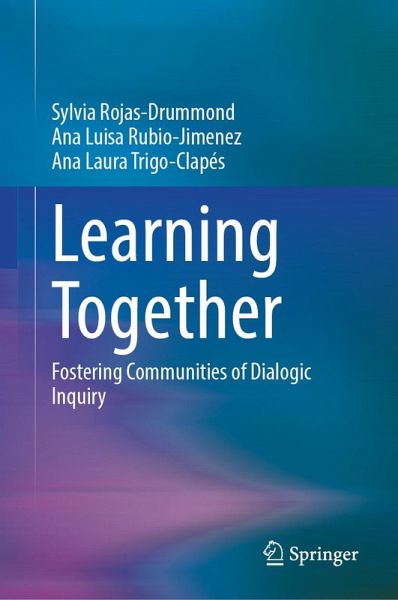
Solidly grounded in theory and empirical evidence, this book presents a novel methodological framework for fostering Communities of Dialogic Inquiry in primary education called Learning Together. These communities create collaborative networks of distributed cognition among school, university, and local community members to equip "apprentices" with a firm scientific foundation, complemented by a robust humanistic citizenship culture, enabling their participation in socioscientific practices in an informed, critical, responsible and inclusive fashion. Learning Together provides concrete, articulated, and richly illustrated teaching-learning strategies for cultivating these communities in diverse school and community settings.
"In this book, the authors make a distinctive, strong and important contribution to our understanding of how education can be made most productive. They draw on a wealth of schools-based research, including their own, to link what is known about the ways humans learn and what can and should happen in classrooms. It should help to promote a more accurate conception of education as a social, cultural, communicative activity, rather than a process whereby teachers simply transmit knowledge to students. I hope it is read by teachers, researchers and others involved in education everywhere". - Neil Mercer, Emeritus Professor of Education, University of Cambridge, UK
"For the authors of this fascinating and timely volume, communities of dialogic inquiry have two main aims: fostering skills that support a key human activity (learning for dialogue) and applying those skills in knowledge acquisition (learning through dialogue). The authors ground those aims in a novel yet convincing interpretation of sociocultural theory: the insightful and wide-ranging literature review that underpins their approach will be appreciated by researchers and practitioners alike. At the same time, the volume goes far beyond theory: it concludes with case studies, which indicate in detail how dialogic inquiry can be embedded in classrooms". - Christine Howe, Emeritus Professor, University of Cambridge, UK
"In this book, the authors make a distinctive, strong and important contribution to our understanding of how education can be made most productive. They draw on a wealth of schools-based research, including their own, to link what is known about the ways humans learn and what can and should happen in classrooms. It should help to promote a more accurate conception of education as a social, cultural, communicative activity, rather than a process whereby teachers simply transmit knowledge to students. I hope it is read by teachers, researchers and others involved in education everywhere". - Neil Mercer, Emeritus Professor of Education, University of Cambridge, UK
"For the authors of this fascinating and timely volume, communities of dialogic inquiry have two main aims: fostering skills that support a key human activity (learning for dialogue) and applying those skills in knowledge acquisition (learning through dialogue). The authors ground those aims in a novel yet convincing interpretation of sociocultural theory: the insightful and wide-ranging literature review that underpins their approach will be appreciated by researchers and practitioners alike. At the same time, the volume goes far beyond theory: it concludes with case studies, which indicate in detail how dialogic inquiry can be embedded in classrooms". - Christine Howe, Emeritus Professor, University of Cambridge, UK
Dieser Download kann aus rechtlichen Gründen nur mit Rechnungsadresse in A, B, BG, CY, CZ, D, DK, EW, E, FIN, F, GR, HR, H, IRL, I, LT, L, LR, M, NL, PL, P, R, S, SLO, SK ausgeliefert werden.