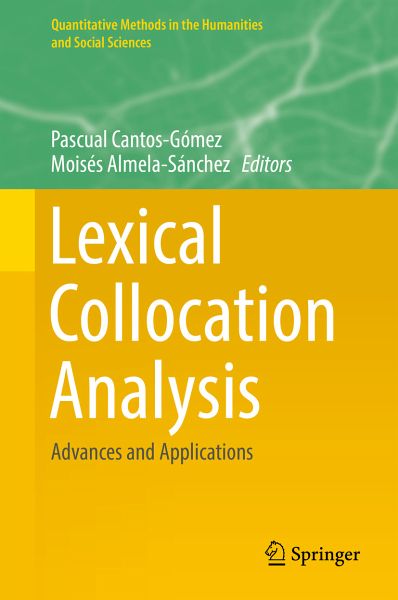
Lexical Collocation Analysis (eBook, PDF)
Advances and Applications
Redaktion: Cantos-Gómez, Pascual; Almela-Sánchez, Moisés
112,95 €
112,95 €
inkl. MwSt.
Sofort per Download lieferbar

56 °P sammeln
112,95 €
Als Download kaufen
112,95 €
inkl. MwSt.
Sofort per Download lieferbar
56 °P sammeln
Jetzt verschenken
Alle Infos zum eBook verschenken
112,95 €
inkl. MwSt.
Sofort per Download lieferbar
Alle Infos zum eBook verschenken
56 °P sammeln

Lexical Collocation Analysis (eBook, PDF)
Advances and Applications
Redaktion: Cantos-Gómez, Pascual; Almela-Sánchez, Moisés
- Format: PDF
- Merkliste
- Auf die Merkliste
- Bewerten Bewerten
- Teilen
- Produkt teilen
- Produkterinnerung
- Produkterinnerung

Bitte loggen Sie sich zunächst in Ihr Kundenkonto ein oder registrieren Sie sich bei
bücher.de, um das eBook-Abo tolino select nutzen zu können.
Hier können Sie sich einloggen
Sie sind bereits eingeloggt. Klicken Sie auf 2. tolino select Abo, um fortzufahren.

Bitte loggen Sie sich zunächst in Ihr Kundenkonto ein oder registrieren Sie sich bei bücher.de, um das eBook-Abo tolino select nutzen zu können.
Examines the state-of-the-art in lexical collocation research and its advances and applications
Designed for non-mathematicians, more precisely for linguists, lexicographers, applied linguists, corpus linguists and computational linguists
Re-examines the notion of word associations, or more precisely, collocations
- Geräte: PC
- ohne Kopierschutz
- eBook Hilfe
- Größe: 2.93MB
Andere Kunden interessierten sich auch für
Taming the Corpus (eBook, PDF)88,95 €
Pieter M. KroonenbergMultivariate Humanities (eBook, PDF)72,95 €
Hendrik KemptChatbots and the Domestication of AI (eBook, PDF)72,95 €
Tibor KissMerkmale und Repräsentationen (eBook, PDF)39,99 €
Winfried LendersLinguistische Datenverarbeitung (eBook, PDF)39,99 €
Ulrich SchmitzComputerlinguistik (eBook, PDF)38,66 €
Bastian A. VollmerBorders Revisited (eBook, PDF)52,95 €-
-
-
Examines the state-of-the-art in lexical collocation research and its advances and applications
Designed for non-mathematicians, more precisely for linguists, lexicographers, applied linguists, corpus linguists and computational linguists
Re-examines the notion of word associations, or more precisely, collocations
Designed for non-mathematicians, more precisely for linguists, lexicographers, applied linguists, corpus linguists and computational linguists
Re-examines the notion of word associations, or more precisely, collocations
Dieser Download kann aus rechtlichen Gründen nur mit Rechnungsadresse in A, B, BG, CY, CZ, D, DK, EW, E, FIN, F, GR, HR, H, IRL, I, LT, L, LR, M, NL, PL, P, R, S, SLO, SK ausgeliefert werden.
Produktdetails
- Produktdetails
- Verlag: Springer Nature Switzerland
- Seitenzahl: 140
- Erscheinungstermin: 21. August 2018
- Englisch
- ISBN-13: 9783319925820
- Artikelnr.: 56816725
- Verlag: Springer Nature Switzerland
- Seitenzahl: 140
- Erscheinungstermin: 21. August 2018
- Englisch
- ISBN-13: 9783319925820
- Artikelnr.: 56816725
- Herstellerkennzeichnung Die Herstellerinformationen sind derzeit nicht verfügbar.
Pascual Cantos-Gómez is Full Professor in the Department of English Language and Literature at the University of Murcia (Spain). He earned his BA and PhD at the University of Murcia; his MA in Computational Linguistics at the University of Essex (UK); and his PGDip in Multivariate Statistics at the UNED (Spain). His main research interests are in Corpus Linguistics, Quantitative Linguistics and Computational Lexicography. He has (co-)authored numerous articles, papers and various books one corpus linguistics, computational lexicography and statistics in linguistics research; his most recent book is Statistical Methods in Language and Linguistic Research (Equinox Publishing). He is the founder and co-editor-in-chief of the international peer-reviewed Journal of Research Design and Statistics in Linguistics and Communication Science (Equinox) and was also editor-in-chief of International Journal of English Studies (Editum). Presently, he is the Dean of the Faculty of Humanities(University of Murcia), Head of the LACELL (Applied Computational Linguistics, Second Language Learning and Lexicography) Research Group and President of the Spanish Association of Corpus Linguistics (AELINCO). Moisés Almela is Tenured Assistant Professor in the Department of English Language and Literature at the University of Murcia (Spain). He holds a BA in German Studies from the Complutense University (Spain), a BA in English Studies from the National University of Distance Education (Spain), an MA in Translation and Interpreting from the University of Murcia (Spain) and a PhD in English Studies from the University of Murcia. His main research interests are in Corpus Linguistics and Corpus-based Lexicography. He has authored numerous articles and papers on collocation analysis. Presently, he is the Chair of the Corpus Linguistics, Computational and Language Engineering Panel of the Spanish Association of Applied Linguistics (AESLA), and of the Corpus-based Lexicology and Lexicography Panel of the Spanish Association of Corpus Linguistics (AELINCO).
Introduction.- Chapter 1. Is language a collostructicon? - A Proposal for looking at collocations, valency, argument structure and other constructions.- Chapter 2. Bridging collocational and syntactic analysis.- Chapter 3. Network analysis techniques applied to dictionaries for identifying semantics in lexical Spanish collocations.- Chapter 4. Collocation graphs and networks: Selected applications.- Chapter 5. Multi-word expressions: A novel computational approach to their bottom-up statistical extraction.- Chapter 6 Collocation candidate extraction from dependency-annotated corpora. Exploring the differences between parsers and dependency annotation schemes.