42,95 €
inkl. MwSt.
Sofort per Download lieferbar
21 °P sammeln

Andere Kunden interessierten sich auch für
") The Illustrated Baburnama (eBook, PDF)45,95 €
The Illustrated Baburnama (eBook, PDF)45,95 €") Art and Architectural Traditions of India and Iran (eBook, PDF)41,95 €
Art and Architectural Traditions of India and Iran (eBook, PDF)41,95 €") The Mughal Empire at War (eBook, PDF)49,95 €
The Mughal Empire at War (eBook, PDF)49,95 €") Modern Practices in North East India (eBook, PDF)41,95 €
Modern Practices in North East India (eBook, PDF)41,95 €") Cosmopolitan Modernity in Early 20th-Century India (eBook, PDF)41,95 €
Cosmopolitan Modernity in Early 20th-Century India (eBook, PDF)41,95 €") Mughal Warfare (eBook, PDF)44,95 €
Mughal Warfare (eBook, PDF)44,95 €") Writings About Kashmir (eBook, PDF)39,95 €
Writings About Kashmir (eBook, PDF)39,95 €
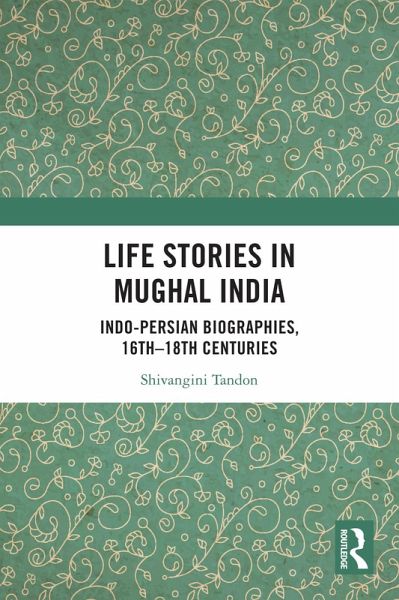
Situated at the intersections between history and literature, the book explores the life-stories written in the Mughal period to recover socio-cultural developments in the period. It focuses on the genre of life-stories and looks at the complex interactions between agency and the ruling structure in shaping historical formations.
The biographical dictionaries explored in this book highlight the significance of the agency of political actors, and the strategies through which the aristocrats and the elites reproduced the political system. At the same time, these texts are also quite helpful in recovering processes through which the ordinary people, in routine, everyday forms negotiated with and contested the political system. Delving into the life-narratives preserved in the tazkiras or biographical compendia, this book looks at the household as a political formation and positions the aristocratic households as integral to the reproduction of imperial sovereignty. The work also delves into the world of emotions and argues for the need to draw linkages between political developments and shifts in emotions and affect.
This book will be an essential resource for scholars and researchers of history especially early modern history, cultural studies, literature, sociology, South Asian history. It will also be of interest to those studying gender and political discourse in early modern South Asia.
The biographical dictionaries explored in this book highlight the significance of the agency of political actors, and the strategies through which the aristocrats and the elites reproduced the political system. At the same time, these texts are also quite helpful in recovering processes through which the ordinary people, in routine, everyday forms negotiated with and contested the political system. Delving into the life-narratives preserved in the tazkiras or biographical compendia, this book looks at the household as a political formation and positions the aristocratic households as integral to the reproduction of imperial sovereignty. The work also delves into the world of emotions and argues for the need to draw linkages between political developments and shifts in emotions and affect.
This book will be an essential resource for scholars and researchers of history especially early modern history, cultural studies, literature, sociology, South Asian history. It will also be of interest to those studying gender and political discourse in early modern South Asia.
Dieser Download kann aus rechtlichen Gründen nur mit Rechnungsadresse in A, B, BG, CY, CZ, D, DK, EW, E, FIN, F, GR, HR, H, IRL, I, LT, L, LR, M, NL, PL, P, R, S, SLO, SK ausgeliefert werden.