112,95 €
112,95 €
inkl. MwSt.
Sofort per Download lieferbar

56 °P sammeln
112,95 €
Als Download kaufen
112,95 €
inkl. MwSt.
Sofort per Download lieferbar
56 °P sammeln
Jetzt verschenken
Alle Infos zum eBook verschenken
112,95 €
inkl. MwSt.
Sofort per Download lieferbar
Alle Infos zum eBook verschenken
56 °P sammeln

Andere Kunden interessierten sich auch für
") Concentrator Photovoltaics (eBook, PDF)160,95 €
Concentrator Photovoltaics (eBook, PDF)160,95 €") Regenerative Energietechnik (eBook, PDF)34,99 €
Regenerative Energietechnik (eBook, PDF)34,99 €") Photovoltaische Stromversorgung (eBook, PDF)33,26 €
Photovoltaische Stromversorgung (eBook, PDF)33,26 €") From Molecules to Materials (eBook, PDF)72,95 €
From Molecules to Materials (eBook, PDF)72,95 €") Praxis solarthermischer Kraftwerke (eBook, PDF)80,91 €
Praxis solarthermischer Kraftwerke (eBook, PDF)80,91 €") Solar Energy Fundamentals and Modeling Techniques (eBook, PDF)136,95 €
Solar Energy Fundamentals and Modeling Techniques (eBook, PDF)136,95 €") Thermische Solarenergie (eBook, PDF)66,99 €
Thermische Solarenergie (eBook, PDF)66,99 €





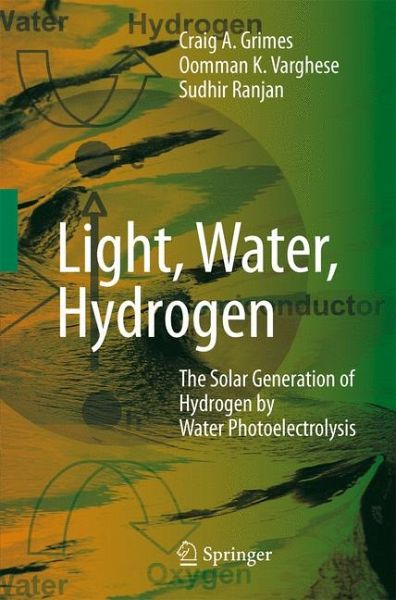
This book covers the field of solar production of hydrogen by water photo-splitting (photoelectrolysis) using semiconductor photoanodes. The emphasis of the discussion is on the use of nanotechnology in the field. The theories behind photocatalysis and photoelectrochemical processes responsible for hydrogen production are given in detail. This provides a state-of-the-art review of the semiconductor materials and methods used for improving the efficiency of the processes. The book also gives an account of the techniques used for making the nanostructures. It begins with a discussion on hydrogen as an energy carrier, a historical background on hydrogen extraction from water, and various methods employed for hydrogen extraction. Strategies are suggested for developing future nanostructured materials to achieve high efficiency, photochemically stable photoanodes optimized for the visible portion of the solar spectrum.
Dieser Download kann aus rechtlichen Gründen nur mit Rechnungsadresse in A, B, BG, CY, CZ, D, DK, EW, E, FIN, F, GR, HR, H, IRL, I, LT, L, LR, M, NL, PL, P, R, S, SLO, SK ausgeliefert werden.
From the reviews:
"The 'Holy Grail' of artificial photosynthesis, particularly for hydrogen production, is often traced ... . This book deals with this field, largely from the point-of-view of solid-state synthesis and engineering. ... The book is useful for getting brief descriptions of the huge literature on oxide semiconductors prepared in different ways and their behavior. ... if oxide materials, and especially TiO2 nanostructures, are of major interest, this book will be useful in traversing the massive literature in this field." (Allen J. Bard, Journal of the American Chemical Society, Vol. 130 (26), 2008)
"Grimes and colleagues (all, Pennsylvania State Univ.) have done a marvelous, meticulous job of collecting the latest developments in hydrogen evolution by nontraditional means to prepare the reader to understand and appreciate the importance of semiconductor photoelectrolysis in the energy future. ... The logically developed chapters are copiously referenced (more than 1,000 references listed) and liberally annotated with graphs, tables, and other illustrative diagrams. Summing Up: Highly recommended. Upper-division undergraduate through professional collections." (S. R. Walk, CHOICE, Vol. 45 (11), July, 2008)
"The 'Holy Grail' of artificial photosynthesis, particularly for hydrogen production, is often traced ... . This book deals with this field, largely from the point-of-view of solid-state synthesis and engineering. ... The book is useful for getting brief descriptions of the huge literature on oxide semiconductors prepared in different ways and their behavior. ... if oxide materials, and especially TiO2 nanostructures, are of major interest, this book will be useful in traversing the massive literature in this field." (Allen J. Bard, Journal of the American Chemical Society, Vol. 130 (26), 2008)
"Grimes and colleagues (all, Pennsylvania State Univ.) have done a marvelous, meticulous job of collecting the latest developments in hydrogen evolution by nontraditional means to prepare the reader to understand and appreciate the importance of semiconductor photoelectrolysis in the energy future. ... The logically developed chapters are copiously referenced (more than 1,000 references listed) and liberally annotated with graphs, tables, and other illustrative diagrams. Summing Up: Highly recommended. Upper-division undergraduate through professional collections." (S. R. Walk, CHOICE, Vol. 45 (11), July, 2008)