Sie sind bereits eingeloggt. Klicken Sie auf 2. tolino select Abo, um fortzufahren.
Bitte loggen Sie sich zunächst in Ihr Kundenkonto ein oder registrieren Sie sich bei bücher.de, um das eBook-Abo tolino select nutzen zu können.
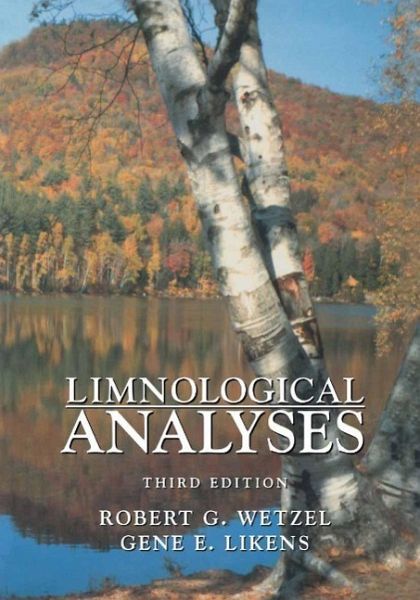
In its third edition, this classic text is thoroughly updated with a series of carefully designed and tested field and laboratory exercises representing the full scope of limnology. It illustrates accepted standard methods as well as modern metabolic and experimental approaches and their research applications. It also covers the physical, chemical, and biological characteristics of standing and running waters and provides students with a solid foundation in this multidisciplinary field. Instructors and students of limnology will value this text for its structured, concise presentation and its…mehr
In its third edition, this classic text is thoroughly updated with a series of carefully designed and tested field and laboratory exercises representing the full scope of limnology. It illustrates accepted standard methods as well as modern metabolic and experimental approaches and their research applications. It also covers the physical, chemical, and biological characteristics of standing and running waters and provides students with a solid foundation in this multidisciplinary field. Instructors and students of limnology will value this text for its structured, concise presentation and its research-oriented approach that invites active participation.
Dieser Download kann aus rechtlichen Gründen nur mit Rechnungsadresse in A, B, BG, CY, CZ, D, DK, EW, E, FIN, F, GR, HR, H, IRL, I, LT, L, LR, M, NL, PL, P, R, S, SLO, SK ausgeliefert werden.
Die Herstellerinformationen sind derzeit nicht verfügbar.
Inhaltsangabe
Exercise 1 Lake Basin Characteristics and Morphometry.- Exercise 2 Light and Temperature.- Exercise 3 Physical Characteristics: Lake Models.- Exercise 4 The Heat Budget of Lakes.- Exercise 5 Morphology and Flow in Streams.- Exercise 6 Dissolved Oxygen.- Exercise 7 Inorganic Nutrients: Nitrogen, Phosphorus, and Other Nutrients.- Exercise 8 The Inorganic Carbon Complex: Alkalinity, Acidity, CO2, pH, Total Inorganic Carbon, Hardness, Aluminum.- Exercise 9 Organic Matter.- Exercise 10 Composition and Biomass of Phytoplankton.- Exercise 11 Collection, Enumeration, and Biomass of Zooplankton.- Exercise 12 Benthic Fauna of Lakes.- Exercise 13 Benthic Fauna of Streams.- Exercise 14 Primary Productivity of Phytoplankton.- Exercise 15 Feeding Rates by Protists and Larger Zooplankton.- Exercise 16 Zooplankton Production.- Exercise 17 Predator-Prey Interactions.- Exercise 18 Enumeration of Fish or Other Aquatic Animals.- Exercise 19 Bacterial Growth and Productivity.- Exercise 20 Decomposition: Relative Bacterial Heterotrophic Activity on Soluble Organic Matter.- Exercise 21 Decomposition: Particulate Organic Matter.- Exercise 22 The Littoral Zone.- Exercise 23 Experimental Manipulation of Model Ecosystems.- Exercise 24 Diurnal Changes in a Stream Ecosystem: An Energy and Nutrient Budget Approach.- Exercise 25 Diurnal Changes in Lake Systems.- Exercise 26 Special Lake Types.- Exercise 27 Historical Records of Changes in the Productivity of Lakes.- Exercise 28 Effect of Sewage Outfall on a Stream Ecosystem.- Exercise 29 Estimates of Whole Lake Metabolism: Hypolimnetic Oxygen Deficits and Carbon Dioxide Accumulation.- Appendix 1 General Chemical Relationships.- Appendix 2 Basic Definitions Used in Community Analyses.- Appendix 3 Useful Relationships Relative to the Use of Colorimeters and Spectrophotometers.- Appendix 4 Characteristics and Taxonomic Sources of Common freshwater Organisms.- Appendix 5 SI Conversion Factors.
Rezensionen
From the reviews of the third edition: "Designed to accommodate undergraduates with diverse backgrounds, this text provides an excellent introduction to limnological methods and problems. ... In other words, this book was written to be used in the classroom, the laboratory, and the field! ... Many line drawings, graphs, and B/W photographs provided. Amply referenced, this book should be considered by professional limnologists, especially those looking for an excellent undergraduate textbook." (Northeastern Naturalist, Vol. 12 (2), 2005) "This is the third edition of this well known text book on limnological methods. ... This book is written for students but also for the teachers and is meanwhile a standard volume ... and a starting point for independent scientific work. Without doubt all students and teachers should have access to this book. ... I would recommend that if you already do not have this book, it is worth more than ever to buy it." (Norbert Walz, International Review of Hydrobiology, Vol. 86 (1), 2001)
Es gelten unsere Allgemeinen Geschäftsbedingungen: www.buecher.de/agb
Impressum
www.buecher.de ist ein Internetauftritt der buecher.de internetstores GmbH
Geschäftsführung: Monica Sawhney | Roland Kölbl | Günter Hilger
Sitz der Gesellschaft: Batheyer Straße 115 - 117, 58099 Hagen
Postanschrift: Bürgermeister-Wegele-Str. 12, 86167 Augsburg
Amtsgericht Hagen HRB 13257
Steuernummer: 321/5800/1497
USt-IdNr: DE450055826