29,95 €
29,95 €
inkl. MwSt.
Sofort per Download lieferbar

15 °P sammeln
29,95 €
Als Download kaufen
29,95 €
inkl. MwSt.
Sofort per Download lieferbar
15 °P sammeln
Jetzt verschenken
Alle Infos zum eBook verschenken
29,95 €
inkl. MwSt.
Sofort per Download lieferbar
Alle Infos zum eBook verschenken
15 °P sammeln

Andere Kunden interessierten sich auch für
") The art of The Faerie Queene (eBook, ePUB)19,95 €
The art of The Faerie Queene (eBook, ePUB)19,95 €") Samuel Richardson as Anonymous Editor and Printer (eBook, ePUB)25,95 €
Samuel Richardson as Anonymous Editor and Printer (eBook, ePUB)25,95 €") The Poet-Hero in the Work of Byron and Shelley (eBook, ePUB)22,95 €
The Poet-Hero in the Work of Byron and Shelley (eBook, ePUB)22,95 €") Spanish Romance in the Battle for Global Supremacy (eBook, ePUB)29,95 €
Spanish Romance in the Battle for Global Supremacy (eBook, ePUB)29,95 €") W. H. Davies (eBook, ePUB)29,95 €
W. H. Davies (eBook, ePUB)29,95 €") Knowing One's Place in Contemporary Irish and Polish Poetry (eBook, ePUB)32,95 €
Knowing One's Place in Contemporary Irish and Polish Poetry (eBook, ePUB)32,95 €") Write My Name (eBook, ePUB)39,95 €
Write My Name (eBook, ePUB)39,95 €
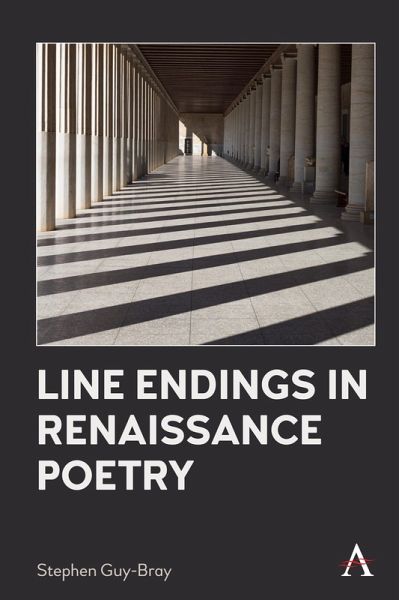
This book looks at how Renaissance poets ended their poetic lines. It considers a range of strategies and argues that line endings are crucial to our understanding of the poems. It begins with an introduction summarizing the work that has already been done in this area and demonstrating the author's own method. While many of the devices the book highlights have been discussed before and while there has been some scholarship on the poetic line as a unit, how lines end has not received much critical attention, and particularly not in the critical work on Renaissance poetry.
The main part of the book is divided into three chapters: one on rhyme; one on enjambment; and one on the sestina. Rhyme is perhaps the most obvious kind of line ending; it was a contentious subject in the English Renaissance. Scholars then debated whether rhyme was necessary or even advisable. Enjambment, in which the end of a line occurs part of the way through a phrase, was especially common in dramatic poetry. In lyric poetry as well, however, it was an important tool for poets. The sestina is a complex form in which matters are the (usually unrhymed) end words, which vary according to a set scheme. There are other technically demanding forms in the Renaissance that focus on end words, but the sestina is the most extreme.
These are the most significant kinds of line endings used by English Renaissance poets. Each chapter provides one or two main poetic examples, but the book considers a range of poems from the period. The book ends with a brief afterword, wherein the author's findings are summarized.
The main part of the book is divided into three chapters: one on rhyme; one on enjambment; and one on the sestina. Rhyme is perhaps the most obvious kind of line ending; it was a contentious subject in the English Renaissance. Scholars then debated whether rhyme was necessary or even advisable. Enjambment, in which the end of a line occurs part of the way through a phrase, was especially common in dramatic poetry. In lyric poetry as well, however, it was an important tool for poets. The sestina is a complex form in which matters are the (usually unrhymed) end words, which vary according to a set scheme. There are other technically demanding forms in the Renaissance that focus on end words, but the sestina is the most extreme.
These are the most significant kinds of line endings used by English Renaissance poets. Each chapter provides one or two main poetic examples, but the book considers a range of poems from the period. The book ends with a brief afterword, wherein the author's findings are summarized.
Dieser Download kann aus rechtlichen Gründen nur mit Rechnungsadresse in A, D ausgeliefert werden.