5,99 €
5,99 €
inkl. MwSt.
Sofort per Download lieferbar

0 °P sammeln
5,99 €
Als Download kaufen
5,99 €
inkl. MwSt.
Sofort per Download lieferbar
0 °P sammeln
Jetzt verschenken
Alle Infos zum eBook verschenken
5,99 €
inkl. MwSt.
Sofort per Download lieferbar
Alle Infos zum eBook verschenken
0 °P sammeln

Andere Kunden interessierten sich auch für
 (eBook, ePUB)") Fluent Forever (Revised Edition) (eBook, ePUB)6,99 €
Fluent Forever (Revised Edition) (eBook, ePUB)6,99 €") Productivity For Authors (eBook, ePUB)9,99 €
Productivity For Authors (eBook, ePUB)9,99 €") Chinese Blockbuster 1 (eBook, ePUB)7,99 €
Chinese Blockbuster 1 (eBook, ePUB)7,99 €") Write Your Journey: A Step-by-Step Guide to Write Your Life Story Fast (eBook, ePUB)4,56 €
Write Your Journey: A Step-by-Step Guide to Write Your Life Story Fast (eBook, ePUB)4,56 €") 1-Minute Chinese, Book 1 (eBook, ePUB)0,00 €
1-Minute Chinese, Book 1 (eBook, ePUB)0,00 €") Public Speaking for Authors, Creatives and Other Introverts (eBook, ePUB)9,99 €
Public Speaking for Authors, Creatives and Other Introverts (eBook, ePUB)9,99 €") 1-Minute Chinese, Book 2 (eBook, ePUB)0,00 €
1-Minute Chinese, Book 2 (eBook, ePUB)0,00 €


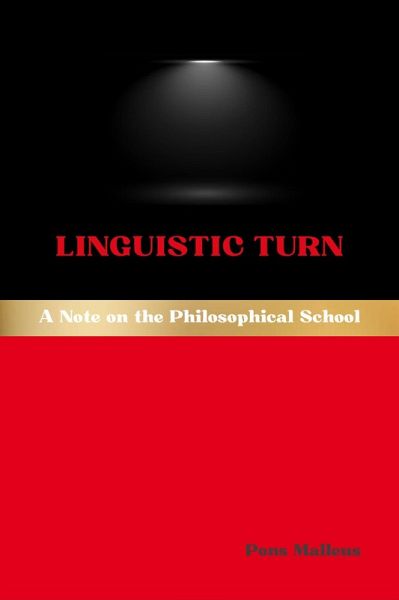
In the history of philosophy, few shifts have been as transformative as the "Linguistic Turn." Emerging in the early 20th century, this intellectual movement recast language-not merely as a medium for expressing thought, but as the very framework within which thought itself takes shape. It redirected philosophical inquiry from metaphysical speculation to the analysis of language, ushering in a profound reorientation of how we understand meaning, truth, and reality. This book explores that pivotal moment and its reverberations across the philosophical landscape.
The Linguistic Turn is not the work of a single philosopher or school, but rather a constellation of thinkers-each grappling with the implications of language for philosophy's most enduring questions. From Gottlob Frege's formal semantics and Bertrand Russell's logical atomism, to Ludwig Wittgenstein's shifting views in the Tractatus and Philosophical Investigations, and through the later developments in ordinary language philosophy with figures like J.L. Austin and Gilbert Ryle-the turn represents a kaleidoscope of insights into the power, limits, and structures of language.
At its core, the Linguistic Turn challenges the notion that we can access a pre-linguistic or purely objective reality. It asserts instead that our access to the world is always mediated through language. This has profound consequences: it forces us to reconsider the possibility of objective knowledge, the boundaries of philosophical inquiry, and the function of philosophy itself. For some, like the logical positivists of the Vienna Circle, language became the filter for determining meaningful discourse. For others, language revealed the embeddedness of meaning in use, in form, and in cultural and historical context.
This book is not a mere historical account of ideas. Rather, it seeks to trace the philosophical consequences of this turn and explore its ongoing relevance. While the Linguistic Turn may have reached its zenith in the mid-20th century, its legacy continues to shape contemporary debates in philosophy of language, epistemology, metaphysics, ethics, and even political theory. The analytic-continental divide, the rise of post-structuralism, and the development of cognitive science all bear marks of its influence.
The reader will encounter both foundational texts and lesser-known but equally important voices. While certain chapters will delve into technical arguments-such as those concerning reference, truth conditions, or speech acts-others will focus on the broader implications of linguistic philosophy for human self-understanding. The goal is to illuminate not only what the Linguistic Turn has contributed to philosophy, but why it continues to matter.
In presenting this work, I have attempted to strike a balance between rigorous exposition and accessible narrative. It is written for the philosophically inclined reader-whether a student encountering these ideas for the first time or a seasoned thinker revisiting them with fresh eyes. I hope that, by the end of the journey, the reader will appreciate language not just as a tool we use, but as a landscape we inhabit-a terrain of meaning that shapes our every thought, belief, and inquiry.
Philosophy did not end with the Linguistic Turn. But it was irrevocably changed by it. And that transformation, in all its complexity and nuance, is what this book seeks to explore.
The Linguistic Turn is not the work of a single philosopher or school, but rather a constellation of thinkers-each grappling with the implications of language for philosophy's most enduring questions. From Gottlob Frege's formal semantics and Bertrand Russell's logical atomism, to Ludwig Wittgenstein's shifting views in the Tractatus and Philosophical Investigations, and through the later developments in ordinary language philosophy with figures like J.L. Austin and Gilbert Ryle-the turn represents a kaleidoscope of insights into the power, limits, and structures of language.
At its core, the Linguistic Turn challenges the notion that we can access a pre-linguistic or purely objective reality. It asserts instead that our access to the world is always mediated through language. This has profound consequences: it forces us to reconsider the possibility of objective knowledge, the boundaries of philosophical inquiry, and the function of philosophy itself. For some, like the logical positivists of the Vienna Circle, language became the filter for determining meaningful discourse. For others, language revealed the embeddedness of meaning in use, in form, and in cultural and historical context.
This book is not a mere historical account of ideas. Rather, it seeks to trace the philosophical consequences of this turn and explore its ongoing relevance. While the Linguistic Turn may have reached its zenith in the mid-20th century, its legacy continues to shape contemporary debates in philosophy of language, epistemology, metaphysics, ethics, and even political theory. The analytic-continental divide, the rise of post-structuralism, and the development of cognitive science all bear marks of its influence.
The reader will encounter both foundational texts and lesser-known but equally important voices. While certain chapters will delve into technical arguments-such as those concerning reference, truth conditions, or speech acts-others will focus on the broader implications of linguistic philosophy for human self-understanding. The goal is to illuminate not only what the Linguistic Turn has contributed to philosophy, but why it continues to matter.
In presenting this work, I have attempted to strike a balance between rigorous exposition and accessible narrative. It is written for the philosophically inclined reader-whether a student encountering these ideas for the first time or a seasoned thinker revisiting them with fresh eyes. I hope that, by the end of the journey, the reader will appreciate language not just as a tool we use, but as a landscape we inhabit-a terrain of meaning that shapes our every thought, belief, and inquiry.
Philosophy did not end with the Linguistic Turn. But it was irrevocably changed by it. And that transformation, in all its complexity and nuance, is what this book seeks to explore.
Dieser Download kann aus rechtlichen Gründen nur mit Rechnungsadresse in A, B, BG, CY, CZ, D, DK, EW, E, FIN, F, GR, H, IRL, I, LT, L, LR, M, NL, PL, P, R, S, SLO, SK ausgeliefert werden.