25,95 €
25,95 €
inkl. MwSt.
Sofort per Download lieferbar

13 °P sammeln
25,95 €
Als Download kaufen
25,95 €
inkl. MwSt.
Sofort per Download lieferbar
13 °P sammeln
Jetzt verschenken
Alle Infos zum eBook verschenken
25,95 €
inkl. MwSt.
Sofort per Download lieferbar
Alle Infos zum eBook verschenken
13 °P sammeln

Andere Kunden interessierten sich auch für
") Explaining Music (eBook, ePUB)22,95 €
Explaining Music (eBook, ePUB)22,95 €") Essays on Italian Poetry and Music in the Renaissance, 1350-1600 (eBook, ePUB)17,95 €
Essays on Italian Poetry and Music in the Renaissance, 1350-1600 (eBook, ePUB)17,95 €") Tommaso Traetta and the Fusion of Italian and French Opera in Parma (eBook, ePUB)82,95 €
Tommaso Traetta and the Fusion of Italian and French Opera in Parma (eBook, ePUB)82,95 €") Glyndebourne (eBook, ePUB)6,99 €
Glyndebourne (eBook, ePUB)6,99 €") Chopin (eBook, ePUB)10,59 €
Chopin (eBook, ePUB)10,59 €") Ojkace Kninske krajine (eBook, ePUB)8,99 €
Ojkace Kninske krajine (eBook, ePUB)8,99 €") Behind the Ballads (eBook, ePUB)4,99 €
Behind the Ballads (eBook, ePUB)4,99 €







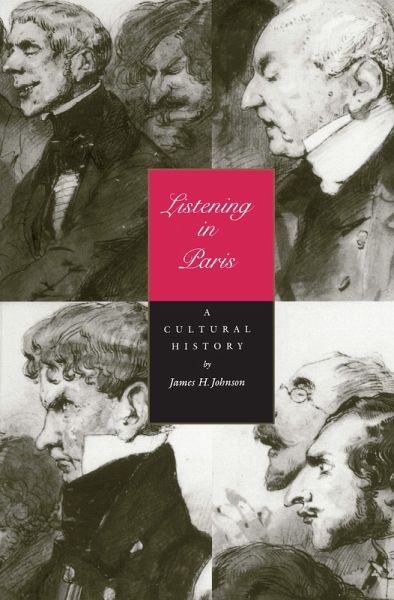
Beginning with the simple question, "Why did audiences grow silent?" Listening in Paris gives a spectator's-eye view of opera and concert life from the Old Regime to the Romantic era, describing the transformation in musical experience from social event to profound aesthetic encounter. James H. Johnson recreates the experience of audiences during these rich decades with brio and wit. Woven into the narrative is an analysis of the political, musical, and aesthetic factors that produced more engaged listening. Johnson shows the gradual pacification of audiences from loud and unruly listeners to the attentive public we know today.
Drawing from a wide range of sources-novels, memoirs, police files, personal correspondence, newspaper reviews, architectural plans, and the like-Johnson brings the performances to life: the hubbub of eighteenth-century opera, the exuberance of Revolutionary audiences, Napoleon's musical authoritarianism, the bourgeoisie's polite consideration. He singles out the music of Gluck, Haydn, Rossini, and Beethoven as especially important in forging new ways of hearing. This book's theoretical edge will appeal to cultural and intellectual historians in many fields and periods.
Beginning with the simple question, "Why did audiences grow silent?" Listening in Paris gives a spectator's-eye view of opera and concert life from the Old Regime to the Romantic era, describing the transformation in musical experience from social
Drawing from a wide range of sources-novels, memoirs, police files, personal correspondence, newspaper reviews, architectural plans, and the like-Johnson brings the performances to life: the hubbub of eighteenth-century opera, the exuberance of Revolutionary audiences, Napoleon's musical authoritarianism, the bourgeoisie's polite consideration. He singles out the music of Gluck, Haydn, Rossini, and Beethoven as especially important in forging new ways of hearing. This book's theoretical edge will appeal to cultural and intellectual historians in many fields and periods.
Beginning with the simple question, "Why did audiences grow silent?" Listening in Paris gives a spectator's-eye view of opera and concert life from the Old Regime to the Romantic era, describing the transformation in musical experience from social
Dieser Download kann aus rechtlichen Gründen nur mit Rechnungsadresse in A, D ausgeliefert werden.