110,95 €
141,60 €**
110,95 €
inkl. MwSt.
**Preis der gedruckten Ausgabe (Gebundenes Buch)
Sofort per Download lieferbar

55 °P sammeln
110,95 €
141,60 €**
110,95 €
inkl. MwSt.
**Preis der gedruckten Ausgabe (Gebundenes Buch)
Sofort per Download lieferbar
Alle Infos zum eBook verschenken
55 °P sammeln
Als Download kaufen
141,60 €****
-22%11
110,95 €
inkl. MwSt.
**Preis der gedruckten Ausgabe (Gebundenes Buch)
Sofort per Download lieferbar
55 °P sammeln
Jetzt verschenken
Alle Infos zum eBook verschenken
141,60 €****
-22%11
110,95 €
inkl. MwSt.
**Preis der gedruckten Ausgabe (Gebundenes Buch)
Sofort per Download lieferbar
Alle Infos zum eBook verschenken
55 °P sammeln

Andere Kunden interessierten sich auch für
") Literacy Then and Now (eBook, PDF)110,95 €
Literacy Then and Now (eBook, PDF)110,95 €") Vorlesen digital (eBook, ePUB)129,95 €
Vorlesen digital (eBook, ePUB)129,95 €") Mobile and Ubiquitous Media (eBook, ePUB)43,95 €
Mobile and Ubiquitous Media (eBook, ePUB)43,95 €") Urban Communication Regulation (eBook, ePUB)46,95 €
Urban Communication Regulation (eBook, ePUB)46,95 €") New Media, Communication, and Society (eBook, ePUB)41,95 €
New Media, Communication, and Society (eBook, ePUB)41,95 €") Global Communication and Media Research (eBook, ePUB)33,95 €
Global Communication and Media Research (eBook, ePUB)33,95 €") Digital Orientations (eBook, ePUB)36,95 €
Digital Orientations (eBook, ePUB)36,95 €

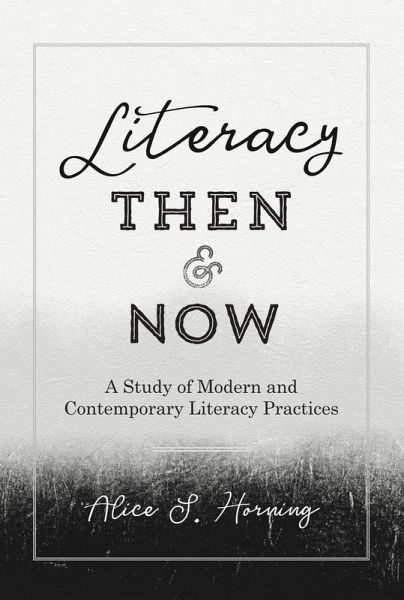
This book argues that the psycholinguistic nature of literacy is universal and seeks to recouperate late nineteenth and early twentieth century techniques for addressing it. After defining the key terms of this study, the book goes onto survey various types of literacy education in the United States. First, it examples various religious organization and their methods for supporting literacy, focusing on the main religious groups in the United States in the Modern period: Christianity, Judaism and Islam. The book then discusses contributions made by NGOs, demonstrating the importance and limitations of reading groups, literary societies, settlement houses, unions, and corporations. Finally, the book examines government managed educational programs in K-12 schools as well as colleges and universities.Ultimately, this book argues, the psycholinguistic character of reading remains consistent over time, place and delivery syste. While sponsors play a key role, self-motivation is a driving force in literacy development. Although literacy education is in an on-going state of transition, the need for critical literacy continues to be an urgent, widespread and essential goal.
Dieser Download kann aus rechtlichen Gründen nur mit Rechnungsadresse in A, D ausgeliefert werden.
"By looking closely at the Modern Period (1880-1930), Literacy Then and Now helps us better understand what Alice S. Horning calls our 'contemporary literacy transition' wherein more than half of Americans are not reading as well as they could-or as well as they must-in order to productively participate in a democracy. Embracing the complexity of the very concept of literacy, Horning explores how literacy was taken up during the Modern Period by religious organizations; colleges and universities; governmental and non-governmental groups; and in K-12 schools. These richly detailed accounts not only yield intriguing insights about the conditions necessary for critical literacy to thrive, but also suggest a unique approach to exploring literacy in our contemporary moment. While others are adamant about the singularity of our digital age, Horning reminds us that history-and the Modern Period, in particular-has a great deal to teach us about what it means to create and sustain an intellectually vibrant culture that prioritizes literacy."-Ellen C. Carillo, University of Connecticut