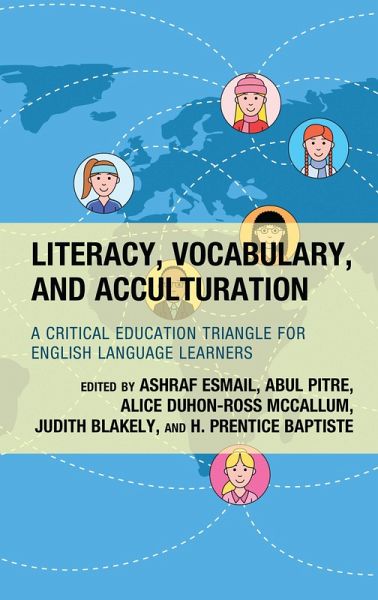
Literacy, Vocabulary, and Acculturation (eBook, PDF)
A Critical Education Triangle for English Language Learners Redaktion: Esmail, Ashraf; Baptiste, H. Prentice; Blakely, Judith; McCallum, Alice Duhon-Ross; Pitre, Abul
Literacy, Vocabulary, and Acculturation (eBook, PDF)
A Critical Education Triangle for English Language Learners Redaktion: Esmail, Ashraf; Baptiste, H. Prentice; Blakely, Judith; McCallum, Alice Duhon-Ross; Pitre, Abul
Sie sind bereits eingeloggt. Klicken Sie auf 2. tolino select Abo, um fortzufahren.
Bitte loggen Sie sich zunächst in Ihr Kundenkonto ein oder registrieren Sie sich bei bücher.de, um das eBook-Abo tolino select nutzen zu können.
The recent increase in immigration patterns in the United States has meant an increase in the number of children whose first language is not English entering American schools. Some reports indicate that as many as one in four students come from families where the language spoken in the home is not English. This book is focused on providing teachers access to credible information that will assist them understand the English language learner, develop effective strategies to teach English language learners, create effective learning environments and use assessments to meet the needs of English…mehr
The recent increase in immigration patterns in the United States has meant an increase in the number of children whose first language is not English entering American schools. Some reports indicate that as many as one in four students come from families where the language spoken in the home is not English. This book is focused on providing teachers access to credible information that will assist them understand the English language learner, develop effective strategies to teach English language learners, create effective learning environments and use assessments to meet the needs of English language learners as well as garner community resources to support for English language learners.
Die Herstellerinformationen sind derzeit nicht verfügbar.
Autorenporträt
Ashraf Esmail is an Associate Professor and Program Coordinator of Criminal Justice at Dillard University. He is the Director for the Center for Racial Justice and Barron Hilton Criminal Justice Endowed Professor. Abul Pitre is Professor and Department Chair of Africana Studies at San Francisco State University. He was appointed Edinboro University's first named professor for his outstanding work in African American education and held the distinguished title of Carter G. Woodson Professor of Education. Alice Duhon Ross is a core faculty for the Richard W. Riley College of Education at Walden University. Current research focus is multicultural, international, peace education. She is a career educator with over 30 years of teaching in higher education and is Nationally Board-Certified Counselor and National Board-Certified School Counselor. Judith Blakely serves in the role of Academic Coordinator at Walden University and works to serve a vital role in maximizing student achievement by incorporating leadership, advocacy, and collaboration. She is certified in multiple states as a School Superintendent, School Administrator (pre-K-12 principal), and Director of Special, Bilingual, and Gifted Education. H. Prentice Baptiste, is a Regents and Distinguished Achievement Professor, and in 2014 was awarded the first College of Education, Diversity Award at New Mexico State University, in Las Cruces, New Mexico, USA. He was President (2016 to 2018) of the National Association for Multicultural Education (NAME), a premier organization advocating for equity and social justice, which he helped found in 1990.
Inhaltsangabe
Introduction Using Your Authentic Voice Through Language, by Camacia Smith-Ross Acknowledgements Chapter 1Beyond the Strategies: Supporting English Language Learners, by David Parker Chapter 2Negotiating Possibilities for Teaching English Learners: A Critical Conversation Between Language Separationand Translanguaging, by Kevin Donley Chapter 3Improving Mathematics Outcomes for English Language Learners Through Implementation of the Elementary Mathematics Initiative, by Cliff Chestnutt and Andrea Smith Chapter 4Evolving the Language We Use: Interrupting Deficit Narratives About Multilingual Learners and Emergent Bilingual Students, by Leah M. Mortenson Chapter 5English Language Bilingualism, by Judith A. Orth and Kathleen M. Hargiss Chapter 6Positioning English Language Learners for Mathematical Success, by Erin Smith Chapter 7Educational Journeys: Youth Voices as the Impetus for Social Justice Curriculum in Latinx Multilingual Classrooms, by Rubén A. González Chapter 8Linking Multicultural Education With Best Practices for Multilingual Students, by Renee Shank and Lin Wu Chapter 9Beyond Language: A Sociocultural Approach to K-12 English Language Teaching and Learning, by Immaculée Harushimana Chapter 10Becoming "Talent Scouts": Identifying Gifted Potential in English Learners, by Holly D. Glaser and Erica C. Meadows Chapter 11Introducing Translanguaging as Pedagogy: Unpacking Preservice ESL Teachers' Language Ideologies and Practices, by Nuo Xu and Verónica E. Valdez Chapter 12Characteristics of English Language Learners, by Nan Li and Courtney A. Howard Chapter 13A Need for Taiwanese Indigenous Immigrant Literature, by Hsiao-Ching Lin and Antonette Aragón Chapter 14Lessons and Transformations From the Borderlands: Preparing Educators to Support Emerging Bilinguals, by Michele L. McConnell and Kelly Metz-Matthews Chapter 15Strategies for Moving From Learning English, Bilingual Education to a More Inclusive Multilingual Education, by Georgina Y. García and Jan Perry Evenstad Chapter 16Real Teachers Teaching Real Students: Where Theory Meets Practice-Learning English in Secondary Schools, by Glori Hodge Smith Chapter 17Creating Social Change for English Language Learners by Improving Access to Grade-Level Instruction, by Charity Funfe Tatah Mentan, Darrell Peterson, Yi-Chen Wu, Kristin Kline Liu, and Kym O'Donnell Chapter 18Binds and Unravels: Science Teachers Deepening Learning for English Language Learners, by Analis Carattini-Ruiz About the Contributors About the Editors
Introduction Using Your Authentic Voice Through Language, by Camacia Smith-Ross Acknowledgements Chapter 1Beyond the Strategies: Supporting English Language Learners, by David Parker Chapter 2Negotiating Possibilities for Teaching English Learners: A Critical Conversation Between Language Separationand Translanguaging, by Kevin Donley Chapter 3Improving Mathematics Outcomes for English Language Learners Through Implementation of the Elementary Mathematics Initiative, by Cliff Chestnutt and Andrea Smith Chapter 4Evolving the Language We Use: Interrupting Deficit Narratives About Multilingual Learners and Emergent Bilingual Students, by Leah M. Mortenson Chapter 5English Language Bilingualism, by Judith A. Orth and Kathleen M. Hargiss Chapter 6Positioning English Language Learners for Mathematical Success, by Erin Smith Chapter 7Educational Journeys: Youth Voices as the Impetus for Social Justice Curriculum in Latinx Multilingual Classrooms, by Rubén A. González Chapter 8Linking Multicultural Education With Best Practices for Multilingual Students, by Renee Shank and Lin Wu Chapter 9Beyond Language: A Sociocultural Approach to K-12 English Language Teaching and Learning, by Immaculée Harushimana Chapter 10Becoming "Talent Scouts": Identifying Gifted Potential in English Learners, by Holly D. Glaser and Erica C. Meadows Chapter 11Introducing Translanguaging as Pedagogy: Unpacking Preservice ESL Teachers' Language Ideologies and Practices, by Nuo Xu and Verónica E. Valdez Chapter 12Characteristics of English Language Learners, by Nan Li and Courtney A. Howard Chapter 13A Need for Taiwanese Indigenous Immigrant Literature, by Hsiao-Ching Lin and Antonette Aragón Chapter 14Lessons and Transformations From the Borderlands: Preparing Educators to Support Emerging Bilinguals, by Michele L. McConnell and Kelly Metz-Matthews Chapter 15Strategies for Moving From Learning English, Bilingual Education to a More Inclusive Multilingual Education, by Georgina Y. García and Jan Perry Evenstad Chapter 16Real Teachers Teaching Real Students: Where Theory Meets Practice-Learning English in Secondary Schools, by Glori Hodge Smith Chapter 17Creating Social Change for English Language Learners by Improving Access to Grade-Level Instruction, by Charity Funfe Tatah Mentan, Darrell Peterson, Yi-Chen Wu, Kristin Kline Liu, and Kym O'Donnell Chapter 18Binds and Unravels: Science Teachers Deepening Learning for English Language Learners, by Analis Carattini-Ruiz About the Contributors About the Editors
Es gelten unsere Allgemeinen Geschäftsbedingungen: www.buecher.de/agb
Impressum
www.buecher.de ist ein Internetauftritt der buecher.de internetstores GmbH
Geschäftsführung: Monica Sawhney | Roland Kölbl | Günter Hilger
Sitz der Gesellschaft: Batheyer Straße 115 - 117, 58099 Hagen
Postanschrift: Bürgermeister-Wegele-Str. 12, 86167 Augsburg
Amtsgericht Hagen HRB 13257
Steuernummer: 321/5800/1497
USt-IdNr: DE450055826