Sie sind bereits eingeloggt. Klicken Sie auf 2. tolino select Abo, um fortzufahren.
Bitte loggen Sie sich zunächst in Ihr Kundenkonto ein oder registrieren Sie sich bei bücher.de, um das eBook-Abo tolino select nutzen zu können.
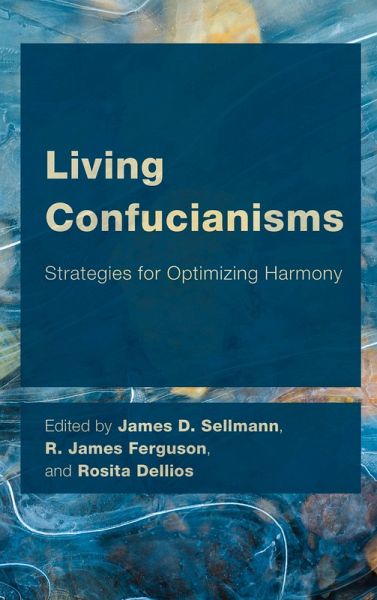
For over two thousand years, Confucianism has built up sophisticated approaches exploring social, political, and environmental harmony. As a valuable cultural resource and one of the main drivers of societal norms across much of East Asia, Confucian philosophy has been going through a global academic revival over the last three decades. It has insights that can help us reflect on the root causes of, and remedies for, disorder in the 21st century, and can build bridges of dialogue across alternative philosophical, political, diplomatic, educational, and religious systems. This volume presents…mehr
For over two thousand years, Confucianism has built up sophisticated approaches exploring social, political, and environmental harmony. As a valuable cultural resource and one of the main drivers of societal norms across much of East Asia, Confucian philosophy has been going through a global academic revival over the last three decades. It has insights that can help us reflect on the root causes of, and remedies for, disorder in the 21st century, and can build bridges of dialogue across alternative philosophical, political, diplomatic, educational, and religious systems. This volume presents diverse 'Confucianisms' as hybrid, evolving traditions that have been indigenized and creatively interpreted to support human fulfilment, using the vast cultural resources of the past to meet the needs of the present and the future.Living Confucianisms: Strategies for Optimizing Harmony explores contemporary harmony from a wide range of perspectives across philosophy, religion, politics, linguistics, diplomacy, international relations and education, with writers from numerous cultural and national backgrounds.
Die Herstellerinformationen sind derzeit nicht verfügbar.
Autorenporträt
James D. Sellmann is professor of philosophy and dean at University of Guam. R. James Ferguson is honorary adjunct assistant professor in the faculty of society & design at Bond University, Australia. Rosita Dellios is associate professor of international relations at Bond University, Australia.
Inhaltsangabe
Introduction: Living Confucianisms Roger T. Ames, Peking University Part I: Optimizing Harmony in Theory 1. Bring Back Harmony in Philosophical Discourse Chenyang Li, Nanyang Technological University 2.Confucian Benevolent Governance (renzheng??) and Positive Peace R. James Ferguson, Bond University, Australia 3. Root Harmony, Justice, Just Harmony (benhe ??, zhengyi??, zhenghe ??) Joshua Mason, Loyola Marymount University Part II: Optimizing Harmony in Ethics and Education 4. Zhu Xi on the Nature of Good (shan ?) and its Harmonious Functioning ( he ?): Neo-Confucian and Western (Greek) Cultural Presuppositions and Intercultural Well-being Diana Arghirescu, Université du Québec à Montréal, Canada 5. Constancy (heng ?) and Human Responsiveness in the Yijing and the Analects Yu-Yi Lai, University of New South Wales 6. Harmony in Confucian Music Education, A Response to the Malaise of Civilization? Wen Shi, Shanghai Jiaotong University 7. Confucian Pedagogy and People's Rights: Sun Yat-sen's (1866-1925) Approach to Linguistic Inclusion for China's Modernization G. Kentak Son, Korea University 8. Confucius Interpreted by a Confucian: Feng Youlan's Interpretations of the Analects Jack Chun, Hong King Polytechnic University Part III: Optimizing Harmony in Practice 9. Confucian Political Philosophy as an Organic Contract Theory James D. Sellmann, University of Guam 10. Confucian Ideals and Sino-western Negotiation in the Asian Century Bee Chen Goh, Southern Cross University, Australia, Chiang Mai University, Thiland 11. Chinese Diplomatic Protocol with Confucian Characteristics Jiali (Julie) Zhou, China Foreign Affairs University 12. Confucianism as an Antidote? The Corruption Virus in African Development Nosa Esiet, Bond University 13. Sino-Indian Conflict: What Would Confucius Do? Darryl Lupton, Bond University Part IV: Optimizing Harmony for the Future 14. On Being a Confucian Futurist Rosita Dellios,Bond University Index About the Contributors
Es gelten unsere Allgemeinen Geschäftsbedingungen: www.buecher.de/agb
Impressum
www.buecher.de ist ein Internetauftritt der buecher.de internetstores GmbH
Geschäftsführung: Monica Sawhney | Roland Kölbl | Günter Hilger
Sitz der Gesellschaft: Batheyer Straße 115 - 117, 58099 Hagen
Postanschrift: Bürgermeister-Wegele-Str. 12, 86167 Augsburg
Amtsgericht Hagen HRB 13257
Steuernummer: 321/5800/1497
USt-IdNr: DE450055826