
30,95 €
inkl. MwSt.
Sofort per Download lieferbar
15 °P sammeln

Andere Kunden interessierten sich auch für
") Transformations in Independent Timor-Leste (eBook, PDF)41,95 €
Transformations in Independent Timor-Leste (eBook, PDF)41,95 €") Nation-Building and National Identity in Timor-Leste (eBook, PDF)48,95 €
Nation-Building and National Identity in Timor-Leste (eBook, PDF)48,95 €") Security, Development and Nation-Building in Timor-Leste (eBook, PDF)43,95 €
Security, Development and Nation-Building in Timor-Leste (eBook, PDF)43,95 €") Routledge Handbook of Contemporary Timor-Leste (eBook, PDF)48,95 €
Routledge Handbook of Contemporary Timor-Leste (eBook, PDF)48,95 €") Social Democracy in East Timor (eBook, PDF)45,95 €
Social Democracy in East Timor (eBook, PDF)45,95 €") Justice and Governance in East Timor (eBook, PDF)45,95 €
Justice and Governance in East Timor (eBook, PDF)45,95 €") Political Institutions in East Timor (eBook, PDF)45,95 €
Political Institutions in East Timor (eBook, PDF)45,95 €


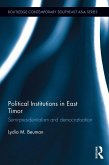
Across many parts of the postcolonial world, it is everyday reality for people to cross regularly between state-based and customary governance, institutions and norms. This book examines this phenomenon in the context of the villages of Timor-Leste, and the state-building efforts that have been conducted by the Timorese government and international development agencies since the vote for independence in 1999.
Drawing on 5 years of ethnographic fieldwork in the remote, rural areas of Timor-Leste, the book provides a critical analysis of the challenges that communities face when navigating coexisting customary and state-based structures and norms in a context where customary law continues to be the central guiding force. It also explores the various creative ways in which local leaders and community members make sense of their local governance environment. It then draws on these insights to provide a more nuanced, contextualised account of the impact of institutional interventions, state-building and democratisation within these villages. While set in the context of state- and nation-building efforts following Timor-Leste's vote for independence, the book also provides a broader examination of the issues that arise for the postcolonial state adequately meeting the needs of its citizens. Further, it explores the challenges that are met by communities when incorporating state influences and demands into their everyday lives.
Expanding the scope of empirical Timor-Leste scholarship by moving beyond anthropological description and providing the first detailed political analysis of local-level governance in contemporary Timorese communities, this book is a valuable contribution to studies on Asian Politics, Governance and International Studies.
Drawing on 5 years of ethnographic fieldwork in the remote, rural areas of Timor-Leste, the book provides a critical analysis of the challenges that communities face when navigating coexisting customary and state-based structures and norms in a context where customary law continues to be the central guiding force. It also explores the various creative ways in which local leaders and community members make sense of their local governance environment. It then draws on these insights to provide a more nuanced, contextualised account of the impact of institutional interventions, state-building and democratisation within these villages. While set in the context of state- and nation-building efforts following Timor-Leste's vote for independence, the book also provides a broader examination of the issues that arise for the postcolonial state adequately meeting the needs of its citizens. Further, it explores the challenges that are met by communities when incorporating state influences and demands into their everyday lives.
Expanding the scope of empirical Timor-Leste scholarship by moving beyond anthropological description and providing the first detailed political analysis of local-level governance in contemporary Timorese communities, this book is a valuable contribution to studies on Asian Politics, Governance and International Studies.
Dieser Download kann aus rechtlichen Gründen nur mit Rechnungsadresse in A, B, BG, CY, CZ, D, DK, EW, E, FIN, F, GR, HR, H, IRL, I, LT, L, LR, M, NL, PL, P, R, S, SLO, SK ausgeliefert werden.