Sie sind bereits eingeloggt. Klicken Sie auf 2. tolino select Abo, um fortzufahren.
Bitte loggen Sie sich zunächst in Ihr Kundenkonto ein oder registrieren Sie sich bei bücher.de, um das eBook-Abo tolino select nutzen zu können.
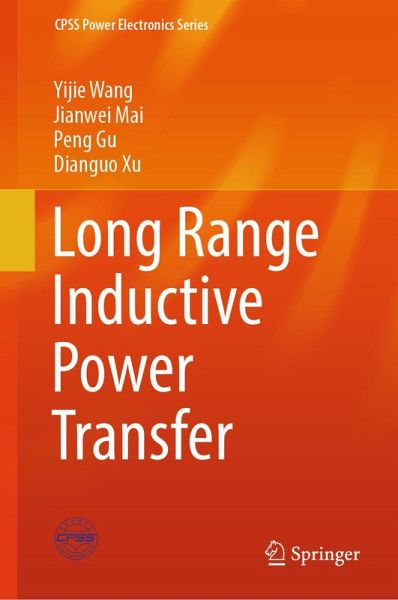
This book is inductive power transfer (IPT) in power electronics. In order to improve the coupling coefficient, improve the quality factor, and control the harmonics, the method of analysis and design of the IPT system is proposed. By increasing the coupling coefficient of the magnetic coupling structure and improving the quality factor of the system, the efficiency of the system is improved and the distance of IPT is extended. The applicable readers are scholars, undergraduates and postgraduates in the field of power electronics.
This book is inductive power transfer (IPT) in power electronics. In order to improve the coupling coefficient, improve the quality factor, and control the harmonics, the method of analysis and design of the IPT system is proposed. By increasing the coupling coefficient of the magnetic coupling structure and improving the quality factor of the system, the efficiency of the system is improved and the distance of IPT is extended. The applicable readers are scholars, undergraduates and postgraduates in the field of power electronics.
Dieser Download kann aus rechtlichen Gründen nur mit Rechnungsadresse in A, B, BG, CY, CZ, D, DK, EW, E, FIN, F, GR, HR, H, IRL, I, LT, L, LR, M, NL, PL, P, R, S, SLO, SK ausgeliefert werden.
Die Herstellerinformationen sind derzeit nicht verfügbar.
Autorenporträt
Yijie Wang was born in Heilongjiang Province, China, in 1982. He received the B.S., M.S., and Ph.D. degrees in electrical engineering from Harbin Institute of Technology, Harbin, China, in 2005, 2007, and 2012, respectively. From 2012 to 2014, he was a Lecturer with the Department of Electrical and Electronics Engineering, Harbin Institute of Technology. From 2014 to 2017, he was an Associate Professor with the Department of Electrical and Electronics Engineering, Harbin Institute of Technology. Since 2017, he has been a Professor with the Department of Electrical and Electronics ngineering, Harbin Institute of Technology. His research interests include dc-dc converters, soft-switching power converters, power factor correction circuits, digital control electronic ballasts, and LED lighting systems. Prof.Wang is an Associate Editor of the IEEE Transactions on Industrial Electronics, IEEE Access, IET Power Electronics and Journal of Power Electronics.
Jianwei Mai wasborn in Henan, China, in 1994. He received the B.S. and Ph.D. degrees in electrical engineering from Harbin Institute of Technology, Harbin, China, in 2017, and 2022, respectively. His research interests include high power density inductive power transfer, wireless power and data transfer and resonant converter with wide range. More than ten technical articles in related fields completed by him have been published in recent years. He was the recipient of the 2022 IEEE TIE Distinguished Reviewers.
Peng Gu was born in Harbin, Heilongjiang Province, China. He received the B.S. degree in electrical engineering from Huazhong University of Science and Technology, Wuhan, China, in 2015, the M.S. degree in electrical engineering from China Electric Power Research Institute, Beijing, China, in 2018, and the Ph.D. degrees in electrical engineering from Harbin Institute of Technology, Harbin, China, in 2023.
His current research interests include wireless power transfer,magnetic coupling structure design, electromagnetic transient analysis, overvoltage and insulation coordination of EHV/UHV ac system, and DC-DC converter. More than ten technical articles in related fields completed by him have been published in recent years.
Dianguo Xu (Fellow, IEEE) received the B.S. degree in Control Engineering from Harbin Engineering University, Harbin, China, in 1982, and the M.S. and Ph.D. degrees in Electrical Engineering from Harbin Institute of Technology (HIT), Harbin, China, in 1984 and 1989, respectively. In 1984, he joined the Department of Electrical Engineering, HIT, as an Assistant Professor. Since 1994, he has been a Professor with the Department of Electrical Engineering, HIT. He was the Dean of School of Electrical Engineering and Automation, HIT, from 2000 to 2010. He was the vice president of HIT, from 2014 to 2020. He has authored/coauthored more than 600 technical papers. His research interests include renewable energy generation technology, power quality mitigation, sensorless vector controlled motor drives, and high-performance servo system. Prof. Xu is a Chairman of IEEE Harbin Section, Co EIC of the IEEE Transactions on Power Electronics, and an Associate Editor of the IEEE Transactions on Industrial Electronics and the IEEE Journal of Emerging and Selected Topics in Power Electronics. He was the recipient of the 2018 IEEE IAS Outstanding Achievement Award.
Inhaltsangabe
Introduction to Long Range Inductive Power Transfer.- Basic Theory of Long Range IPT.- Analysis and Design of Compensation Network for Long Range Inductive Power Transfer.- Long Range IPT System based on Multi-Stage Three-Dimensional Magnetic Coupling Structure.- Principle Analysis of Improving Quality Factor.- Scheme Design for Improving Quality Factor.- Harmonic Control of Rectifier Bridge in Long Range IPT With Light Load.
Introduction to Long Range Inductive Power Transfer.- Basic Theory of Long Range IPT.- Analysis and Design of Compensation Network for Long Range Inductive Power Transfer.- Long Range IPT System based on Multi-Stage Three-Dimensional Magnetic Coupling Structure.- Principle Analysis of Improving Quality Factor.- Scheme Design for Improving Quality Factor.- Harmonic Control of Rectifier Bridge in Long Range IPT With Light Load.
Es gelten unsere Allgemeinen Geschäftsbedingungen: www.buecher.de/agb
Impressum
www.buecher.de ist ein Internetauftritt der buecher.de internetstores GmbH
Geschäftsführung: Monica Sawhney | Roland Kölbl | Günter Hilger
Sitz der Gesellschaft: Batheyer Straße 115 - 117, 58099 Hagen
Postanschrift: Bürgermeister-Wegele-Str. 12, 86167 Augsburg
Amtsgericht Hagen HRB 13257
Steuernummer: 321/5800/1497
USt-IdNr: DE450055826