44,95 €
inkl. MwSt.
Sofort per Download lieferbar
22 °P sammeln

Andere Kunden interessierten sich auch für
") Vietnam (eBook, ePUB)31,95 €
Vietnam (eBook, ePUB)31,95 €") Vietnam's High Ground (eBook, ePUB)50,95 €
Vietnam's High Ground (eBook, ePUB)50,95 €") The Myths of Tet (eBook, ePUB)40,95 €
The Myths of Tet (eBook, ePUB)40,95 €") Diem's Final Failure (eBook, ePUB)40,95 €
Diem's Final Failure (eBook, ePUB)40,95 €") Losing Power (eBook, ePUB)24,95 €
Losing Power (eBook, ePUB)24,95 €") Beyond 17: The Apollo Applications Program and Losing the New Frontier (eBook, ePUB)4,49 €
Beyond 17: The Apollo Applications Program and Losing the New Frontier (eBook, ePUB)4,49 €") The OSS in Burma (eBook, ePUB)28,95 €
The OSS in Burma (eBook, ePUB)28,95 €







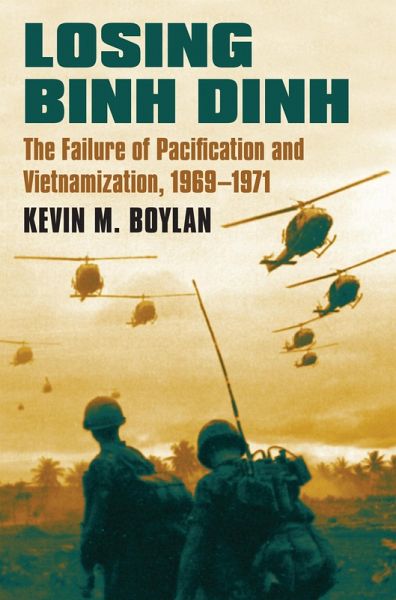
Americans have fought two prolonged battles over Vietnamone in southeast Asia and one, ongoing even now, at homeover whether the war was unnecessary, unjust, and unwinnable. Revisionist historians who reject this view have formulated many contra-factual scenarios for how the war might have been won, but also put forward one historically testable hypothesisnamely that the war actually was won after the 1968 Tet Offensive, only to be thrown away later through a failure of political will. It is this Lost Victory hypothesis that Kevin M. Boylan takes up in Losing Binh Dinh, aiming to determine once and for all whether the historical record supports such a claim.
Proponents of the Lost Victory thesis contend that by 1972, President Richard Nixon's policy of Vietnamization had effectively eliminated South Vietnamese insurgents, pacified the countryside, and prepared the South Vietnamese to defend their own territory with only logistical and financial support from Americans. Rejecting the top-down approach favored by Revisionists, Boylan examines the facts on the ground in Binh Dinh, a strategically vital province that was the second most populous in South Vietnam, controlled key transportation routes, and contained one of the nation's few major seaports as well as the huge US Air Force base at Phu Cat. Taking an in-depth look at operations that were conducted in the province, Boylan is able to uncover the fundamental flaw in the dual objectives of Vietnamization and Pacificationnamely, that they were mutually exclusive. The inefficiency and corruption of the South Vietnamese government and armed forces was so crippling that progress in pacification occurred only when Americans took the leadwhich, in turn, left the South Vietnamese even more dependent on US support.
Proponents of the Lost Victory thesis contend that by 1972, President Richard Nixon's policy of Vietnamization had effectively eliminated South Vietnamese insurgents, pacified the countryside, and prepared the South Vietnamese to defend their own territory with only logistical and financial support from Americans. Rejecting the top-down approach favored by Revisionists, Boylan examines the facts on the ground in Binh Dinh, a strategically vital province that was the second most populous in South Vietnam, controlled key transportation routes, and contained one of the nation's few major seaports as well as the huge US Air Force base at Phu Cat. Taking an in-depth look at operations that were conducted in the province, Boylan is able to uncover the fundamental flaw in the dual objectives of Vietnamization and Pacificationnamely, that they were mutually exclusive. The inefficiency and corruption of the South Vietnamese government and armed forces was so crippling that progress in pacification occurred only when Americans took the leadwhich, in turn, left the South Vietnamese even more dependent on US support.
Dieser Download kann aus rechtlichen Gründen nur mit Rechnungsadresse in A, D ausgeliefert werden.