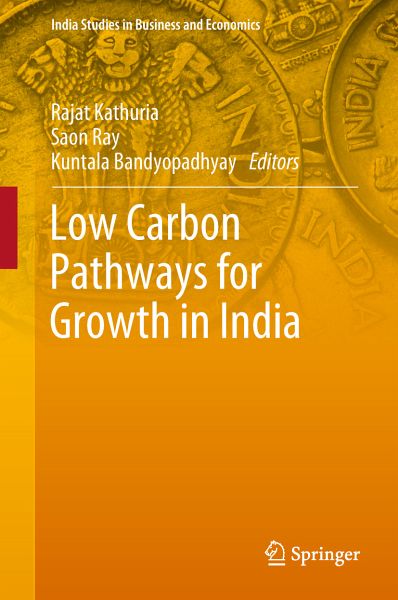
Low Carbon Pathways for Growth in India (eBook, PDF)
Redaktion: Kathuria, Rajat; Bandyopadhyay, Kuntala; Ray, Saon
80,95 €
80,95 €
inkl. MwSt.
Sofort per Download lieferbar

40 °P sammeln
80,95 €
Als Download kaufen
80,95 €
inkl. MwSt.
Sofort per Download lieferbar
40 °P sammeln
Jetzt verschenken
Alle Infos zum eBook verschenken
80,95 €
inkl. MwSt.
Sofort per Download lieferbar
Alle Infos zum eBook verschenken
40 °P sammeln

Low Carbon Pathways for Growth in India (eBook, PDF)
Redaktion: Kathuria, Rajat; Bandyopadhyay, Kuntala; Ray, Saon
- Format: PDF
- Merkliste
- Auf die Merkliste
- Bewerten Bewerten
- Teilen
- Produkt teilen
- Produkterinnerung
- Produkterinnerung

Bitte loggen Sie sich zunächst in Ihr Kundenkonto ein oder registrieren Sie sich bei
bücher.de, um das eBook-Abo tolino select nutzen zu können.
Hier können Sie sich einloggen
Sie sind bereits eingeloggt. Klicken Sie auf 2. tolino select Abo, um fortzufahren.

Bitte loggen Sie sich zunächst in Ihr Kundenkonto ein oder registrieren Sie sich bei bücher.de, um das eBook-Abo tolino select nutzen zu können.
Discusses how India can grow in a sustainable manner and in a low carbon way
Examines various sectors which are important in creating low carbon growth pathways for India
Contains both technical and non-technical contributions to cater to a wider readership, with a special focus on policy makers
- Geräte: PC
- ohne Kopierschutz
- eBook Hilfe
- Größe: 3.55MB
Andere Kunden interessierten sich auch für
Valentin CrastanKey Figures for Achieving Global Climate Goals (eBook, PDF)72,95 €
Jaleh SamadiFuture of CO2 Capture, Transport and Storage Projects (eBook, PDF)36,95 €
From Fossil Fuels to Low Carbon Energy Transition (eBook, PDF)80,95 €
Regulating Water Security in Unconventional Oil and Gas (eBook, PDF)68,95 €
Thomas UnnerstallThe German Energy Transition (eBook, PDF)56,95 €
Durmus KayaEnergy Management and Energy Efficiency in Industry (eBook, PDF)88,95 €
Energy Production in the Mississippi River Delta (eBook, PDF)72,95 €-
-
-
Discusses how India can grow in a sustainable manner and in a low carbon way
Examines various sectors which are important in creating low carbon growth pathways for India
Contains both technical and non-technical contributions to cater to a wider readership, with a special focus on policy makers
Examines various sectors which are important in creating low carbon growth pathways for India
Contains both technical and non-technical contributions to cater to a wider readership, with a special focus on policy makers
Dieser Download kann aus rechtlichen Gründen nur mit Rechnungsadresse in A, B, BG, CY, CZ, D, DK, EW, E, FIN, F, GR, HR, H, IRL, I, LT, L, LR, M, NL, PL, P, R, S, SLO, SK ausgeliefert werden.
Produktdetails
- Produktdetails
- Verlag: Springer Nature Singapore
- Seitenzahl: 188
- Erscheinungstermin: 1. August 2018
- Englisch
- ISBN-13: 9789811309052
- Artikelnr.: 53475427
- Verlag: Springer Nature Singapore
- Seitenzahl: 188
- Erscheinungstermin: 1. August 2018
- Englisch
- ISBN-13: 9789811309052
- Artikelnr.: 53475427
- Herstellerkennzeichnung Die Herstellerinformationen sind derzeit nicht verfügbar.
Rajat Kathuria is Director and Chief Executive at the Indian Council for Research on International Economic Relations (ICRIER), New Delhi. He has over 20 years experience in teaching and 15 years experience in economic policy, besides research interests on a range of issues relating to regulation and competition policy. He has worked with the World Bank, Washington DC as a Consultant and carried out research assignments for a number of international organizations, including ILO, UNCTAD, LirneAsia, World Bank and ADB. He has published in international and national journals, besides in popular magazines and newspapers. He is founder member of Broadband Society for Universal Access and served on the Board of Delhi Management Association. He is on several government committees and on the research advisory council of SBI. He has an undergraduate degree in Economics from St. Stephens College, a Masters from Delhi School of Economics and a PhD degree from the University of Maryland, College Park. Saon Ray is Senior Fellow, Indian Council for Research on International Economic Relations (ICRIER), New Delhi. An economist specializing in industry and international trade issues, her areas of interest include global value chains, technological upgrading of Indian industries, free trade agreements and trade creation effects. She has worked in the area of trade policy, technology transfer, foreign direct investment, efficiency and productivity of firms, energy and climate change related issues. She has published widely on these issues in books and journal articles. Her Ph.D. in Economics from the Jawaharlal Nehru University examined the role of intellectual property rights in transferring technology to developing countries. Kuntala Bandyopadhyay is a Research Associate with ICRIER. Her research interests include development economics, particularly in the areas of energy and climate, and trade and labour issues. She is currently involved in the New Climate Economy project, which is investigating the feasibility of de-carbonization of Indian Railways. She has an M.Phil. in Economics from Jawaharlal Nehru University and is currently pursuing her Ph.D. at the same university.
India's Energy Demand and Supply.- Low Carbon Pathways for Growth in India: Assessment of Climate Models.- Low Carbon Pathways.- Cost of Inaction on Mitigating Climate change.- Sectoral Perspectives.- Low Carbon Pathways for Urban Development and Mobility in India.- Strategies to Lower Carbon Emissions in Industry.- Energy Efficiency Approach to Urban Water Supply.- Water, Ecosystem Services, and Food Security.- De-carbonization of the Indian Railways.- Advent of Solar in India.- Conclusion.