26,95 €
26,95 €
inkl. MwSt.
Sofort per Download lieferbar

13 °P sammeln
26,95 €
Als Download kaufen
26,95 €
inkl. MwSt.
Sofort per Download lieferbar
13 °P sammeln
Jetzt verschenken
Alle Infos zum eBook verschenken
26,95 €
inkl. MwSt.
Sofort per Download lieferbar
Alle Infos zum eBook verschenken
13 °P sammeln

Andere Kunden interessierten sich auch für
") Digital Astrophotography: The State of the Art (eBook, PDF)28,95 €
Digital Astrophotography: The State of the Art (eBook, PDF)28,95 €") Creating and Enhancing Digital Astro Images (eBook, PDF)26,95 €
Creating and Enhancing Digital Astro Images (eBook, PDF)26,95 €") Practical Astrophotography (eBook, PDF)30,95 €
Practical Astrophotography (eBook, PDF)30,95 €") CCD Astrophotography: High-Quality Imaging from the Suburbs (eBook, PDF)28,95 €
CCD Astrophotography: High-Quality Imaging from the Suburbs (eBook, PDF)28,95 €") The Art and Science of CCD Astronomy (eBook, PDF)40,95 €
The Art and Science of CCD Astronomy (eBook, PDF)40,95 €") The 100 Best Astrophotography Targets (eBook, PDF)36,95 €
The 100 Best Astrophotography Targets (eBook, PDF)36,95 €") One-Shot Color Astronomical Imaging (eBook, PDF)28,95 €
One-Shot Color Astronomical Imaging (eBook, PDF)28,95 €

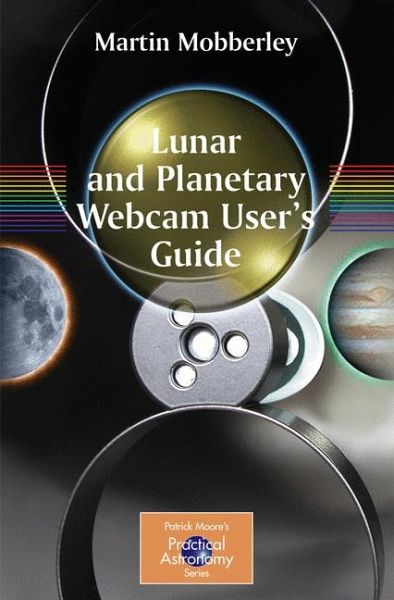
This book aims to de-mystify the jargon of webcams and computer processing and provides detailed hints and tips for imaging the Sun, Moon and planets with a webcam. It demonstrates how inexpensive technology is revolutionizing imaging in amateur astronomy. These advances have enabled anyone with a modest telescope and a webcam to obtain jaw-dropping lunar and planetary images to rival those taken with cameras costing thousands of dollars. A glance through the images in this book shows just what spectacular results can be achieved by using a webcam with a telescope. Each observing target is dealt with separately, so specialized techniques are explained in context. The book further explains how webcams can be connected direct to a PC so that software can be used to "stack" multiple images, providing a stunning increase in image quality.
Dieser Download kann aus rechtlichen Gründen nur mit Rechnungsadresse in A, B, BG, CY, CZ, D, DK, EW, E, FIN, F, GR, HR, H, IRL, I, LT, L, LR, M, NL, PL, P, R, S, SLO, SK ausgeliefert werden.
From the reviews:
[This book] is superb! I am still falling off webcam learning curves, so I found many good nuggets of information in the book. I especially liked the in-depth analyses of the Moon and planets--it provides good direction on what to image. --Don Parker
"Astronomers now recognize that webcams are the best thing to happen to planetary observing since Galileo first pointed a telescope at Jupiter nearly 400 years ago. ... So it is timely that Martin Mobberley has added to Springer's burgeoning Practical Astronomy Series with a comprehensive guide to exploit this exciting technology ... . this is a good book that contains information and hints that will benefit both the beginner and the more experienced imager. It's written in a style that is clear ... . Recommended." (Grant Privett, Astronomy Now, December, 2006)
"In the last few years ... webcams have revolutionized amateur astronomy ... . This book demystifies the jargon of webcams and computer processing, and provides detailed hints and tips for imaging the Sun, Moon, and planets with a webcam. The author looks at each observing target separately, describing and explaining all specialized techniques in context. Glance through the images in this book to see just how much you can easily achieve by using a webcam with your telescope." (Lunar and Planetary Information Bulletin, 2007)
"Martin Mobberley is a well known observer and imager. In this book he takes a hands on look at webcamming the Solar System. ... is very well written and easy to understand. The step guides are clear and I would recommend this book to both experienced and novice imagers alike. In fact even if you're not interested in hi resolution imaging the story of the rectal bung makes this a great read....Youl'll have to buy the book though to find out more ... ." (Dave Gradwell, Astronomy and Space, February, 2007)
[This book] is superb! I am still falling off webcam learning curves, so I found many good nuggets of information in the book. I especially liked the in-depth analyses of the Moon and planets--it provides good direction on what to image. --Don Parker
"Astronomers now recognize that webcams are the best thing to happen to planetary observing since Galileo first pointed a telescope at Jupiter nearly 400 years ago. ... So it is timely that Martin Mobberley has added to Springer's burgeoning Practical Astronomy Series with a comprehensive guide to exploit this exciting technology ... . this is a good book that contains information and hints that will benefit both the beginner and the more experienced imager. It's written in a style that is clear ... . Recommended." (Grant Privett, Astronomy Now, December, 2006)
"In the last few years ... webcams have revolutionized amateur astronomy ... . This book demystifies the jargon of webcams and computer processing, and provides detailed hints and tips for imaging the Sun, Moon, and planets with a webcam. The author looks at each observing target separately, describing and explaining all specialized techniques in context. Glance through the images in this book to see just how much you can easily achieve by using a webcam with your telescope." (Lunar and Planetary Information Bulletin, 2007)
"Martin Mobberley is a well known observer and imager. In this book he takes a hands on look at webcamming the Solar System. ... is very well written and easy to understand. The step guides are clear and I would recommend this book to both experienced and novice imagers alike. In fact even if you're not interested in hi resolution imaging the story of the rectal bung makes this a great read....Youl'll have to buy the book though to find out more ... ." (Dave Gradwell, Astronomy and Space, February, 2007)