104,95 €
inkl. MwSt.
Sofort per Download lieferbar
52 °P sammeln

Andere Kunden interessierten sich auch für
") Machining Dynamics (eBook, PDF)96,95 €
Machining Dynamics (eBook, PDF)96,95 €") Industry 4.0 and Advanced Manufacturing (eBook, PDF)191,95 €
Industry 4.0 and Advanced Manufacturing (eBook, PDF)191,95 €") Metal Cutting Theory (eBook, PDF)120,95 €
Metal Cutting Theory (eBook, PDF)120,95 €") Harmonic Balance for Nonlinear Vibration Problems (eBook, PDF)120,95 €
Harmonic Balance for Nonlinear Vibration Problems (eBook, PDF)120,95 €") Industry 4.0 and Advanced Manufacturing (eBook, PDF)175,95 €
Industry 4.0 and Advanced Manufacturing (eBook, PDF)175,95 €") Simulation and Experiments of Material-Oriented Ultra-Precision Machining (eBook, PDF)72,95 €
Simulation and Experiments of Material-Oriented Ultra-Precision Machining (eBook, PDF)72,95 €") System Modelling and Optimization (eBook, PDF)112,95 €
System Modelling and Optimization (eBook, PDF)112,95 €







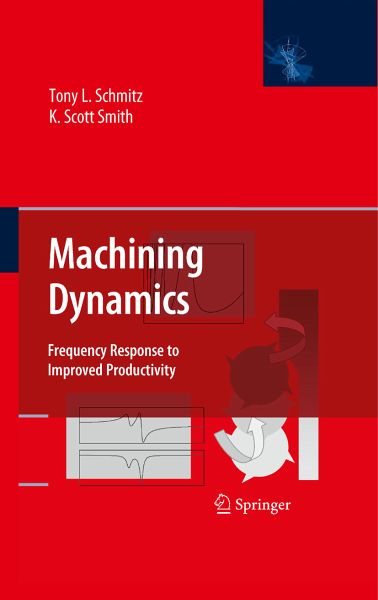
"Machining dynamics: Frequency response to improved productivity" will train engineers and students in the practical application of machining dynamics, with a particular focus on milling. The book is arranged such that the steps required to improve machining productivity through chatter avoidance and reduced surface location error (forced vibrations resulting in part geometric errors) are clearly evident.
The following topics are covered in detail: modal analysis, including experimental methods, to obtain the tool point frequency response function; descriptions of turning and milling, including force modeling, time domain simulation, stability lobe diagram algorithms, and surface location error calculation for milling; and receptance coupling methods for tool point frequency response prediction, including beam theory. Numerical examples are included, as well as the MATLAB code used to develop the figures.
The following topics are covered in detail: modal analysis, including experimental methods, to obtain the tool point frequency response function; descriptions of turning and milling, including force modeling, time domain simulation, stability lobe diagram algorithms, and surface location error calculation for milling; and receptance coupling methods for tool point frequency response prediction, including beam theory. Numerical examples are included, as well as the MATLAB code used to develop the figures.
Dieser Download kann aus rechtlichen Gründen nur mit Rechnungsadresse in A, B, BG, CY, CZ, D, DK, EW, E, FIN, F, GR, HR, H, IRL, I, LT, L, LR, M, NL, PL, P, R, S, SLO, SK ausgeliefert werden.