17,95 €
inkl. MwSt.
Sofort per Download lieferbar
9 °P sammeln

Andere Kunden interessierten sich auch für
") Copper Shaft-Hole Axes and Early Metallurgy in South-Eastern Europe: An Integrated Approach (eBook, PDF)20,95 €
Copper Shaft-Hole Axes and Early Metallurgy in South-Eastern Europe: An Integrated Approach (eBook, PDF)20,95 €") Coton Park, Rugby, Warwickshire: A Middle Iron Age Settlement with Copper Alloy Casting (eBook, PDF)15,95 €
Coton Park, Rugby, Warwickshire: A Middle Iron Age Settlement with Copper Alloy Casting (eBook, PDF)15,95 €") Agia Varvara-Almyras: An Iron Age Copper Smelting Site in Cyprus (eBook, PDF)14,95 €
Agia Varvara-Almyras: An Iron Age Copper Smelting Site in Cyprus (eBook, PDF)14,95 €") Late Roman to Late Byzantine/Early Islamic Period Lamps in the Holy Land (eBook, PDF)14,95 €
Late Roman to Late Byzantine/Early Islamic Period Lamps in the Holy Land (eBook, PDF)14,95 €") Stone Tools in the Ancient Near East and Egypt (eBook, PDF)17,95 €
Stone Tools in the Ancient Near East and Egypt (eBook, PDF)17,95 €") Danubian Lands between the Black, Aegean and Adriatic Seas (eBook, PDF)20,95 €
Danubian Lands between the Black, Aegean and Adriatic Seas (eBook, PDF)20,95 €") Gnathia and related Hellenistic ware on the East Adriatic coast (eBook, PDF)20,95 €
Gnathia and related Hellenistic ware on the East Adriatic coast (eBook, PDF)20,95 €

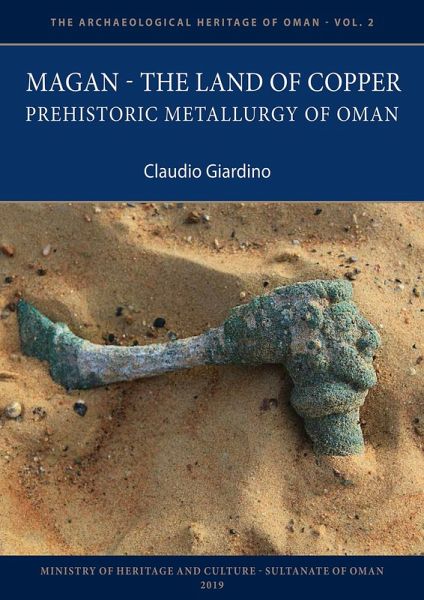
The development of a prehistoric civilization in theSultanate of Oman was strongly connected with the exploitation and the use ofcopper. The Oman Peninsula has several rich copper ore deposits that have beenexploited since prehistoric times. The earliest evidence of metallurgicalactivities in Oman dates back to the end of the Neolithic period in the 4thmillennium BC. Thanks to the availability of this precious raw material, Omanbecame one of the main copper sources for the entire Middle East during theBronze Age. The cuneiform texts of Mesopotamia referred to Oman as the Land ofMagan, a region where the precious copper was found in fabulous abundance. Thisvolume describes the geography and environments of Oman, its rich copper oredeposits and the ancient mining and smelting techniques, and it also includesan overview of the physical properties of the different metals exploited inantiquity and of the analytical techniques used in archaeometallurgy. Moreover,the author presents for the first time a comprehensive and detailed typology ofthe metal objects discovered at sites in Oman dating to the millennia from theNeolithic up to the Early Iron Age, emphasizing the development of advancedalloying techniques in order to obtain artefacts with specific proprieties andappearance.
Dieser Download kann aus rechtlichen Gründen nur mit Rechnungsadresse in A, B, BG, CY, CZ, D, DK, EW, E, FIN, F, GR, HR, H, IRL, I, LT, L, LR, M, NL, PL, P, R, S, SLO, SK ausgeliefert werden.