76,95 €
76,95 €
inkl. MwSt.
Sofort per Download lieferbar

38 °P sammeln
76,95 €
Als Download kaufen
76,95 €
inkl. MwSt.
Sofort per Download lieferbar
38 °P sammeln
Jetzt verschenken
Alle Infos zum eBook verschenken
76,95 €
inkl. MwSt.
Sofort per Download lieferbar
Alle Infos zum eBook verschenken
38 °P sammeln

Andere Kunden interessierten sich auch für
") Reweaving the Relational Mat (eBook, ePUB)39,95 €
Reweaving the Relational Mat (eBook, ePUB)39,95 €") Gender Inequality in the Ordained Ministry of the Church of England (eBook, ePUB)39,95 €
Gender Inequality in the Ordained Ministry of the Church of England (eBook, ePUB)39,95 €") Christianity and the Limits of Minority Acceptance in America (eBook, ePUB)29,95 €
Christianity and the Limits of Minority Acceptance in America (eBook, ePUB)29,95 €") Making Evangelical History (eBook, ePUB)42,95 €
Making Evangelical History (eBook, ePUB)42,95 €") Baby, You are My Religion (eBook, ePUB)39,95 €
Baby, You are My Religion (eBook, ePUB)39,95 €") Balancing on the Mechitza (eBook, ePUB)10,95 €
Balancing on the Mechitza (eBook, ePUB)10,95 €") Politics and Religion: The Basics (eBook, ePUB)18,95 €
Politics and Religion: The Basics (eBook, ePUB)18,95 €




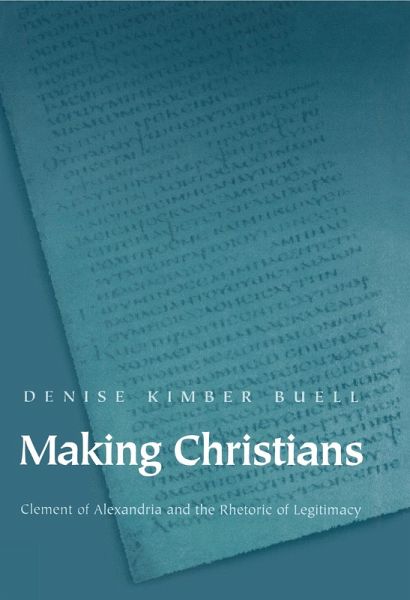
How did second-century Christians vie with each other in seeking to produce an authoritative discourse of Christian identity? In this innovative book, Denise Buell argues that many early Christians deployed the metaphors of procreation and kinship in the struggle over claims to represent the truth of Christian interpretation, practice, and doctrine. In particular, she examines the intriguing works of the influential theologian Clement of Alexandria (ca. 150-210 c.e.), for whom cultural assumptions about procreation and kinship played an important role in defining which Christians have the proper authority to teach, and which kinds of knowledge are authentic.
Buell argues that metaphors of procreation and kinship can serve to make power differentials appear natural. She shows that early Christian authors recognized this and often turned to such metaphors to mark their own positions as legitimate and marginalize others as false. Attention to the functions of this language offers a way out of the trap of reconstructing the development of early Christianity along the axes of "heresy" and "orthodoxy," while not denying that early Christians employed this binary. Ultimately, Buell argues, strategic use of kinship language encouraged conformity over diversity and had a long lasting effect both on Christian thought and on the historiography of early Christianity.
Aperceptive and closely argued contribution to early Christian studies, Making Christians also branches out to the areas of kinship studies and the social construction of gender.
Buell argues that metaphors of procreation and kinship can serve to make power differentials appear natural. She shows that early Christian authors recognized this and often turned to such metaphors to mark their own positions as legitimate and marginalize others as false. Attention to the functions of this language offers a way out of the trap of reconstructing the development of early Christianity along the axes of "heresy" and "orthodoxy," while not denying that early Christians employed this binary. Ultimately, Buell argues, strategic use of kinship language encouraged conformity over diversity and had a long lasting effect both on Christian thought and on the historiography of early Christianity.
Aperceptive and closely argued contribution to early Christian studies, Making Christians also branches out to the areas of kinship studies and the social construction of gender.
Dieser Download kann aus rechtlichen Gründen nur mit Rechnungsadresse in A, D ausgeliefert werden.