Sie sind bereits eingeloggt. Klicken Sie auf 2. tolino select Abo, um fortzufahren.
Bitte loggen Sie sich zunächst in Ihr Kundenkonto ein oder registrieren Sie sich bei bücher.de, um das eBook-Abo tolino select nutzen zu können.
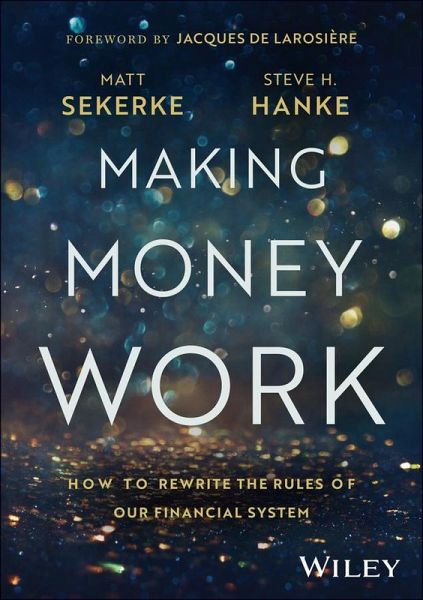
The Global Financial Crisis broke the monetary system. Here's how to fix it. In Making Money Work: How to Rewrite the Rules of Our Financial System, Matt Sekerke and Steve H. Hanke deliver a rigorous and fascinating exploration of the monetary economy. You'll find a detailed and clear roadmap of how and why fiat money is created and destroyed, its connections to the broader economy, and the objective mechanisms that underwrite and maintain its value. In their exploration, Sekerke and Hanke solve many problems and puzzles and shed light on several important questions: Why economists…mehr
The Global Financial Crisis broke the monetary system. Here's how to fix it.
In Making Money Work: How to Rewrite the Rules of Our Financial System, Matt Sekerke and Steve H. Hanke deliver a rigorous and fascinating exploration of the monetary economy. You'll find a detailed and clear roadmap of how and why fiat money is created and destroyed, its connections to the broader economy, and the objective mechanisms that underwrite and maintain its value.
In their exploration, Sekerke and Hanke solve many problems and puzzles and shed light on several important questions:
Why economists misunderstand the structure and function of the monetary system
The central role of the commercial banking system in fiat money regimes, and why commercial banks are not like other financial intermediaries
The economic and regulatory constraints on bank money creation
The interplay between banking and capital markets in funding investment projects
How the "banks" that dominate the international financial landscape distort the lines between banking and capital markets business
Why banking regulation and fiscal policy determine and constrain monetary policy to an equal or greater extent than central bank actions
Sekerke and Hanke trace important post-crisis policy developments and sketch the broad strokes of a new operating model that would restore the performance of the monetary system and make better use of aggregate savings:
Making neutrality the explicit goal of monetary policy, properly understood
Increasing the supply of bankable projects and keeping them on bank balance sheets
Breaking the financial system's fatal attraction to land and real estate
Reducing regulatory distortions in lending markets
Reforming universal banking institutions and stimulating competition
Transitioning to a quantity-based monetary policy framework
An engaging and incisive guide to the global systems of money and banking, Making Money Work is destined to become a sought-after classic for bankers, finance professionals, policymakers, regulators, academics, and laypeople with an interest in money and banking.
Dieser Download kann aus rechtlichen Gründen nur mit Rechnungsadresse in D ausgeliefert werden.
Die Herstellerinformationen sind derzeit nicht verfügbar.
Autorenporträt
MATT SEKERKE is a Managing Director at SEDA Experts, Senior Macro Advisor at Hiddenite Capital Partners, a Fellow at the Institute for Applied Economics, Global Health, and the Study of Business Enterprise at the Johns Hopkins University, and a Visiting Fellow in the Department of Finance at Durham University Business School. He is the author of Bayesian Risk Management (Wiley Finance, 2015).
STEVE H. HANKE is a Professor of Applied Economics and Founder and Co-Director of the Institute for Applied Economics, Global Health, and the Study of Business Enterprise at the Johns Hopkins University. Hanke has served as an advisor to governments and heads of state in Europe, South America, and Asia. Currently, he serves as Chairman of the Supervisory Board of AMG Critical Materials in Amsterdam. He is the co-author of Capital, Interest, and Waiting (Palgrave Macmillan, 2024) with Leland B. Yeager.
Inhaltsangabe
Foreword by Jacques de Larosière iii Introduction v Part One: How Money Works. Institutions of the Monetary Economy 1 Chapter 1 Rethinking Monetary Economics 3 Macroeconomics Without Money 3 Broad Money and the Banking System 4 From Interest-rate Policy to Quantity-based Policy 6 Neutral Monetary Policy 7 Productive Capital Markets 7 Chapter 2 Fiat Money Systems 9 Specifying Money So That Money Matters 9 Money is essentially an abstract measure of value 10 Money consists in a claim or credit 11 The state, or an authority, is an essential basis for money 12 Money is not neutral in the economic process 13 Fiat Monetary Standards 15 Metallic standards 15 Standards after metallic standards 17 Foreign exchange and the quest for an international monetary standard 17 Revisiting the Foundations of Monetary Economics 20 Chapter 3 The Institutional Structure of the Monetary Economy 21 The Government Sector 21 The fiscal authority 22 The monetary authority 23 The consolidated government 24 The Commercial Banking System 26 Deposit creation by individual banks 27 Fallacious accounts of bank funding and deposit creation 28 Financial Intermediaries 31 Asset managers 31 Money market funds 32 Asset-backed securities 33 Consolidated financial intermediation sector 34 The Nonbank Public: Nonfinancial Firms and Households 35 Nonfinancial business 36 Households 37 The Rest of the World 37 The Money Supply and its Connections to the Nonbank Public 38 The System of Claims as a Foundation for Monetary Theory 40 Chapter 4 Financial Intermediation in the Capital Markets 42 Savings and Investment: The Standard Macroeconomic Story 43 Savings and Investment: The Microeconomic Foundations 44 The NPV criterion 45 Information asymmetry 46 Equity rationing 46 Revising the growth model 47 Financial Intermediation and Project Stratification 48 Chapter 5 Credit Creation by the Commercial Banking System 50 Savings and Investment: Expanding the Standard Story 50 The Set of Bankable Projects 53 Maturity Transformation and Bank Risk Management 55 Credit risk management 55 Interest rate risk management 57 Liquidity risk management 58 Economic Growth with Credit and Capital Markets 61 Chapter 6 Universal Banks and the Banking-Capital Markets Boundary 63 Complementarities and Competition in Banking and Capital Markets Business 65 Risk Transformation in Securitization Markets 67 Risk Transfer Contracts 68 Bank Lending to Nonbank Financial Institutions 71 Risk Management in Universal Banks 72 Part Two: A Broader View of Monetary Policy 75 Chapter 7 Analytical Frameworks and Basic Monetary Facts 82 The Equation of Exchange and the Demand for Money 83 The Cambridge equation 84 The equation of exchange in economic theory 84 Divisia Broad Money 86 Constructing Divisia indices 87 Comparing Divisia and simple sum aggregates 88 Sources of Divisia money 92 Divisia money by sectors and strata 93 Evolution of Bank Balance Sheets from 1945 to 2023 97 Broad trends 99 Finer details 101 Bank lending versus capital market finance 103 Three Big Questions 109 Chapter 8 The Regulation of Universal Banks 112 Bank Capital Regulation 114 Defining bank capital 114 Capital adequacy before the Basel era 116 Capital adequacy after the First Basel Accord 117 The 1996 market risk amendment 118 The monetary policy impact of the Basel I era 119 The Problem of the Trading Book 120 Regulatory Capital Under Basel III 122 Bank Liquidity Regulation 123 The Liquidity Coverage Ratio 124 The Net Stable Funding Ratio 127 Summing Up 128 Chapter 9 Monetary Aspects of the Government Budget 129 Stable Government Debt Dynamics and the Monetary Standard 130 Stability conditions 130 Deposit insurance 132 Fiscal Influences on Aggregate Conditions 133 Central bank transactions in government obligations 133 Government-sponsored Enterprises and financial agencies 134 Monetary consequences of GSE guarantees 136 The Federal Home Loan Bank system 137 Crowding-out in capital markets 138 The Disaggregated Budget Arithmetic 139 Some examples of sector-level fiscal influence 140 Sectoral impact of the fiscal impulse from quantitative easing 141 Appendix 9.A Propagation of a Fiscal Impulse 143 Chapter 10 Central Bank Policy 146 Central Bank Policy Implementation Before and After the GFC 147 Interest Rate Policy Transmission and Asset Prices 156 An Unintended Period of Steady Broad Money Growth 158 Prospects for Future Interest Rate Policy 161 Part Three: Rewriting the Rules of Our Financial System 163 Chapter 11 Defining Neutral Monetary Policy 165 Neutral Monetary Policy 165 Efficient Use of Global Savings 169 Chapter 12 Universal Banks in the Monetary System 172 Competition in Commercial Banking 173 Governance 178 Regulation 180 Chapter 13 The Base of Investable and Bankable Projects 181 Chapter 14 Rewriting the Rules 192 Bibliography 213 Endnotes 232 About the Authors Index
Foreword by Jacques de Larosière iii Introduction v Part One: How Money Works. Institutions of the Monetary Economy 1 Chapter 1 Rethinking Monetary Economics 3 Macroeconomics Without Money 3 Broad Money and the Banking System 4 From Interest-rate Policy to Quantity-based Policy 6 Neutral Monetary Policy 7 Productive Capital Markets 7 Chapter 2 Fiat Money Systems 9 Specifying Money So That Money Matters 9 Money is essentially an abstract measure of value 10 Money consists in a claim or credit 11 The state, or an authority, is an essential basis for money 12 Money is not neutral in the economic process 13 Fiat Monetary Standards 15 Metallic standards 15 Standards after metallic standards 17 Foreign exchange and the quest for an international monetary standard 17 Revisiting the Foundations of Monetary Economics 20 Chapter 3 The Institutional Structure of the Monetary Economy 21 The Government Sector 21 The fiscal authority 22 The monetary authority 23 The consolidated government 24 The Commercial Banking System 26 Deposit creation by individual banks 27 Fallacious accounts of bank funding and deposit creation 28 Financial Intermediaries 31 Asset managers 31 Money market funds 32 Asset-backed securities 33 Consolidated financial intermediation sector 34 The Nonbank Public: Nonfinancial Firms and Households 35 Nonfinancial business 36 Households 37 The Rest of the World 37 The Money Supply and its Connections to the Nonbank Public 38 The System of Claims as a Foundation for Monetary Theory 40 Chapter 4 Financial Intermediation in the Capital Markets 42 Savings and Investment: The Standard Macroeconomic Story 43 Savings and Investment: The Microeconomic Foundations 44 The NPV criterion 45 Information asymmetry 46 Equity rationing 46 Revising the growth model 47 Financial Intermediation and Project Stratification 48 Chapter 5 Credit Creation by the Commercial Banking System 50 Savings and Investment: Expanding the Standard Story 50 The Set of Bankable Projects 53 Maturity Transformation and Bank Risk Management 55 Credit risk management 55 Interest rate risk management 57 Liquidity risk management 58 Economic Growth with Credit and Capital Markets 61 Chapter 6 Universal Banks and the Banking-Capital Markets Boundary 63 Complementarities and Competition in Banking and Capital Markets Business 65 Risk Transformation in Securitization Markets 67 Risk Transfer Contracts 68 Bank Lending to Nonbank Financial Institutions 71 Risk Management in Universal Banks 72 Part Two: A Broader View of Monetary Policy 75 Chapter 7 Analytical Frameworks and Basic Monetary Facts 82 The Equation of Exchange and the Demand for Money 83 The Cambridge equation 84 The equation of exchange in economic theory 84 Divisia Broad Money 86 Constructing Divisia indices 87 Comparing Divisia and simple sum aggregates 88 Sources of Divisia money 92 Divisia money by sectors and strata 93 Evolution of Bank Balance Sheets from 1945 to 2023 97 Broad trends 99 Finer details 101 Bank lending versus capital market finance 103 Three Big Questions 109 Chapter 8 The Regulation of Universal Banks 112 Bank Capital Regulation 114 Defining bank capital 114 Capital adequacy before the Basel era 116 Capital adequacy after the First Basel Accord 117 The 1996 market risk amendment 118 The monetary policy impact of the Basel I era 119 The Problem of the Trading Book 120 Regulatory Capital Under Basel III 122 Bank Liquidity Regulation 123 The Liquidity Coverage Ratio 124 The Net Stable Funding Ratio 127 Summing Up 128 Chapter 9 Monetary Aspects of the Government Budget 129 Stable Government Debt Dynamics and the Monetary Standard 130 Stability conditions 130 Deposit insurance 132 Fiscal Influences on Aggregate Conditions 133 Central bank transactions in government obligations 133 Government-sponsored Enterprises and financial agencies 134 Monetary consequences of GSE guarantees 136 The Federal Home Loan Bank system 137 Crowding-out in capital markets 138 The Disaggregated Budget Arithmetic 139 Some examples of sector-level fiscal influence 140 Sectoral impact of the fiscal impulse from quantitative easing 141 Appendix 9.A Propagation of a Fiscal Impulse 143 Chapter 10 Central Bank Policy 146 Central Bank Policy Implementation Before and After the GFC 147 Interest Rate Policy Transmission and Asset Prices 156 An Unintended Period of Steady Broad Money Growth 158 Prospects for Future Interest Rate Policy 161 Part Three: Rewriting the Rules of Our Financial System 163 Chapter 11 Defining Neutral Monetary Policy 165 Neutral Monetary Policy 165 Efficient Use of Global Savings 169 Chapter 12 Universal Banks in the Monetary System 172 Competition in Commercial Banking 173 Governance 178 Regulation 180 Chapter 13 The Base of Investable and Bankable Projects 181 Chapter 14 Rewriting the Rules 192 Bibliography 213 Endnotes 232 About the Authors Index
Es gelten unsere Allgemeinen Geschäftsbedingungen: www.buecher.de/agb
Impressum
www.buecher.de ist ein Internetauftritt der buecher.de internetstores GmbH
Geschäftsführung: Monica Sawhney | Roland Kölbl | Günter Hilger
Sitz der Gesellschaft: Batheyer Straße 115 - 117, 58099 Hagen
Postanschrift: Bürgermeister-Wegele-Str. 12, 86167 Augsburg
Amtsgericht Hagen HRB 13257
Steuernummer: 321/5800/1497
USt-IdNr: DE450055826