19,99 €
inkl. MwSt.
Sofort per Download lieferbar
0 °P sammeln

Andere Kunden interessierten sich auch für
") The Destinies of the Stars (eBook, ePUB)19,99 €
The Destinies of the Stars (eBook, ePUB)19,99 €") The discovery of a world in the moone (eBook, ePUB)19,99 €
The discovery of a world in the moone (eBook, ePUB)19,99 €") An original theory or new hypothesis of the universe (eBook, ePUB)19,99 €
An original theory or new hypothesis of the universe (eBook, ePUB)19,99 €") The celestial worlds discover'd (eBook, ePUB)19,99 €
The celestial worlds discover'd (eBook, ePUB)19,99 €") Zetetic astronomy (eBook, ePUB)19,99 €
Zetetic astronomy (eBook, ePUB)19,99 €") The Plurality of Worlds (eBook, ePUB)19,99 €
The Plurality of Worlds (eBook, ePUB)19,99 €") Conversations on the Plurality of Worlds (eBook, ePUB)19,99 €
Conversations on the Plurality of Worlds (eBook, ePUB)19,99 €
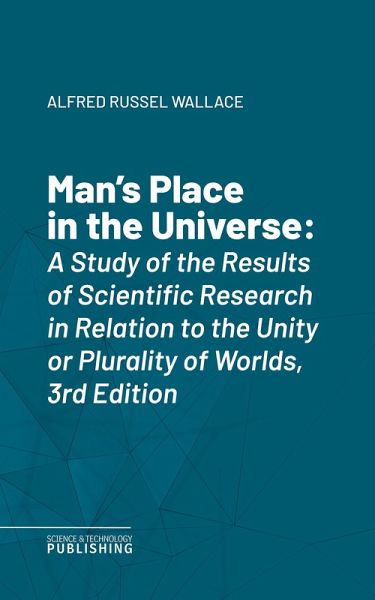
Man's Place in the Universe: A Study of the Results of Scientific Research in Relation to the Unity or Plurality of Worlds, 3rd Edition, by Alfred Russel Wallace, is a seminal work that explores one of humanity's oldest and most profound questions: Are we alone in the universe? First published in the early 20th century, this book delves into the scientific, philosophical, and astronomical evidence available at the time to examine the possibility of life beyond Earth. Wallace, renowned for his contributions to evolutionary theory, brings his analytical rigor to bear on the debate over the plurality of worlds, challenging prevailing assumptions and offering a detailed critique of the arguments for extraterrestrial life. In this comprehensive study, Wallace systematically reviews the latest astronomical discoveries, including the nature of the solar system, the physical conditions of the planets, and the structure of the universe. He scrutinizes the habitability of other planets, considering factors such as temperature, atmosphere, and the presence of water, and evaluates whether these worlds could support life as we know it. Wallace also addresses the philosophical implications of humanity's place in the cosmos, questioning the anthropocentric view and considering the broader significance of our existence. The third edition of Man's Place in the Universe incorporates updates and refinements based on new scientific findings, reflecting Wallace's commitment to accuracy and intellectual honesty. The book is notable for its clear, logical argumentation and its willingness to challenge popular beliefs, making it a landmark in the history of science writing. Wallace's thoughtful analysis not only provides a snapshot of early 20th-century scientific thought but also raises questions that remain relevant in contemporary discussions about life beyond Earth. Rich in historical context and scientific insight, Man's Place in the Universe is both a rigorous scientific treatise and a philosophical meditation on humanity's significance in the vast expanse of the cosmos. It invites readers to ponder the uniqueness of our planet and the profound mystery of our existence, making it an essential read for anyone interested in astronomy, philosophy, or the enduring question of whether we are alone in the universe.
Dieser Download kann aus rechtlichen Gründen nur mit Rechnungsadresse in A, B, BG, CY, CZ, D, DK, EW, E, FIN, F, GR, HR, H, IRL, I, LT, L, LR, M, NL, PL, P, R, S, SLO, SK ausgeliefert werden.