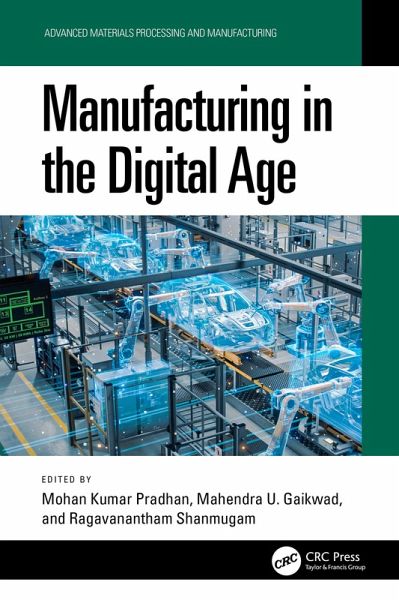
Manufacturing in the Digital Age (eBook, PDF)
Redaktion: Pradhan, Mohan Kumar; Shanmugam, Ragavanantham; Gaikwad, Mahendra U.

Alle Infos zum eBook verschenken
Manufacturing in the Digital Age (eBook, PDF)
Redaktion: Pradhan, Mohan Kumar; Shanmugam, Ragavanantham; Gaikwad, Mahendra U.
- Format: PDF
- Merkliste
- Auf die Merkliste
- Bewerten Bewerten
- Teilen
- Produkt teilen
- Produkterinnerung
- Produkterinnerung

Hier können Sie sich einloggen
Bitte loggen Sie sich zunächst in Ihr Kundenkonto ein oder registrieren Sie sich bei bücher.de, um das eBook-Abo tolino select nutzen zu können.
This book covers manufacturing in the current context of Industry 4.0 and the impending era of Industry 5.0 exploring the path established by the manufacturing sector including developments, constraints, difficulties, and solutions. The importance of sustainability in the manufacturing sector, particularly in the context of Industry 4.0, is the focus. The difficulties in implementing Industry 4.0 and Industry 5.0 and providing advice on how to get past these barriers are also discussed including sustainable methods and approaches to deal with environmental issues.
Covers robotics, IoT,…mehr
- Geräte: PC
- mit Kopierschutz
- eBook Hilfe
- Größe: 13.52MB
") Technological Challenges and Management (eBook, PDF)48,95 €
Technological Challenges and Management (eBook, PDF)48,95 €") Soft Computing Applications and Techniques in Healthcare (eBook, PDF)51,95 €
Soft Computing Applications and Techniques in Healthcare (eBook, PDF)51,95 €") Polinpapilinho F. KatinaBlockchain-Enabled Resilience (eBook, PDF)45,95 €
Polinpapilinho F. KatinaBlockchain-Enabled Resilience (eBook, PDF)45,95 €") Data Protection and Privacy in Healthcare (eBook, PDF)57,95 €
Data Protection and Privacy in Healthcare (eBook, PDF)57,95 €") Brahim RekiekAirport Baggage Handling Systems (eBook, PDF)47,95 €
Brahim RekiekAirport Baggage Handling Systems (eBook, PDF)47,95 €") Adedeji B. BadiruSystems Engineering Using the DEJI Systems Model® (eBook, PDF)44,95 €
Adedeji B. BadiruSystems Engineering Using the DEJI Systems Model® (eBook, PDF)44,95 €") Enabling Technologies for the Successful Deployment of Industry 4.0 (eBook, PDF)48,95 €
Enabling Technologies for the Successful Deployment of Industry 4.0 (eBook, PDF)48,95 €-
-
-


- Covers robotics, IoT, additive manufacturing, sustainability, and machine learning for productivity and quality in digital age manufacturing
- Includes case studies based on real world aspects and research and innovations in the field of digitalization and optimization of manufacturing
- Covers sustainability interventions in the digital age manufacturing
- Explains product design and development in the era of Industry 4.0 and 5.0
- Reviews data management and policy-based aspects
This book is aimed at researchers and graduate students in mechanical, industrial, and production engineering.
Dieser Download kann aus rechtlichen Gründen nur mit Rechnungsadresse in A, B, BG, CY, CZ, D, DK, EW, E, FIN, F, GR, HR, H, IRL, I, LT, L, LR, M, NL, PL, P, R, S, SLO, SK ausgeliefert werden.
- Produktdetails
- Verlag: Taylor & Francis eBooks
- Seitenzahl: 258
- Erscheinungstermin: 27. November 2025
- Englisch
- ISBN-13: 9781040600405
- Artikelnr.: 75686347
- Verlag: Taylor & Francis eBooks
- Seitenzahl: 258
- Erscheinungstermin: 27. November 2025
- Englisch
- ISBN-13: 9781040600405
- Artikelnr.: 75686347
- Herstellerkennzeichnung Die Herstellerinformationen sind derzeit nicht verfügbar.
Foreword, Chapter 1 Introduction to Manufacturing in the Digital Age 1.1
The Order from First Production to the Industrial Revolution 1.1.1
Definition and History of Manufacturing 1.1.2 Traditional Manufacturing
Processes 1.1.3 Challenges and Limitations of Traditional Manufacturing 1.2
Revolutionizing Manufacturing with Digital Transformation 1.2.1 Definition
of Digital Manufacturing 1.2.2 Key Factors of Digital Transformation in
Manufacturing 1.2.3 The Role of Industry 4.0 1.3 Key Technologies in
Digital Manufacturing 1.3.1 IoT 1.3.2 Big Data and Analytics 1.3.3 AI and
ML 1.3.4 Robotics and Automation 1.3.5 Additive Manufacturing (3D Printing)
1.3.6 Digital Twins 1.3.7 Cloud Computing 1.3.8 Cybersecurity 1.4 Impact of
Digital Manufacturing 1.4.1 On Product Development 1.4.2 On Supply Chain
Management 1.4.3 On Workforce 1.5 Case Studies and Real-World Examples
1.5.1 Success Stories from Leading Manufacturers 1.5.2 Challenges Faced and
Overcome 1.5.3 Lessons Drawn and Leading Practices 1.6 Benefits of Digital
Manufacturing 1.6.1 Increased Efficiency and Productivity 1.6.2 Cost
Reduction 1.6.3 Improved Quality and Consistency 1.6.4 Enhanced Flexibility
and Agility 1.7 Challenges and Barriers to Adoption 1.7.1 Technical
Challenges 1.7.2 Cost and Investment Considerations 1.7.3 Workforce
Resistance and Cultural Change 1.7.4 Data Privacy and Security Concerns 1.8
Future Trends in Digital Manufacturing 1.8.1 Emerging Technologies 1.8.2
Predictions for the Next Decade 1.8.3 The Role of Sustainability and Green
Manufacturing 1.9 Conclusion Chapter 2 Advancements in Industry 4.0 and
Introduction to Industry 5.0 2.1 Introduction 2.1.1 Overview of the
Industrial Revolutions 2.1.2 Introduction to I4o and I5o 2.1.3 Chapter
Objectives 2.2 Core Technologies of I4o 2.2.1 IoT 2.2.2 AI and ML 2.2.3 CPS
2.2.4 Big Data Analytics 2.2.5 Robotics and Automation 2.3 Applications and
Implications of I4o 2.3.1 Smart Factories 2.3.2 SCM 2.3.3 Predictive
Maintenance and AI in Manufacturing 2.3.4 Digital Twins 2.4 I5o: A
Human-Centric Approach 2.4.1 From Automation to Augmentation 2.4.2 Ethical
and Value-Oriented Technology in I5o 2.4.3 Resilience and Sustainability
2.4.4 Customization and Personalization 2.5 Key Technologies Enabling I5o
2.5.1 Advanced AI and Robotics 2.5.2 CPS in I5o 2.5.3 Metaverse and Virtual
Collaboration Tools 2.6 Transitioning from I4o to I5o 2.6.1 Evolutionary
Path 2.6.2 Overcoming Challenges in the Transition 2.6.3 Collaborative
Ecosystem 2.7 Case Studies and Practical Insights 2.7.1 Smart Factories in
Action 2.7.2 Personalized Manufacturing 2.8 Conclusion 2.8.1 Summary of Key
Innovations Driving I4o and I5o 2.8.2 Outlook on Future Developments in I5o
Chapter 3 Product Design and Development in the Digital Era 3.1
Introduction 3.2 Digital Design and Prototyping 3.2.1 Computer-Aided Design
(CAD) 3.2.2 Virtual Reality (VR) and Augmented Reality (AR) 3.3
Collaborative Design and Development 3.3.1 Cloud-Based Collaboration 3.3.2
Integrated Design and Development Tools 3.3.3 Communication and Messaging
Platforms 3.3.4 Project Management and Collaboration Tools 3.3.5 User
Testing and Feedback 3.3.6 Security and Access Controls 3.4 Data-Driven
Decision-Making 3.4.1 User Behavior Analysis 3.4.2 Performance Analytics
3.4.3 Iterative Design and Development 3.4.4 Predictive Analytics 3.4.5
Cost-Benefit Analysis 3.4.6 Security Analytics 3.5 Sustainability and
Efficiency 3.5.1 Green Software Engineering 3.5.2 Renewable Energy in Data
Centers 3.5.3 Life Cycle Assessment (LCA) for Digital Products 3.5.4 Agile
and DevOps for Efficiency 3.5.5 Automation and Efficiency 3.5.6 User
Experience (UX) and Performance Optimization 3.5.7 Remote Collaboration and
Sustainable Work Practices 3.5.8 Resource Efficiency in Cloud Computing 3.6
Challenges 3.6.1 Data Privacy and Security 3.6.2 Rapid Technological
Changes 3.6.3 User Experience (UX) Design Challenges 3.6.4 Artificial
Intelligence (AI) Integration Challenges 3.6.5 Positive and Negative Social
Effects 3.6.6 Skill Gaps 3.6.7 Reluctance to Change 3.7 Case Studies 3.7.1
Digital Transformation at Siemens 3.7.2 Nike's Digital Innovation 3.7.3
Ford's Electrification Strategy 3.7.4 Adobe's Creative Cloud 3.7.5
Samsung's Product Innovation 3.7.6 Nike+ 3.7.7 Starbucks' Mobile App 3.7.8
Peloton Interactive Fitness 3.7.9 HelloFresh Meal Kits 3.7.10 Netflix 3.8
Future Trends 3.8.1 Human-Centered and Inclusive Design 3.8.2 Customization
and Personalization 3.8.3 Digital Twins 3.8.4 IoT Integration 3.8.5 AR and
VR in Product Prototyping 3.8.6 Robotics and Automation 3.8.7 Biometric
Integration 3.8.8 Edge Computing in Product Functionality 3.8.9 Voice User
Interfaces (VUI) 3.8.10 Blockchain for Supply Chain Transparency 3.8.11
Emphasis on Emotional Design 3.9 Conclusions Chapter 4 Internet of Things
(IoT) in Smart Manufacturing 4.1 Introduction 4.1.1 Manufacturing 4.1.2 IoT
4.2 Application of IOT 4.2.1 Enhanced Operational Efficiency 4.2.2
Predictive Maintenance 4.2.3 Quality Improvement 4.2.4 Supply Chain
Optimization 4.2.5 Energy Efficiency 4.2.6 Customization and Flexibility
4.2.7 Innovation and Competitive Advantage 4.2.8 Data Integration and
Analytics 4.3 Digitalization of Manufacturing Processes Relies Heavily on
Internet of Things (IoT) 4.4 To Enable Real-Time Data Collection 4.5
Predictive Maintenance 4.6 Improved Supply Chain Management 4.7 Industry
4.0 and Industry 5.0 are Integrating IoT 4.8 Sensor 4.9 Devices 4.10
Networks 4.11 Conclusion Chapter 5 Sustainable Manufacturing Practices in
the Digital Age 5.1 Introduction 5.1.1 Sustainable Manufacturing in a
Digital Context 5.2 Function of Additive Manufacturing in the Digital Era
of Sustainable Manufacturing 5.3 Challenges to Implementing Sustainable
Manufacturing Practices in the Digital Age 5.4 Innovation and Technology
for Sustainability 5.5 New Developments in Digital Sustainability Trends
5.5.1 Green AI. 5.5.2 Bio-Manufacturing 5.5.3 Edge Computing 5.5.4
Decentralized Energy Grids 5.6 The Digital Transformation of Sustainability
5.6.1 Smart Factories: A Step Toward Zero Waste 5.7 The Benefits of
Sustainable Manufacturing Practices in Digital Ages 5.8 Smart
Manufacturing: The Path to Sustainability 5.9 The Future of Sustainable
Manufacturing in the Digital Age 5.10 Conclusion Chapter 6 Challenges and
Solutions of Industry 4.0 to Industry 5.0 6.1 Introduction to Industry 4.0
6.2 Challenges and Solutions in Adopting Industry 4.0 6.3 Datasets 6.4
Challenges and Solutions in Adopting Industry 5.0 6.5 Conclusions Chapter 7
Sustainable Industrial Transformation: Exploring Industry 4.0 and 5.0 7.1
Introduction 7.2 Evolution of Industrial Revolutions 7.3 Challenges of
Industry 4.0 7.4 A Strategic Method to Meet the Obstacles 7.5 Industry 5.0:
A Strategic Solution 7.6 Technological Advancements in Industry 4.0 and 5.0
7.7 Future Research Directions 7.8 Conclusion Chapter 8 Artificial Neural
Networks with Training Algorithms for Prediction of Surface Roughness in
Electrical Discharge Machining 8.1 Introduction 8.1.1 Research Novelty 8.2
Experiments and Methods 8.2.1 Experimental Set Up 8.2.2 Design of
Experiment 8.2.3 Surface Roughness 8.2.4 Artificial Neural Networks 8.2.5
ANN Training Algorithms 8.2.6 Levenberg-Marquardt Algorithm 8.2.7 Conjugate
Gradient Algorithm 8.2.8 Resilient-Backpropagation Algorithm 8.2.9
Evaluation Criteria 8.3 Results and Discussion 8.4 Conclusions Chapter 9
Effect of Performance Measures on Lean Manufacturing System Considering
Industry 4.0 9.1 Introduction 9.2 Lean Manufacturing System: An Overview
9.2.1 Machine-Level Configurations 9.2.2 System Base Configurations 9.3
Process 9.4 Changeover Time 9.5 Conclusion and Future Scope Chapter 10
Human-Machine Harmony in the Production Sector: How Automation is
Transforming Manufacturing 10.1 Introduction 10.2 Fixed Automation 10.2.1
Definition and Characteristics of Fixed Automation 10.2.2 Examples of Fixed
Automation 10.2.3 Advantages of Fixed Automation 10.2.4 Limitations of
Fixed Automation 10.3 Fluid Automation 10.3.1 Concept and Definition 10.3.2
Key Components of Fluid Automation 10.3.3 Applications of Fluid Automation
10.3.4 Advantages and Challenges of Fluid Automation 10.4 Human-Machine
Collaboration 10.4.1 Role of Automation in Repetitive and Advanced Tasks
10.4.2 Workforce Skill Requirements 10.4.3 Designing Workplaces for Safety
and Collaboration 10.5 Industry 4.0 Integration 10.5.1 Industry 4.0 Vision
and Goals 10.5.2 Importance of Interoperability 10.5.3 Real-Time
Information Sharing and Adaptability 10.6 Conclusion 10.6.1 Synergy between
Humans and Machines 10.6.2 Fluid Automation as a Path to Flexibility 10.6.3
Future Manufacturing Outlook Chapter 11 Efficient Automation Solution for
Invoice Data Extraction and Compilation: A Streamlined Approach for
Enhanced Productivity 11.1 Introduction 11.2 Introduction to Robotic
Process Automation (RPA) and its Advantages 11.3 Purpose and Significance
of the Study 11.4 Methodology 11.4.1 Overview of Selected RPA Tools (e.g.,
UiPath, Automation Anywhere) 11.4.2 Step-By-Step Explanation of the
Automation Process 11.4.3 Handling Failed Extractions 11.5 Implementation
Steps 11.6 Results and Discussion 11.6.1 Performance Metrics (Accuracy,
Time Savings) 11.6.2 Sample Outputs (e.g., Processed Invoices, Excel Data)
11.6.3 Comparative Analysis with Manual Processing Methods 11.7 Benefits of
Automation 11.8 Challenges and Limitations of Automation Systems 11.9
Challenges in Manufacturing Environments 11.10 Solutions Tailored to
Manufacturing 11.11 Conclusion Chapter 12 Modernizing and Streamlining
Vendor Records Using Robotics Process Automation for Uplifting Business
12.1 Introduction 12.1.1 Basics of Robotics Process Automation (RPA) 12.1.2
How it Works 12.1.3 Importance of RPA 12.2 Literature Review 12.2.1
Presence of RPA 12.2.2 History 12.2.3 Features and Main Characteristics
12.2.4 Types of RPA 12.2.5 Artificial Intelligence and RPA 12.3 Use Case
Example 12.3.1 Current Process Followed in the Chudekar Agro Pvt. Ltd.
Company 12.3.2 Future Changes Can be Done Using RPA 12.4 Advantages of RPA
12.5 Disadvantages Rather Challenges of RPA 12.6 Current RPA Providers 12.7
The RPA Market's Future is Fueled by Hyper Automation 12.8 Conclusion
References. Index.
Foreword, Chapter 1 Introduction to Manufacturing in the Digital Age 1.1
The Order from First Production to the Industrial Revolution 1.1.1
Definition and History of Manufacturing 1.1.2 Traditional Manufacturing
Processes 1.1.3 Challenges and Limitations of Traditional Manufacturing 1.2
Revolutionizing Manufacturing with Digital Transformation 1.2.1 Definition
of Digital Manufacturing 1.2.2 Key Factors of Digital Transformation in
Manufacturing 1.2.3 The Role of Industry 4.0 1.3 Key Technologies in
Digital Manufacturing 1.3.1 IoT 1.3.2 Big Data and Analytics 1.3.3 AI and
ML 1.3.4 Robotics and Automation 1.3.5 Additive Manufacturing (3D Printing)
1.3.6 Digital Twins 1.3.7 Cloud Computing 1.3.8 Cybersecurity 1.4 Impact of
Digital Manufacturing 1.4.1 On Product Development 1.4.2 On Supply Chain
Management 1.4.3 On Workforce 1.5 Case Studies and Real-World Examples
1.5.1 Success Stories from Leading Manufacturers 1.5.2 Challenges Faced and
Overcome 1.5.3 Lessons Drawn and Leading Practices 1.6 Benefits of Digital
Manufacturing 1.6.1 Increased Efficiency and Productivity 1.6.2 Cost
Reduction 1.6.3 Improved Quality and Consistency 1.6.4 Enhanced Flexibility
and Agility 1.7 Challenges and Barriers to Adoption 1.7.1 Technical
Challenges 1.7.2 Cost and Investment Considerations 1.7.3 Workforce
Resistance and Cultural Change 1.7.4 Data Privacy and Security Concerns 1.8
Future Trends in Digital Manufacturing 1.8.1 Emerging Technologies 1.8.2
Predictions for the Next Decade 1.8.3 The Role of Sustainability and Green
Manufacturing 1.9 Conclusion Chapter 2 Advancements in Industry 4.0 and
Introduction to Industry 5.0 2.1 Introduction 2.1.1 Overview of the
Industrial Revolutions 2.1.2 Introduction to I4o and I5o 2.1.3 Chapter
Objectives 2.2 Core Technologies of I4o 2.2.1 IoT 2.2.2 AI and ML 2.2.3 CPS
2.2.4 Big Data Analytics 2.2.5 Robotics and Automation 2.3 Applications and
Implications of I4o 2.3.1 Smart Factories 2.3.2 SCM 2.3.3 Predictive
Maintenance and AI in Manufacturing 2.3.4 Digital Twins 2.4 I5o: A
Human-Centric Approach 2.4.1 From Automation to Augmentation 2.4.2 Ethical
and Value-Oriented Technology in I5o 2.4.3 Resilience and Sustainability
2.4.4 Customization and Personalization 2.5 Key Technologies Enabling I5o
2.5.1 Advanced AI and Robotics 2.5.2 CPS in I5o 2.5.3 Metaverse and Virtual
Collaboration Tools 2.6 Transitioning from I4o to I5o 2.6.1 Evolutionary
Path 2.6.2 Overcoming Challenges in the Transition 2.6.3 Collaborative
Ecosystem 2.7 Case Studies and Practical Insights 2.7.1 Smart Factories in
Action 2.7.2 Personalized Manufacturing 2.8 Conclusion 2.8.1 Summary of Key
Innovations Driving I4o and I5o 2.8.2 Outlook on Future Developments in I5o
Chapter 3 Product Design and Development in the Digital Era 3.1
Introduction 3.2 Digital Design and Prototyping 3.2.1 Computer-Aided Design
(CAD) 3.2.2 Virtual Reality (VR) and Augmented Reality (AR) 3.3
Collaborative Design and Development 3.3.1 Cloud-Based Collaboration 3.3.2
Integrated Design and Development Tools 3.3.3 Communication and Messaging
Platforms 3.3.4 Project Management and Collaboration Tools 3.3.5 User
Testing and Feedback 3.3.6 Security and Access Controls 3.4 Data-Driven
Decision-Making 3.4.1 User Behavior Analysis 3.4.2 Performance Analytics
3.4.3 Iterative Design and Development 3.4.4 Predictive Analytics 3.4.5
Cost-Benefit Analysis 3.4.6 Security Analytics 3.5 Sustainability and
Efficiency 3.5.1 Green Software Engineering 3.5.2 Renewable Energy in Data
Centers 3.5.3 Life Cycle Assessment (LCA) for Digital Products 3.5.4 Agile
and DevOps for Efficiency 3.5.5 Automation and Efficiency 3.5.6 User
Experience (UX) and Performance Optimization 3.5.7 Remote Collaboration and
Sustainable Work Practices 3.5.8 Resource Efficiency in Cloud Computing 3.6
Challenges 3.6.1 Data Privacy and Security 3.6.2 Rapid Technological
Changes 3.6.3 User Experience (UX) Design Challenges 3.6.4 Artificial
Intelligence (AI) Integration Challenges 3.6.5 Positive and Negative Social
Effects 3.6.6 Skill Gaps 3.6.7 Reluctance to Change 3.7 Case Studies 3.7.1
Digital Transformation at Siemens 3.7.2 Nike's Digital Innovation 3.7.3
Ford's Electrification Strategy 3.7.4 Adobe's Creative Cloud 3.7.5
Samsung's Product Innovation 3.7.6 Nike+ 3.7.7 Starbucks' Mobile App 3.7.8
Peloton Interactive Fitness 3.7.9 HelloFresh Meal Kits 3.7.10 Netflix 3.8
Future Trends 3.8.1 Human-Centered and Inclusive Design 3.8.2 Customization
and Personalization 3.8.3 Digital Twins 3.8.4 IoT Integration 3.8.5 AR and
VR in Product Prototyping 3.8.6 Robotics and Automation 3.8.7 Biometric
Integration 3.8.8 Edge Computing in Product Functionality 3.8.9 Voice User
Interfaces (VUI) 3.8.10 Blockchain for Supply Chain Transparency 3.8.11
Emphasis on Emotional Design 3.9 Conclusions Chapter 4 Internet of Things
(IoT) in Smart Manufacturing 4.1 Introduction 4.1.1 Manufacturing 4.1.2 IoT
4.2 Application of IOT 4.2.1 Enhanced Operational Efficiency 4.2.2
Predictive Maintenance 4.2.3 Quality Improvement 4.2.4 Supply Chain
Optimization 4.2.5 Energy Efficiency 4.2.6 Customization and Flexibility
4.2.7 Innovation and Competitive Advantage 4.2.8 Data Integration and
Analytics 4.3 Digitalization of Manufacturing Processes Relies Heavily on
Internet of Things (IoT) 4.4 To Enable Real-Time Data Collection 4.5
Predictive Maintenance 4.6 Improved Supply Chain Management 4.7 Industry
4.0 and Industry 5.0 are Integrating IoT 4.8 Sensor 4.9 Devices 4.10
Networks 4.11 Conclusion Chapter 5 Sustainable Manufacturing Practices in
the Digital Age 5.1 Introduction 5.1.1 Sustainable Manufacturing in a
Digital Context 5.2 Function of Additive Manufacturing in the Digital Era
of Sustainable Manufacturing 5.3 Challenges to Implementing Sustainable
Manufacturing Practices in the Digital Age 5.4 Innovation and Technology
for Sustainability 5.5 New Developments in Digital Sustainability Trends
5.5.1 Green AI. 5.5.2 Bio-Manufacturing 5.5.3 Edge Computing 5.5.4
Decentralized Energy Grids 5.6 The Digital Transformation of Sustainability
5.6.1 Smart Factories: A Step Toward Zero Waste 5.7 The Benefits of
Sustainable Manufacturing Practices in Digital Ages 5.8 Smart
Manufacturing: The Path to Sustainability 5.9 The Future of Sustainable
Manufacturing in the Digital Age 5.10 Conclusion Chapter 6 Challenges and
Solutions of Industry 4.0 to Industry 5.0 6.1 Introduction to Industry 4.0
6.2 Challenges and Solutions in Adopting Industry 4.0 6.3 Datasets 6.4
Challenges and Solutions in Adopting Industry 5.0 6.5 Conclusions Chapter 7
Sustainable Industrial Transformation: Exploring Industry 4.0 and 5.0 7.1
Introduction 7.2 Evolution of Industrial Revolutions 7.3 Challenges of
Industry 4.0 7.4 A Strategic Method to Meet the Obstacles 7.5 Industry 5.0:
A Strategic Solution 7.6 Technological Advancements in Industry 4.0 and 5.0
7.7 Future Research Directions 7.8 Conclusion Chapter 8 Artificial Neural
Networks with Training Algorithms for Prediction of Surface Roughness in
Electrical Discharge Machining 8.1 Introduction 8.1.1 Research Novelty 8.2
Experiments and Methods 8.2.1 Experimental Set Up 8.2.2 Design of
Experiment 8.2.3 Surface Roughness 8.2.4 Artificial Neural Networks 8.2.5
ANN Training Algorithms 8.2.6 Levenberg-Marquardt Algorithm 8.2.7 Conjugate
Gradient Algorithm 8.2.8 Resilient-Backpropagation Algorithm 8.2.9
Evaluation Criteria 8.3 Results and Discussion 8.4 Conclusions Chapter 9
Effect of Performance Measures on Lean Manufacturing System Considering
Industry 4.0 9.1 Introduction 9.2 Lean Manufacturing System: An Overview
9.2.1 Machine-Level Configurations 9.2.2 System Base Configurations 9.3
Process 9.4 Changeover Time 9.5 Conclusion and Future Scope Chapter 10
Human-Machine Harmony in the Production Sector: How Automation is
Transforming Manufacturing 10.1 Introduction 10.2 Fixed Automation 10.2.1
Definition and Characteristics of Fixed Automation 10.2.2 Examples of Fixed
Automation 10.2.3 Advantages of Fixed Automation 10.2.4 Limitations of
Fixed Automation 10.3 Fluid Automation 10.3.1 Concept and Definition 10.3.2
Key Components of Fluid Automation 10.3.3 Applications of Fluid Automation
10.3.4 Advantages and Challenges of Fluid Automation 10.4 Human-Machine
Collaboration 10.4.1 Role of Automation in Repetitive and Advanced Tasks
10.4.2 Workforce Skill Requirements 10.4.3 Designing Workplaces for Safety
and Collaboration 10.5 Industry 4.0 Integration 10.5.1 Industry 4.0 Vision
and Goals 10.5.2 Importance of Interoperability 10.5.3 Real-Time
Information Sharing and Adaptability 10.6 Conclusion 10.6.1 Synergy between
Humans and Machines 10.6.2 Fluid Automation as a Path to Flexibility 10.6.3
Future Manufacturing Outlook Chapter 11 Efficient Automation Solution for
Invoice Data Extraction and Compilation: A Streamlined Approach for
Enhanced Productivity 11.1 Introduction 11.2 Introduction to Robotic
Process Automation (RPA) and its Advantages 11.3 Purpose and Significance
of the Study 11.4 Methodology 11.4.1 Overview of Selected RPA Tools (e.g.,
UiPath, Automation Anywhere) 11.4.2 Step-By-Step Explanation of the
Automation Process 11.4.3 Handling Failed Extractions 11.5 Implementation
Steps 11.6 Results and Discussion 11.6.1 Performance Metrics (Accuracy,
Time Savings) 11.6.2 Sample Outputs (e.g., Processed Invoices, Excel Data)
11.6.3 Comparative Analysis with Manual Processing Methods 11.7 Benefits of
Automation 11.8 Challenges and Limitations of Automation Systems 11.9
Challenges in Manufacturing Environments 11.10 Solutions Tailored to
Manufacturing 11.11 Conclusion Chapter 12 Modernizing and Streamlining
Vendor Records Using Robotics Process Automation for Uplifting Business
12.1 Introduction 12.1.1 Basics of Robotics Process Automation (RPA) 12.1.2
How it Works 12.1.3 Importance of RPA 12.2 Literature Review 12.2.1
Presence of RPA 12.2.2 History 12.2.3 Features and Main Characteristics
12.2.4 Types of RPA 12.2.5 Artificial Intelligence and RPA 12.3 Use Case
Example 12.3.1 Current Process Followed in the Chudekar Agro Pvt. Ltd.
Company 12.3.2 Future Changes Can be Done Using RPA 12.4 Advantages of RPA
12.5 Disadvantages Rather Challenges of RPA 12.6 Current RPA Providers 12.7
The RPA Market's Future is Fueled by Hyper Automation 12.8 Conclusion
References. Index.