17,79 €
inkl. MwSt.
Sofort per Download lieferbar
0 °P sammeln

Andere Kunden interessierten sich auch für
") Alpha God (eBook, ePUB)15,81 €
Alpha God (eBook, ePUB)15,81 €") Evolutionary Psychology (eBook, ePUB)74,95 €
Evolutionary Psychology (eBook, ePUB)74,95 €") Missing the Revolution (eBook, ePUB)28,95 €
Missing the Revolution (eBook, ePUB)28,95 €") The Aesthetic Animal (eBook, ePUB)9,95 €
The Aesthetic Animal (eBook, ePUB)9,95 €") Evolutionary Social Psychology (eBook, ePUB)39,95 €
Evolutionary Social Psychology (eBook, ePUB)39,95 €") Current Topics in Animal Learning (eBook, ePUB)49,95 €
Current Topics in Animal Learning (eBook, ePUB)49,95 €") Socio-Analytic Dialogue (eBook, ePUB)82,95 €
Socio-Analytic Dialogue (eBook, ePUB)82,95 €





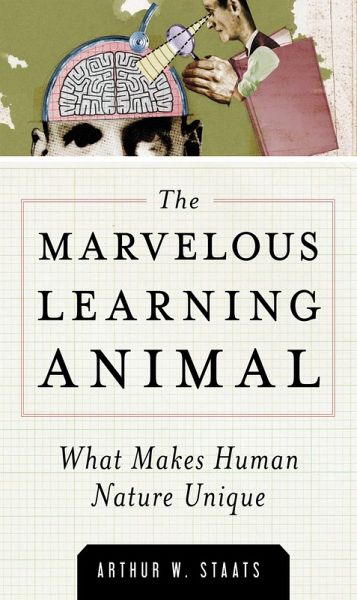
What makes us human? In recent decades, researchers have focused on innate tendencies and inherited traits as explanations for human behavior, especially in light of groundbreaking human genome research. The author thinks this trend is misleading. As he shows in great detail in this engaging, thought-provoking, and highly informative book, what makes our species unique is our marvelous ability to learn, which is an ability that no other primate possesses. In his exploration of human progress, the author reveals that the immensity of human learning has not been fully understood or examined. Evolution has endowed us with extremely versatile bodies and a brain comprised of one hundred billion neurons, which makes us especially suited for a wide range of sophisticated learning. Already in childhood, human beings begin learning complex repertoires-language, sports, value systems, music, science, rules of behavior, and many other aspects of culture. These repertoires build on one another in special ways, and our brains develop in response to the learning experiences we receive from those around us and from what we read and hear and see. When humans gather in society, the cumulative effect of building learning upon learning is enormous. The author presents a new way of understanding humanness-in the behavioral nature of the human body, in the unique human way of learning, in child development, in personality, and in abnormal behavior. With all this, and his years of basic and applied research, he develops a new theory of human evolution and a new vision of the human being. This book offers up a unified concept that not only provides new ways of understanding human behavior and solving human problems but also lays the foundations for opening new areas of science.
Dieser Download kann aus rechtlichen Gründen nur mit Rechnungsadresse in A, B, BG, CY, CZ, D, DK, EW, E, FIN, F, GR, HR, H, I, LT, L, LR, M, NL, PL, P, R, S, SLO, SK ausgeliefert werden.