27,95 €
27,95 €
inkl. MwSt.
Sofort per Download lieferbar

14 °P sammeln
27,95 €
Als Download kaufen
27,95 €
inkl. MwSt.
Sofort per Download lieferbar
14 °P sammeln
Jetzt verschenken
Alle Infos zum eBook verschenken
27,95 €
inkl. MwSt.
Sofort per Download lieferbar
Alle Infos zum eBook verschenken
14 °P sammeln

Andere Kunden interessierten sich auch für
") Political Parties and the State in Post-Communist Europe (eBook, PDF)33,95 €
Political Parties and the State in Post-Communist Europe (eBook, PDF)33,95 €") Post-Communist and Post-Soviet Parliaments (eBook, PDF)45,95 €
Post-Communist and Post-Soviet Parliaments (eBook, PDF)45,95 €") Rethinking Punishment in the Era of Mass Incarceration (eBook, PDF)42,95 €
Rethinking Punishment in the Era of Mass Incarceration (eBook, PDF)42,95 €") Arts of Subjectivity: A New Animism for the Post-Media Era (eBook, PDF)26,95 €
Arts of Subjectivity: A New Animism for the Post-Media Era (eBook, PDF)26,95 €") Post-Truth, Philosophy and Law (eBook, PDF)41,95 €
Post-Truth, Philosophy and Law (eBook, PDF)41,95 €") Religion in the Era of Postsecularism (eBook, PDF)43,95 €
Religion in the Era of Postsecularism (eBook, PDF)43,95 €") Voting Rights in the Era of Globalization (eBook, PDF)45,95 €
Voting Rights in the Era of Globalization (eBook, PDF)45,95 €
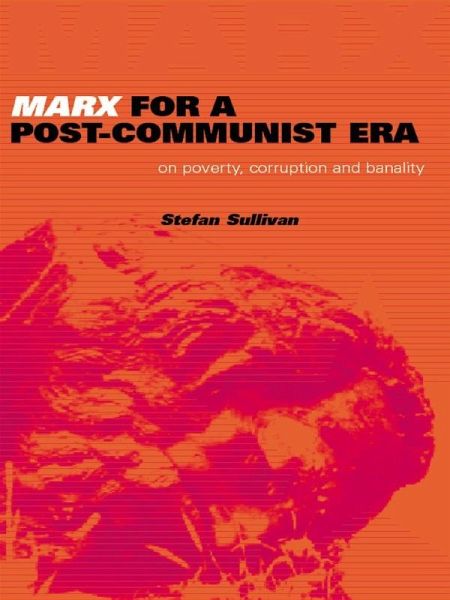
Was Marxism a variety of German Idealist self-actualization in economic form? A deeply flawed blueprint for social engineering? A catechism for post-colonial insurgencies? the intellectual foundations of modern social democracy? In this wide ranging summation, Sullivan tackles the multi-tentacled reach of Marx's legacy, and explores both the limits and the lasting significance of his ideas.
Structured around three obstacles to freedom - poverty, corruption and banality - the work engages both Marx and his critics in addressing unresolved issues of the current social and political order. As such, the work, after two introductory chapters, leaves behind Marxology and its familiar cast of characters (Bernstein, Kautsky, Adorno, Lukacs, Fanon, Horkheimer, Marcuse, etc.) to address both neo-Marxist and non-Marxist interpretations of these obstacles. These include growth-led poverty alleviation, human capital theory, current debates on rent-seeking and public choice theory, weaknesses in Frankfurt School approaches to mass culture, and emerging trends in cyberspace and leisure consumption.
Marx for a Post-Communist Era is credited as a foundational theoretical source in a wide range of contemporary studies. Some examples include a government-sponsored anti-corruption report in Peru, a study of neoliberalism and education reform in the UK, and an urban planning essay on museum spaces and the public good.
Structured around three obstacles to freedom - poverty, corruption and banality - the work engages both Marx and his critics in addressing unresolved issues of the current social and political order. As such, the work, after two introductory chapters, leaves behind Marxology and its familiar cast of characters (Bernstein, Kautsky, Adorno, Lukacs, Fanon, Horkheimer, Marcuse, etc.) to address both neo-Marxist and non-Marxist interpretations of these obstacles. These include growth-led poverty alleviation, human capital theory, current debates on rent-seeking and public choice theory, weaknesses in Frankfurt School approaches to mass culture, and emerging trends in cyberspace and leisure consumption.
Marx for a Post-Communist Era is credited as a foundational theoretical source in a wide range of contemporary studies. Some examples include a government-sponsored anti-corruption report in Peru, a study of neoliberalism and education reform in the UK, and an urban planning essay on museum spaces and the public good.
Dieser Download kann aus rechtlichen Gründen nur mit Rechnungsadresse in A, B, BG, CY, CZ, D, DK, EW, E, FIN, F, GR, HR, H, IRL, I, LT, L, LR, M, NL, PL, P, R, S, SLO, SK ausgeliefert werden.