65,95 €
65,95 €
inkl. MwSt.
Sofort per Download lieferbar

33 °P sammeln
65,95 €
Als Download kaufen
65,95 €
inkl. MwSt.
Sofort per Download lieferbar
33 °P sammeln
Jetzt verschenken
Alle Infos zum eBook verschenken
65,95 €
inkl. MwSt.
Sofort per Download lieferbar
Alle Infos zum eBook verschenken
33 °P sammeln

Andere Kunden interessierten sich auch für
") Politics, Ontology and Knowledge in Spinoza (eBook, PDF)0,00 €
Politics, Ontology and Knowledge in Spinoza (eBook, PDF)0,00 €") Spinoza's Paradoxical Conservatism (eBook, PDF)69,95 €
Spinoza's Paradoxical Conservatism (eBook, PDF)69,95 €") Time, Duration and Eternity in Spinoza (eBook, PDF)65,95 €
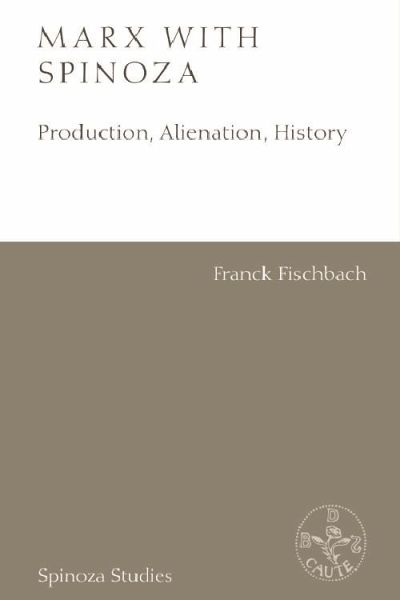
Time, Duration and Eternity in Spinoza (eBook, PDF)65,95 €") Marx with Spinoza (eBook, ePUB)65,95 €
Marx with Spinoza (eBook, ePUB)65,95 €") Democratic Thought from Machiavelli to Spinoza (eBook, PDF)76,95 €
Democratic Thought from Machiavelli to Spinoza (eBook, PDF)76,95 €") Spinoza-Machiavelli Encounter (eBook, PDF)0,00 €
Spinoza-Machiavelli Encounter (eBook, PDF)0,00 €") Spinoza, the Transindividual (eBook, PDF)0,00 €
Spinoza, the Transindividual (eBook, PDF)0,00 €


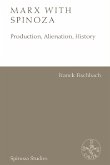

A provocative study of the intersection of Spinoza and Marx that shows how their respective philosophies engage overlapping questions and problems
- Offers the first translation of Fischbach's work, and the most important book published in France on Spinoza and Marx, into English
- Pairs these philosophers of production who are both critical philosophers of subjectivity
- Presents a major study of the points of intersection in the thought of Spinoza and Marx
- Develops original approaches to concepts such as alienation, history, and nature
Spinoza and Marx would seem to be two very opposed philosophers. Spinoza was interested in contemplating eternal truths of nature while Marx was interested in the history of capital.
Franck Fischbach suggests that by reading the two together we may better understand both history and nature, as well as ourselves, making possible a new understanding of human nature. Rather than see history and nature as opposed, history is nothing but the constant transformation of nature.
Central to this transformation is a new understanding of alienation not as loss of the self in a world of objects, but as loss of objects in a world that disconnects us from nature and social relations, leaving us isolated as a subject. The isolated individual, the kingdom within a kingdom, as Spinoza put it, is not the condition of our liberation but the basis of our subjection.
Dieser Download kann aus rechtlichen Gründen nur mit Rechnungsadresse in A, B, BG, CY, CZ, D, DK, EW, E, FIN, F, GR, HR, H, IRL, I, LT, L, LR, M, NL, PL, P, R, S, SLO, SK ausgeliefert werden.