35,95 €
35,95 €
inkl. MwSt.
Sofort per Download lieferbar

18 °P sammeln
35,95 €
Als Download kaufen
35,95 €
inkl. MwSt.
Sofort per Download lieferbar
18 °P sammeln
Jetzt verschenken
Alle Infos zum eBook verschenken
35,95 €
inkl. MwSt.
Sofort per Download lieferbar
Alle Infos zum eBook verschenken
18 °P sammeln

Andere Kunden interessierten sich auch für
") Clinton Foreign Policy Reader (eBook, PDF)36,95 €
Clinton Foreign Policy Reader (eBook, PDF)36,95 €") Common Sense on Weapons of Mass Destruction (eBook, PDF)22,95 €
Common Sense on Weapons of Mass Destruction (eBook, PDF)22,95 €") Rice, Agriculture, and the Food Supply in Premodern Japan (eBook, PDF)47,95 €
Rice, Agriculture, and the Food Supply in Premodern Japan (eBook, PDF)47,95 €") The Years of Hunger: Soviet Agriculture, 1931-1933 (eBook, PDF)120,95 €
The Years of Hunger: Soviet Agriculture, 1931-1933 (eBook, PDF)120,95 €") Crude Britannia (eBook, PDF)91,95 €
Crude Britannia (eBook, PDF)91,95 €") Salt and the Colombian State (eBook, PDF)40,95 €
Salt and the Colombian State (eBook, PDF)40,95 €") Legacies of Dust (eBook, PDF)63,95 €
Legacies of Dust (eBook, PDF)63,95 €







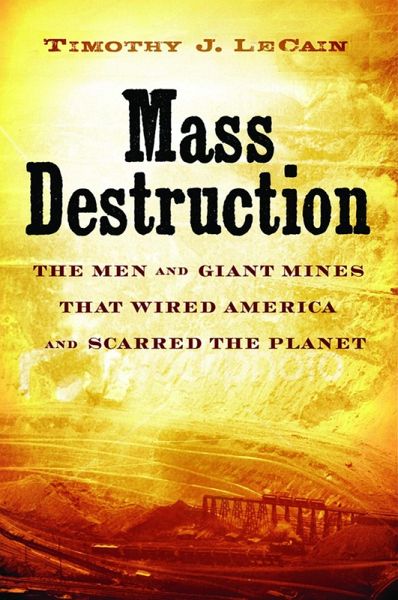
The place: The steep mountains outside Salt Lake City. The time: The first decade of the twentieth century. The man: Daniel Jackling, a young metallurgical engineer. The goal: A bold new technology that could provide billions of pounds of cheap copper for a rapidly electrifying America. The result: Bingham''s enormous "Glory Hole," the first large-scale open-pit copper mine, an enormous chasm in the earth and one of the largest humanmade artifacts on the planet. Mass Destruction is the compelling story of Jackling and the development of open-pit hard rock mining, its role in the wiring of an electrified America, as well its devastating environmental consequences.
Mass destruction mining soon spread around the nation and the globe, providing raw materials essential to the mass production and mass consumption that increasingly defined the emerging "American way of life." At the dawn of the last century, Jackling''s open pit replaced immense but constricted underground mines that probed nearly a mile beneath the earth, to become the ultimate symbol of the modern faith that science and technology could overcome all natural limits. A new culture of mass destruction emerged that promised nearly infinite supplies not only of copper, but also of coal, timber, fish, and other natural resources.
But, what were the consequences? Timothy J. LeCain deftly analyzes how open-pit mining continues to affect the environment in its ongoing devastation of nature and commodification of the physical world. The nation''s largest toxic Superfund site would be one effect, as well as other types of environmental dead zones around the globe. Yet today, as the world''s population races toward American levels of resource consumption, truly viable alternatives to the technology of mass destruction have not yet emerged.
Mass destruction mining soon spread around the nation and the globe, providing raw materials essential to the mass production and mass consumption that increasingly defined the emerging "American way of life." At the dawn of the last century, Jackling''s open pit replaced immense but constricted underground mines that probed nearly a mile beneath the earth, to become the ultimate symbol of the modern faith that science and technology could overcome all natural limits. A new culture of mass destruction emerged that promised nearly infinite supplies not only of copper, but also of coal, timber, fish, and other natural resources.
But, what were the consequences? Timothy J. LeCain deftly analyzes how open-pit mining continues to affect the environment in its ongoing devastation of nature and commodification of the physical world. The nation''s largest toxic Superfund site would be one effect, as well as other types of environmental dead zones around the globe. Yet today, as the world''s population races toward American levels of resource consumption, truly viable alternatives to the technology of mass destruction have not yet emerged.
Dieser Download kann aus rechtlichen Gründen nur mit Rechnungsadresse in A, B, BG, CY, CZ, D, DK, EW, E, FIN, F, GR, HR, H, IRL, I, LT, L, LR, M, NL, PL, P, R, S, SLO, SK ausgeliefert werden.
Es gelten unsere Allgemeinen Geschäftsbedingungen: www.buecher.de/agb
Impressum
www.buecher.de ist ein Internetauftritt der buecher.de internetstores GmbH
Geschäftsführung: Monica Sawhney | Roland Kölbl | Günter Hilger
Sitz der Gesellschaft: Batheyer Straße 115 - 117, 58099 Hagen
Postanschrift: Bürgermeister-Wegele-Str. 12, 86167 Augsburg
Amtsgericht Hagen HRB 13257
Steuernummer: 321/5800/1497
USt-IdNr: DE450055826
Bitte wählen Sie Ihr Anliegen aus.
Rechnungen
Retourenschein anfordern
Bestellstatus
Storno