Sie sind bereits eingeloggt. Klicken Sie auf 2. tolino select Abo, um fortzufahren.
Bitte loggen Sie sich zunächst in Ihr Kundenkonto ein oder registrieren Sie sich bei bücher.de, um das eBook-Abo tolino select nutzen zu können.
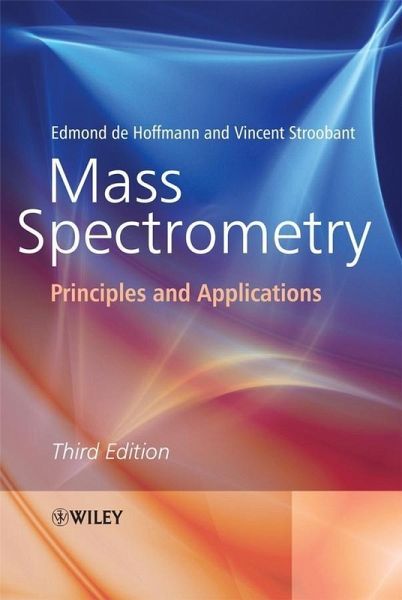
The latest edition of a highly successful textbook, Mass Spectrometry, Third Edition provides students with a complete overview of the principles, theories and key applications of modern mass spectrometry. All instrumental aspects of mass spectrometry are clearly and concisely described: sources, analysers and detectors. Tandem mass spectrometry is introduced early on and then developed in more detail in a later chapter. Emphasis is placed throughout the text on optimal utilisation conditions. Various fragmentation patterns are described together with analytical information that derives from…mehr
The latest edition of a highly successful textbook, Mass Spectrometry, Third Edition provides students with a complete overview of the principles, theories and key applications of modern mass spectrometry. All instrumental aspects of mass spectrometry are clearly and concisely described: sources, analysers and detectors. Tandem mass spectrometry is introduced early on and then developed in more detail in a later chapter. Emphasis is placed throughout the text on optimal utilisation conditions. Various fragmentation patterns are described together with analytical information that derives from the mass spectra. This new edition has been thoroughly revised and updated and has been redesigned to give the book a more contemporary look. As with previous editions it contains numerous examples, references and a series of exercises of increasing difficulty to encourage student understanding. Updates include: Increased coverage of MALDI and ESI, more detailed description of time of flight spectrometers, new material on isotope ratio mass spectrometry, and an expanded range of applications. Mass Spectrometry, Third Edition is an invaluable resource for all undergraduate and postgraduate students using this technique in departments of chemistry, biochemistry, medicine, pharmacology, agriculture, material science and food science. It is also of interest for researchers looking for an overview of the latest techniques and developments.
Dieser Download kann aus rechtlichen Gründen nur mit Rechnungsadresse in D ausgeliefert werden.
Die Herstellerinformationen sind derzeit nicht verfügbar.
Autorenporträt
Edmond de Hoffmann, Université Catholique de Louvain, Belgium & Ludwig Institute for Cancer Research, Brussels, Belgium.
Vincent Stroobant, Ludwig Institute for Cancer Research, Brussels, Belgium.
Inhaltsangabe
- Contents
- Preface
- Introduction
- Principles
- Diagram of a Mass Spectrometer
- History
- Ion Free Path
1 Ion Sources 1.1 Electron Ionization 1.2 Chemical Ionization 1.3 Field Ionization 1.4 Fast Atom Bombardment and Liquid Secondary Ion Mass Spectrometry 1.5 Field Desorption 1.6 Plasma Desorption 1.7 Laser Desorption 1.8 Matrix-Assisted Laser Desorption Ionization 1.9 Thermospray 1.10 Atmospheric Pressure Ionization 1.11 Electrospray 1.12 Atmospheric Pressure Chemical Ionization 1.13 Atmospheric Pressure Photoionization (APPI) 1.14 Atmospheric Pressure Secondary Ion Mass Spectrometry (APSIMS) 1.15 Inorganic Ionization Sources 1.16 Gas-Phase Ion-Molecule Reactions 1.17 Formation and Fragmentation of Ions: Basic Rules
2 Mass Analyzers 2.1 Quadrupole Analyzers 2.2 Ion Trap Analyzers 2.3 The Electrostatic Trap or "Orbitrap" 2.4 Time-of-Flight Analyzers 2.5 Magnetic and Electromagnetic Analyzers 2.6 Ion Cyclotron Resonance and Fourier Transform Mass Spectrometry 2.7 Hybrid Instruments
3 Detectors and Computers 3.1 Detectors 3.2 Computers
4 Tandem Mass Spectrometry (MS/MS) 4.1 Tandem Mass Spectrometry in Space or in Time 4.2 Tandem Mass Spectrometry Scan Modes 4.3 Collision-activated or Collision-induced Dissociation (CAD or CID) 4.4 Other Methods of Ion Activation 4.5 Reactions Studied in MS/MS 4.6 Tandem Mass Spectrometry Applications
5 Mass Spectrometry/Chromatography Coupling 5.1 Elution Chromatography Coupling Techniques 5.2 Chromatography Data Acquisition Modes 5.3 Data Recording and Treatment
6 Analytical Information 6.1 Mass Spectrometry Spectral Collections 6.2 High Resolution 6.3 Isotopic Abundances 6.4 Low-mass Fragments and Lost Neutrals 6.5 Number of Rings or Unsaturations 6.6 Mass and Electron Parities, Closed-shell Ions and Open-shell Ions 6.7 Quantitative Data
7 Fragmentation Reactions 7.1 Electron Ionization and Fragmentation Rates 7.2 Quasi-equilibrium and RRKM Theory 7.3 Ionization and Appearance Energies 7.4 Fragmentation Reactions of Positive Ions 7.5 Fragmentation Reactions of Negative Ions 7.6 Charge Remote Fragmentation (CRF) 7.7 Spectrum Interpretation
8 Analysis of Biomolecules 8.1 Biomolecules and Mass Spectrometry 8.2 Proteins and Peptides 8.3. Oligonucleotides 8.4. Oligosaccharides 8.5. Lipids 8.6 Metabolomics
1 Ion Sources 1.1 Electron Ionization 1.2 Chemical Ionization 1.3 Field Ionization 1.4 Fast Atom Bombardment and Liquid Secondary Ion Mass Spectrometry 1.5 Field Desorption 1.6 Plasma Desorption 1.7 Laser Desorption 1.8 Matrix-Assisted Laser Desorption Ionization 1.9 Thermospray 1.10 Atmospheric Pressure Ionization 1.11 Electrospray 1.12 Atmospheric Pressure Chemical Ionization 1.13 Atmospheric Pressure Photoionization (APPI) 1.14 Atmospheric Pressure Secondary Ion Mass Spectrometry (APSIMS) 1.15 Inorganic Ionization Sources 1.16 Gas-Phase Ion-Molecule Reactions 1.17 Formation and Fragmentation of Ions: Basic Rules
2 Mass Analyzers 2.1 Quadrupole Analyzers 2.2 Ion Trap Analyzers 2.3 The Electrostatic Trap or "Orbitrap" 2.4 Time-of-Flight Analyzers 2.5 Magnetic and Electromagnetic Analyzers 2.6 Ion Cyclotron Resonance and Fourier Transform Mass Spectrometry 2.7 Hybrid Instruments
3 Detectors and Computers 3.1 Detectors 3.2 Computers
4 Tandem Mass Spectrometry (MS/MS) 4.1 Tandem Mass Spectrometry in Space or in Time 4.2 Tandem Mass Spectrometry Scan Modes 4.3 Collision-activated or Collision-induced Dissociation (CAD or CID) 4.4 Other Methods of Ion Activation 4.5 Reactions Studied in MS/MS 4.6 Tandem Mass Spectrometry Applications
5 Mass Spectrometry/Chromatography Coupling 5.1 Elution Chromatography Coupling Techniques 5.2 Chromatography Data Acquisition Modes 5.3 Data Recording and Treatment
6 Analytical Information 6.1 Mass Spectrometry Spectral Collections 6.2 High Resolution 6.3 Isotopic Abundances 6.4 Low-mass Fragments and Lost Neutrals 6.5 Number of Rings or Unsaturations 6.6 Mass and Electron Parities, Closed-shell Ions and Open-shell Ions 6.7 Quantitative Data
7 Fragmentation Reactions 7.1 Electron Ionization and Fragmentation Rates 7.2 Quasi-equilibrium and RRKM Theory 7.3 Ionization and Appearance Energies 7.4 Fragmentation Reactions of Positive Ions 7.5 Fragmentation Reactions of Negative Ions 7.6 Charge Remote Fragmentation (CRF) 7.7 Spectrum Interpretation
8 Analysis of Biomolecules 8.1 Biomolecules and Mass Spectrometry 8.2 Proteins and Peptides 8.3. Oligonucleotides 8.4. Oligosaccharides 8.5. Lipids 8.6 Metabolomics