39,95 €
39,95 €
inkl. MwSt.
Sofort per Download lieferbar

20 °P sammeln
39,95 €
Als Download kaufen
39,95 €
inkl. MwSt.
Sofort per Download lieferbar
20 °P sammeln
Jetzt verschenken
Alle Infos zum eBook verschenken
39,95 €
inkl. MwSt.
Sofort per Download lieferbar
Alle Infos zum eBook verschenken
20 °P sammeln

Andere Kunden interessierten sich auch für
") Paved A Way (eBook, ePUB)7,99 €
Paved A Way (eBook, ePUB)7,99 €") Dreamers and Designers (eBook, ePUB)11,95 €
Dreamers and Designers (eBook, ePUB)11,95 €") Smart Cities (eBook, ePUB)11,95 €
Smart Cities (eBook, ePUB)11,95 €") Turf War (eBook, ePUB)2,99 €
Turf War (eBook, ePUB)2,99 €") Common Ground in a Liquid City (eBook, ePUB)9,95 €
Common Ground in a Liquid City (eBook, ePUB)9,95 €") Times Square Remade (eBook, ePUB)22,95 €
Times Square Remade (eBook, ePUB)22,95 €") House Divided (eBook, ePUB)5,99 €
House Divided (eBook, ePUB)5,99 €



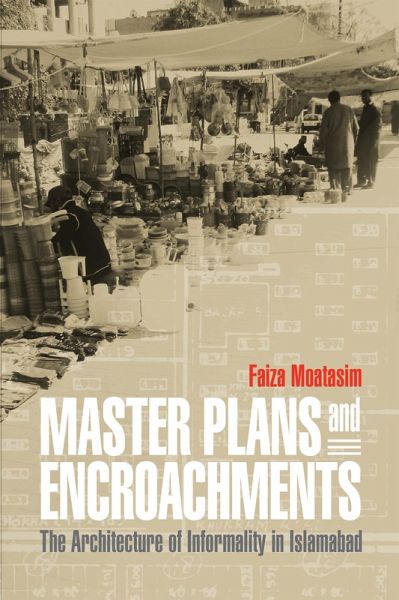
Among urban designers and municipal officials, the term encroachment is defined as a deviation from the official master plan. But in cities today, such informal modifications to the urban fabric are deeply enmeshed with formal planning procedures. Master Plans and Encroachments examines informality in the high-modernist city of Islamabad as a strategic conformity to official schemes and regulations rather than as a deviation from them.
For the new administrative capital of Pakistan designed in 1959 by Greek architect and planner Constantinos A. Doxiadis, Islamabad's master plan offers a clear template of formal urban design within which informal spaces and processes have been articulated. Drawing on deep archival research, wide-ranging interviews, and an array of visual material, including photographs, maps, and architectural drawings, Faiza Moatasim shows how Islamabad's master plan is not simply a blueprint that guides future urban development or makes its violations apparent; it is used by both city officials and citizens to develop informal spaces that accommodate unfulfilled needs and desires of those living and working in the city.
Master Plans and Encroachments is the first book that examines the informal practices of both the privileged and the underprivileged. The book highlights how low-, middle-, and upper-income people do not randomly build informal spaces; they strategically use architectural techniques to support their informal claims to space, which are often met with the government's tacit approval. By focusing on those spaces in Islamabad's urban fabric that are not part of its official master plan, the book demonstrates how planning actually works in complex ways.
For the new administrative capital of Pakistan designed in 1959 by Greek architect and planner Constantinos A. Doxiadis, Islamabad's master plan offers a clear template of formal urban design within which informal spaces and processes have been articulated. Drawing on deep archival research, wide-ranging interviews, and an array of visual material, including photographs, maps, and architectural drawings, Faiza Moatasim shows how Islamabad's master plan is not simply a blueprint that guides future urban development or makes its violations apparent; it is used by both city officials and citizens to develop informal spaces that accommodate unfulfilled needs and desires of those living and working in the city.
Master Plans and Encroachments is the first book that examines the informal practices of both the privileged and the underprivileged. The book highlights how low-, middle-, and upper-income people do not randomly build informal spaces; they strategically use architectural techniques to support their informal claims to space, which are often met with the government's tacit approval. By focusing on those spaces in Islamabad's urban fabric that are not part of its official master plan, the book demonstrates how planning actually works in complex ways.
Dieser Download kann aus rechtlichen Gründen nur mit Rechnungsadresse in A, D ausgeliefert werden.