118,95 €
118,95 €
inkl. MwSt.
Erscheint vor. 13.02.26

59 °P sammeln
118,95 €
Als Download kaufen
118,95 €
inkl. MwSt.
Erscheint vor. 13.02.26
59 °P sammeln
Jetzt verschenken
Alle Infos zum eBook verschenken
118,95 €
inkl. MwSt.
Erscheint vor. 13.02.26
Alle Infos zum eBook verschenken
59 °P sammeln

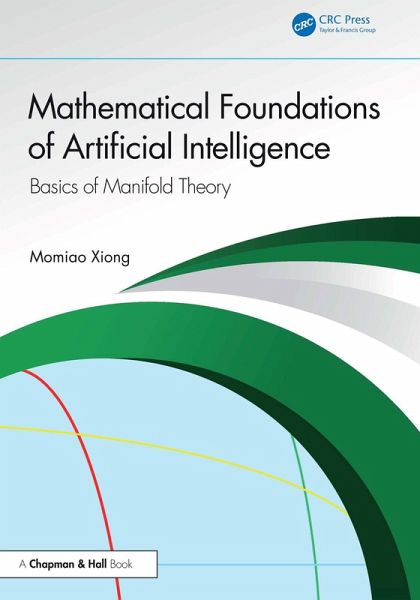
Mathematical Foundations of Artificial Intelligence: Basics of Manifold Theory is the first volume in a two-part series. Together, they establish a unifying mathematical framework based on smooth manifold theory and Riemannian geometry·essential tools for representing, analyzing, and integrating the growing complexity of modern artificial intelligence (AI) systems and scientific models.
Differential geometry now plays a central role across AI, biology, physics, and medicine. From deep learning, generative modeling, and manifold learning to reasoning algorithms and physical AI, manifolds offer a coherent geometric language that bridges theory and practice. This volume introduces key concepts·topological and smooth manifolds, Riemannian metrics, differential forms, Lie derivatives, and statistical geometry·alongside illustrative applications to data science, genomics, drug discovery, and AI-driven systems.
Unlike traditional texts, this book combines rigor with intuition, integrating formal theory, computational methods, and interdisciplinary insights, and is ideal for graduate students and professionals in mathematics, statistics, computer science, AI, physics, bioinformatics, and biomedical sciences. It also serves as a foundational reference for researchers developing AI systems grounded in geometry, scientific modeling, and data-driven discovery.
Key Features
. Unifies core manifold concepts to support integrated thinking across disciplines
. Treats manifolds as natural geometric domains for data representation in AI and the sciences
. Bridges abstract theory with practical algorithms and real-world applications
. Develops Lie derivative aware graphical neural networks for adaptive-AI and molecular property prediction
. Develops Lie derivative enhanced reaction-diffusion equations for disease gene identification and treatment design
. Develops probabilistic modeling and information geometry for modern learning systems
. Applies geometric insight to AI fields, including generative models, graph learning, and reasoning
. Applies the Gauss map and Chen-Gauss-Bonnet theorem to physical AI incorporating geometric constraints for robotics and tumor cell location and range identification
. Features step-by-step examples, case studies, and visual explanations to support understanding
. Serves as an advanced educational and skill-building resource in the age of AI, leveraging the capabilities of emerging AI tools for automatic programming and self-study
Differential geometry now plays a central role across AI, biology, physics, and medicine. From deep learning, generative modeling, and manifold learning to reasoning algorithms and physical AI, manifolds offer a coherent geometric language that bridges theory and practice. This volume introduces key concepts·topological and smooth manifolds, Riemannian metrics, differential forms, Lie derivatives, and statistical geometry·alongside illustrative applications to data science, genomics, drug discovery, and AI-driven systems.
Unlike traditional texts, this book combines rigor with intuition, integrating formal theory, computational methods, and interdisciplinary insights, and is ideal for graduate students and professionals in mathematics, statistics, computer science, AI, physics, bioinformatics, and biomedical sciences. It also serves as a foundational reference for researchers developing AI systems grounded in geometry, scientific modeling, and data-driven discovery.
Key Features
. Unifies core manifold concepts to support integrated thinking across disciplines
. Treats manifolds as natural geometric domains for data representation in AI and the sciences
. Bridges abstract theory with practical algorithms and real-world applications
. Develops Lie derivative aware graphical neural networks for adaptive-AI and molecular property prediction
. Develops Lie derivative enhanced reaction-diffusion equations for disease gene identification and treatment design
. Develops probabilistic modeling and information geometry for modern learning systems
. Applies geometric insight to AI fields, including generative models, graph learning, and reasoning
. Applies the Gauss map and Chen-Gauss-Bonnet theorem to physical AI incorporating geometric constraints for robotics and tumor cell location and range identification
. Features step-by-step examples, case studies, and visual explanations to support understanding
. Serves as an advanced educational and skill-building resource in the age of AI, leveraging the capabilities of emerging AI tools for automatic programming and self-study
Dieser Download kann aus rechtlichen Gründen nur mit Rechnungsadresse in A, B, BG, CY, CZ, D, DK, EW, E, FIN, F, GR, HR, H, IRL, I, LT, L, LR, M, NL, PL, P, R, S, SLO, SK ausgeliefert werden.