99,95 €
inkl. MwSt.
Sofort per Download lieferbar
50 °P sammeln

Andere Kunden interessierten sich auch für
") Mathematical Psychology (eBook, ePUB)99,95 €
Mathematical Psychology (eBook, ePUB)99,95 €") The Mathematical Foundation of Multi-Space Learning Theory (eBook, PDF)44,95 €
The Mathematical Foundation of Multi-Space Learning Theory (eBook, PDF)44,95 €") Time for Science Education (eBook, PDF)112,95 €
Time for Science Education (eBook, PDF)112,95 €") KdV & KAM (eBook, PDF)72,95 €
KdV & KAM (eBook, PDF)72,95 €") The Psychology of Teaching Critical History (eBook, PDF)41,95 €
The Psychology of Teaching Critical History (eBook, PDF)41,95 €") Mathematical and Analogical Reasoning of Young Learners (eBook, PDF)37,95 €
Mathematical and Analogical Reasoning of Young Learners (eBook, PDF)37,95 €") The Routledge Handbook of Inclusive Education for Teacher Educators (eBook, PDF)47,95 €
The Routledge Handbook of Inclusive Education for Teacher Educators (eBook, PDF)47,95 €







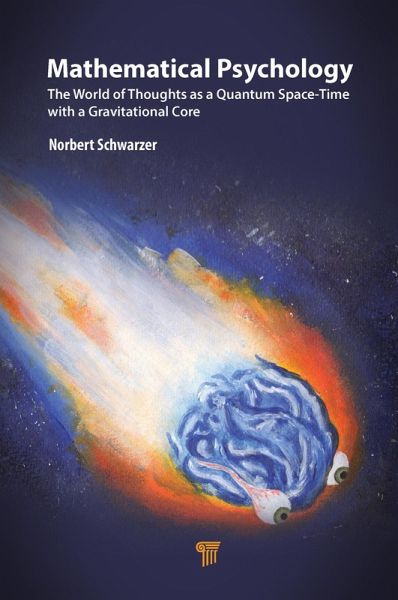
A drawback of standard approaches to try and understand the world of feelings such as love, hate, fear, and anger plus consciousness via quantum concepts results from the old problem that Quantum Theory does not appear to be fully compatible with Einstein's General Theory of Relativity.
To overcome these difficulties, we explicitly tried to avoid "pushing" any existing theory into the comprehension of the human mind and all its derivatives. On the assumption that everything, including consciousness, may consist of attributes or properties and subjecting them to a general Hamilton extremal principle, we surprisingly ended up in generalized Einstein field equations with the whole ensemble having the characteristics of a Quantum Gravity Theory.
The field of psychology has lacked a unified theory to support phenomenological observations until now, and it took a mathematical physicist to find it. With example concepts of group-think and quantum-gravity-based human thought processes given among many more, it provides a basis for understanding and mitigating and potentially even preventing socioeconomic debt cycles and war...
...and it shows why love can become the black hole in a universe of feelings.
To overcome these difficulties, we explicitly tried to avoid "pushing" any existing theory into the comprehension of the human mind and all its derivatives. On the assumption that everything, including consciousness, may consist of attributes or properties and subjecting them to a general Hamilton extremal principle, we surprisingly ended up in generalized Einstein field equations with the whole ensemble having the characteristics of a Quantum Gravity Theory.
The field of psychology has lacked a unified theory to support phenomenological observations until now, and it took a mathematical physicist to find it. With example concepts of group-think and quantum-gravity-based human thought processes given among many more, it provides a basis for understanding and mitigating and potentially even preventing socioeconomic debt cycles and war...
...and it shows why love can become the black hole in a universe of feelings.
Dieser Download kann aus rechtlichen Gründen nur mit Rechnungsadresse in A, B, BG, CY, CZ, D, DK, EW, E, FIN, F, GR, HR, H, IRL, I, LT, L, LR, M, NL, PL, P, R, S, SLO, SK ausgeliefert werden.