56,95 €
56,95 €
inkl. MwSt.
Sofort per Download lieferbar

28 °P sammeln
56,95 €
Als Download kaufen
56,95 €
inkl. MwSt.
Sofort per Download lieferbar
28 °P sammeln
Jetzt verschenken
Alle Infos zum eBook verschenken
56,95 €
inkl. MwSt.
Sofort per Download lieferbar
Alle Infos zum eBook verschenken
28 °P sammeln

Andere Kunden interessierten sich auch für
") Max Weber (eBook, ePUB)56,95 €
Max Weber (eBook, ePUB)56,95 €") Max Weber and His Contempories (eBook, PDF)55,95 €
Max Weber and His Contempories (eBook, PDF)55,95 €") Music on Demand (eBook, PDF)45,95 €
Music on Demand (eBook, PDF)45,95 €") Transnational Musicians (eBook, PDF)40,95 €
Transnational Musicians (eBook, PDF)40,95 €") Why Sámi Sing (eBook, PDF)39,95 €
Why Sámi Sing (eBook, PDF)39,95 €") Fashion Theory (eBook, PDF)45,95 €
Fashion Theory (eBook, PDF)45,95 €") Law and the Modern Mind (eBook, PDF)51,95 €
Law and the Modern Mind (eBook, PDF)51,95 €







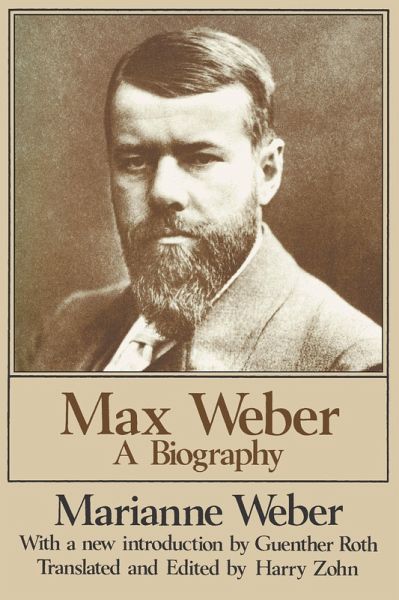
A founder of contemporary social science, Max Weber was born in Germany in 1864. At his death 56 years later, he was nationally known for his scholarly and political writings, but it was the international reception of his oeuvre over the last forty years that has made him world-famous. "The Protestant Ethic and the Spirit of Capitalism," "The Economic Ethics of the World Religions" and his magnum opus, "Economy and Society," with its treatment of the relations of economics, politics, law and religion, belong to the great achievements of 20th-century social science.
The groundwork for the posthumous Weber reception was laid by Weber's widow Marianne, a well-known feminist writer, who followed up her edition of his collected works with one of the greatest biographies in a generation that produced many important accounts of itself. Although unavailable in English until a decade ago, the importance of Marianne Weber's 1926 work had been widely understood. Sociologist Robert A. Nisbet called it "a moving and deeply felt biographical memoir." Historian Gerhard Masur cited the book as "the foundation of all further inquiries into Max Weber's life and influence."
Beginning with Max's ancestry and early years, Marianne Weber guides us through his life as student, young lawyer, scholar and political writer, quoting liberally from his voluminous correspondence. Her account of his nervous breakdown after 1897, which curtailed his academic career but ultimately strengthened his creative energies, provides deep insight into some of the personal tensions that troubled him to the end. In addition to her perceptive personal and intellectual life before the First World War, describing many scholars, social reformers, politicians and literary figures within and beyond the famous Heidelberg circle of the Webers. The new introduction by Guenther Roth situates Marianne Weber's own role in the contemporary setting and discusses the current state of Weber research and of the international Weber reception.
The groundwork for the posthumous Weber reception was laid by Weber's widow Marianne, a well-known feminist writer, who followed up her edition of his collected works with one of the greatest biographies in a generation that produced many important accounts of itself. Although unavailable in English until a decade ago, the importance of Marianne Weber's 1926 work had been widely understood. Sociologist Robert A. Nisbet called it "a moving and deeply felt biographical memoir." Historian Gerhard Masur cited the book as "the foundation of all further inquiries into Max Weber's life and influence."
Beginning with Max's ancestry and early years, Marianne Weber guides us through his life as student, young lawyer, scholar and political writer, quoting liberally from his voluminous correspondence. Her account of his nervous breakdown after 1897, which curtailed his academic career but ultimately strengthened his creative energies, provides deep insight into some of the personal tensions that troubled him to the end. In addition to her perceptive personal and intellectual life before the First World War, describing many scholars, social reformers, politicians and literary figures within and beyond the famous Heidelberg circle of the Webers. The new introduction by Guenther Roth situates Marianne Weber's own role in the contemporary setting and discusses the current state of Weber research and of the international Weber reception.
Dieser Download kann aus rechtlichen Gründen nur mit Rechnungsadresse in A, B, BG, CY, CZ, D, DK, EW, E, FIN, F, GR, HR, H, IRL, I, LT, L, LR, M, NL, PL, P, R, S, SLO, SK ausgeliefert werden.