92,95 €
92,95 €
inkl. MwSt.
Sofort per Download lieferbar

46 °P sammeln
92,95 €
Als Download kaufen
92,95 €
inkl. MwSt.
Sofort per Download lieferbar
46 °P sammeln
Jetzt verschenken
Alle Infos zum eBook verschenken
92,95 €
inkl. MwSt.
Sofort per Download lieferbar
Alle Infos zum eBook verschenken
46 °P sammeln

Andere Kunden interessierten sich auch für
") Native American Log Cabins in the Southeast (eBook, PDF)26,95 €
Native American Log Cabins in the Southeast (eBook, PDF)26,95 €") Building the Past (eBook, PDF)62,95 €
Building the Past (eBook, PDF)62,95 €") Decoding the Codex Borgia (eBook, PDF)147,95 €
Decoding the Codex Borgia (eBook, PDF)147,95 €") Cusco (eBook, PDF)58,95 €
Cusco (eBook, PDF)58,95 €") Architecture and Order (eBook, PDF)44,95 €
Architecture and Order (eBook, PDF)44,95 €") Banaras: Urban Forms and Cultural Histories (eBook, PDF)45,95 €
Banaras: Urban Forms and Cultural Histories (eBook, PDF)45,95 €") The Materialization of Time in the Ancient Maya World (eBook, PDF)183,95 €
The Materialization of Time in the Ancient Maya World (eBook, PDF)183,95 €


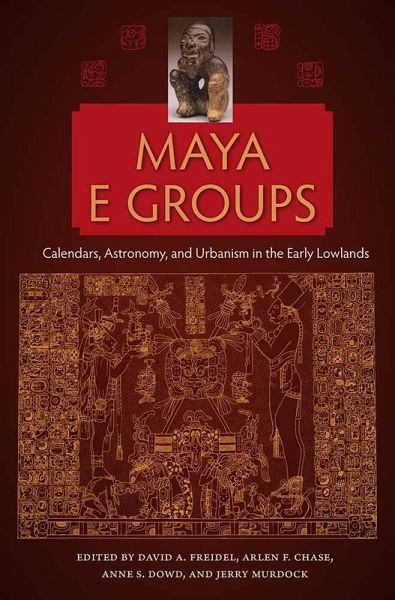
As complex societies emerged in the Maya lowlands during the first millennium BCE, so did stable communities focused around public squares and the worship of a divine ruler tied to a Maize God cult. "E Groups," central to many of these settlements, are architectural complexes: typically, a long platform supporting three struc¬tures and facing a western pyramid across a formal plaza. Aligned with the movements of the sun, E Groups have long been interpreted as giant calendrical devices crucial to the rise of Maya civilization. This volume presents new archaeological data to reveal that E Groups were constructed earlier than previously thought. In fact, they are the earliest identifiable architectural plan at many Maya settlements. More than just astronomical observatories or calendars, E Groups were a key element of community organization, urbanism, and identity in the heart of the Maya lowlands. They served as gathering places for emerging communities and centers of ritual; they were the very first civic-religious public architecture in the Maya lowlands. Investigating a wide variety of E Group sites-including some of the most famous like the Mundo Perdido in Tikal and the hitherto little known complex at Chan, as well as others in Ceibal, El Palmar, Cival, Calakmul, Caracol, Xunantunich, Yaxnohcah, Yaxuná, and San Bartolo-this volume pieces together the development of social and political complexity in ancient Maya civilization. James Aimers Anthony F. Aveni Jamie J. Awe Boris Beltran M. Kathryn Brown Arlen F. Chase Diane Z. Chase Anne S. Dowd James Doyle Francisco Estrada-Belli David A. Freidel Julie A. Hoggarth Takeshi Inomata Patricia A. Mcanany Susan Milbrath Jerry Murdock Kathryn Reese-Taylor Prudence M. Rice Cynthia Robin Franco D. Rossi Jeremy A. Sabloff William A. Saturno Travis W. Stanton A volume in the series Maya Studies, edited by Diane Z. Chase and Arlen F. Chase
Dieser Download kann aus rechtlichen Gründen nur mit Rechnungsadresse in A, D ausgeliefert werden.