22,95 €
22,95 €
inkl. MwSt.
Sofort per Download lieferbar

11 °P sammeln
22,95 €
Als Download kaufen
22,95 €
inkl. MwSt.
Sofort per Download lieferbar
11 °P sammeln
Jetzt verschenken
Alle Infos zum eBook verschenken
22,95 €
inkl. MwSt.
Sofort per Download lieferbar
Alle Infos zum eBook verschenken
11 °P sammeln

Andere Kunden interessierten sich auch für
") Dartmouth College v. Woodward (eBook, ePUB)20,95 €
Dartmouth College v. Woodward (eBook, ePUB)20,95 €") Gibbons v. Ogden (eBook, ePUB)18,95 €
Gibbons v. Ogden (eBook, ePUB)18,95 €") The Slaughterhouse Cases (eBook, ePUB)22,95 €
The Slaughterhouse Cases (eBook, ePUB)22,95 €") Marbury v. Madison (eBook, ePUB)22,95 €
Marbury v. Madison (eBook, ePUB)22,95 €") U.S. v. Darby Lumber (eBook, ePUB)22,95 €
U.S. v. Darby Lumber (eBook, ePUB)22,95 €") American by Birth (eBook, ePUB)22,95 €
American by Birth (eBook, ePUB)22,95 €") The Treason Trials of Aaron Burr (eBook, ePUB)22,95 €
The Treason Trials of Aaron Burr (eBook, ePUB)22,95 €

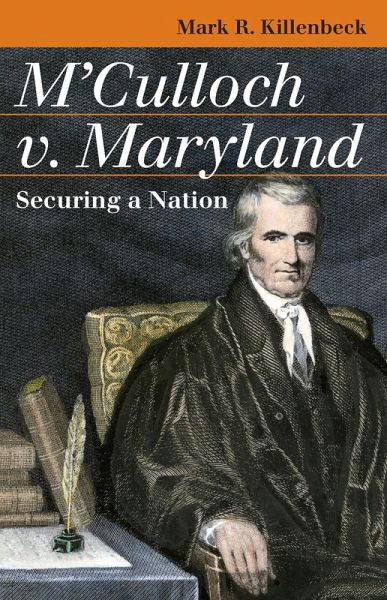
Federalismincluding its meanings and limitsremains one of the most contested principles in constitutional law. To fully understand its importance, we must turn to a landmark decision nearly two centuries old. M'Culloch v. Maryland (1819) is widely regarded as the Supreme Court's most important and influential decisionone that essentially defined the nature and scope of federal authority and its relationship to the states. Mark Killenbeck's sharply insightful study helps us understand why.
Killenbeck recounts how the cashier of the Baltimore branch of the Second Bank of the United States refused to pay Maryland's tax on the bank and how that act precipitated a showdown in the Supreme Court, which addressed two questions: whether the U.S. Congress had the authority to establish a national bank and whether Maryland's tax on the bank was barred by the Constitution. In one of Chief Justice John Marshall's most famous opinions, the Court unanimously answered yes to both, authorizing the federal government to exercise powers not expressly articulated in the Constitutionand setting an alarming precedent for statesrights advocates.
The issues at the heart of M'Culloch are as important today as they were then: the nature and scope of federal constitutional authority, the division of authority between federal and state governments, and the role of the Supreme Court in interpreting and applying the Constitution. Situating the case within the protracted debate about the bank and about federal-state relations, the Panic of 1819, the fate of the Second Bank following the Court's momentous decision, and the ever-expanding and increasingly contentious debate over slavery, Killenbeck's book provides a virtual constitutional history of the first fifty years of the nation. As such, it shows that the development of the Constitution as a viable governing document took place over time and that M'Culloch, with its very broad reading of federal power, marked a turning point for the Constitution, the Court, and the nation.
As the Court continues to reshape the boundaries of federal power, M'Culloch looms large as a precedent in a debate that has never been fully settled. And as states today grapple with such questions as abortion, gay rights, medical marijuana, or assisted suicide, this book puts that precedent in perspective and offers a firm grasp of its implications for the future.
Killenbeck recounts how the cashier of the Baltimore branch of the Second Bank of the United States refused to pay Maryland's tax on the bank and how that act precipitated a showdown in the Supreme Court, which addressed two questions: whether the U.S. Congress had the authority to establish a national bank and whether Maryland's tax on the bank was barred by the Constitution. In one of Chief Justice John Marshall's most famous opinions, the Court unanimously answered yes to both, authorizing the federal government to exercise powers not expressly articulated in the Constitutionand setting an alarming precedent for statesrights advocates.
The issues at the heart of M'Culloch are as important today as they were then: the nature and scope of federal constitutional authority, the division of authority between federal and state governments, and the role of the Supreme Court in interpreting and applying the Constitution. Situating the case within the protracted debate about the bank and about federal-state relations, the Panic of 1819, the fate of the Second Bank following the Court's momentous decision, and the ever-expanding and increasingly contentious debate over slavery, Killenbeck's book provides a virtual constitutional history of the first fifty years of the nation. As such, it shows that the development of the Constitution as a viable governing document took place over time and that M'Culloch, with its very broad reading of federal power, marked a turning point for the Constitution, the Court, and the nation.
As the Court continues to reshape the boundaries of federal power, M'Culloch looms large as a precedent in a debate that has never been fully settled. And as states today grapple with such questions as abortion, gay rights, medical marijuana, or assisted suicide, this book puts that precedent in perspective and offers a firm grasp of its implications for the future.
Dieser Download kann aus rechtlichen Gründen nur mit Rechnungsadresse in A, D ausgeliefert werden.