Sollten wir den Preis dieses Artikels vor dem Erscheinungsdatum senken, werden wir dir den Artikel bei der Auslieferung automatisch zum günstigeren Preis berechnen.
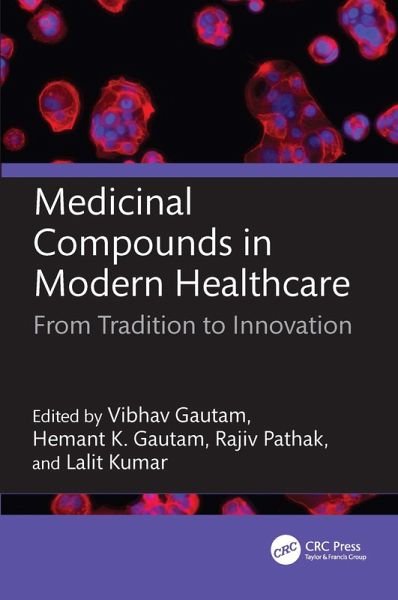
Medicinal Compounds in Modern Healthcare (eBook, PDF)
From Tradition to Innovation Redaktion: Gautam, Vibhav; Kumar, Lalit; Pathak, Rajiv; Gautam, Hemant K.
Sie sind bereits eingeloggt. Klicken Sie auf 2. tolino select Abo, um fortzufahren.
Bitte loggen Sie sich zunächst in Ihr Kundenkonto ein oder registrieren Sie sich bei bücher.de, um das eBook-Abo tolino select nutzen zu können.
This book reviews the evolution, development, and application of medicinal compounds, beginning with their historical context and advancing to modern innovations. The book describes the therapeutic potential of bioactive compounds from microorganisms, the role of antioxidants and anti-inflammatory agents in managing chronic diseases, and the use of small molecules in pain management and mental healthcare. It further explores immunomodulatory compounds, epigenetic modifiers, and the latest advancements in drug development, including integrative medicine approaches and the applications of…mehr
This book reviews the evolution, development, and application of medicinal compounds, beginning with their historical context and advancing to modern innovations. The book describes the therapeutic potential of bioactive compounds from microorganisms, the role of antioxidants and anti-inflammatory agents in managing chronic diseases, and the use of small molecules in pain management and mental healthcare. It further explores immunomodulatory compounds, epigenetic modifiers, and the latest advancements in drug development, including integrative medicine approaches and the applications of nanotechnology in traditional medicine. Additionally, the book addresses the use of immunomodulatory agents like methotrexate and paclitaxel in cancer treatment, regulatory considerations for ensuring safety and efficacy in medicinal compounds, and the growing field of nutraceuticals. Towards the end, the book covers the extraction, profiling, and ADMET evaluation of medicinal compounds, intellectual property challenges, and the significance of traditional medicine in modern healthcare.
Key Features:
Reviews the development of medicinal compounds from historical remedies to modern innovations
Presents the therapeutic potential of bioactive compounds from microorganisms and the crucial roles of antioxidants and anti-inflammatory agents in disease management
Describes the innovations in drug delivery systems, epigenetic modifiers, and immunomodulatory agents
Provides guidance on regulatory considerations and intellectual property in medicinal compound development
Examines the role of nanotechnology and the integration of traditional and modern therapies
This book is intended for researchers of ethnopharmacology, pharmaceutical sciences, and medicinal chemistry.
Dieser Download kann aus rechtlichen Gründen nur mit Rechnungsadresse in A, B, BG, CY, CZ, D, DK, EW, E, FIN, F, GR, HR, H, IRL, I, LT, L, LR, M, NL, PL, P, R, S, SLO, SK ausgeliefert werden.
Die Herstellerinformationen sind derzeit nicht verfügbar.
Autorenporträt
Vibhav Gautam received his postgraduate degree in Biotechnology from Savitribai Phule Pune University, Pune, India. He has completed his PhD degree in Biotechnology from National Institute of Plant Genome Research, India (Degree awarded by Jawaharlal Nehru University, New Delhi, India). Dr. Gautam is currently working as Assistant Professor at Centre of Experimental Medicine and Surgery, Institute of Medical sciences, Banaras Hindu University, Varanasi, India. Currently, his work involves the use of various spectroscopy¿based techniques to identify the lead compound/s derived from fungal endophytes that show potential activity against breast cancer. Furthermore, his work also includes the use of various microscopic techniques to study the surface topology and architecture of bioengineered nanoparticles mediated by fungal endophytes. Hemant K. Gautam earned his Master's and Ph.D. degrees in Microbiology from the Indian Agricultural Research Institute in New Delhi, India. He has Post-doctoral experience in France and Israel. He presently works as a Chief Scientist and Professor at the Institute of Genomics and Integrative Biology in New Delhi. He is affiliated with several universities and belongs to a variety of scientific and academic organizations. He is a recipient of the SARC Award, Bharat Excellence Award, Biotechnology Award, Israel Government Fellowship, UNESCO Fellow, and International Project Reviewer RBUCE-UP, UniverSud, Paris. He has authored over 100 academic papers, two books, and has submitted over 500 novel sequences to the NCBI database. He has visited several countries, including France, Israel, Australia, Bulgaria, China, Thailand, Germany, the United States, Singapore, Vietnam, Malaysia, and Ukraine. He is a Biosafety expert from Department of Biotechnology India. Dr. Gautam is involved in a variety of interdisciplinary projects, including in the areas of microbiology, microbial biotechnology, genomics, and nanobiotics. Dr. Gautam's goal is to develop techniques for rationally engineering next-generation smart antimicrobials by understanding their fundamental features and exploiting such structures to battle the "Antimicrobial resistance" silent pandemic knocking on the door. Rajiv Pathak is an accomplished virologist whose academic journey began with an M.Sc. from the University of Lucknow (2007-2009), followed by a Ph.D. at the CSIR-Institute of Genomics & Integrative Biology, Delhi (2010-2016), where he explored the role of G-quadruplex-forming sequences in microbial genomes. He continued his scientific pursuits with a postdoctoral fellowship at the Department of Genetics, Albert Einstein College of Medicine, New York, USA (2017-2022), where he currently serves as a Staff Scientist. Dr. Pathak has contributed significantly to multiple interdisciplinary projects aimed at advancing therapeutic strategies and addressing key challenges in infectious disease research. His work spans a wide spectrum, including the functional relevance of G-quadruplexes in microorganisms, development of novel therapeutic approaches against multidrug-resistant bacteria, HIV-1 latency and persistence, early replication kinetics of SARS-CoV-2, and the molecular pathogenesis of SMARCB1-associated atypical teratoid/rhabdoid tumors (a rare pediatric cancer). He has authored over 33 peer-reviewed publications in high-impact journals such as Nucleic Acids Research, Acta Neuropathologica, and Nature Communications. His research has been recognized internationally, including Cold Spring Harbor Laboratory meetings. His commitment and dedication to scientific advancement is further demonstrated by his active involvement in the scientific societies, where he has served on editorial board member for 6 journals and reviewed over 60 manuscripts for more than 20 renowned journals in the field. Lalit Kumar received his MBBS and Master of Surgery (MS) degrees from the Institute of Medical Sciences, Banaras Hindu University, Varanasi, India. He subsequently completed his M.Ch. degree in Urology from S.P. Medical College, Bikaner, India. Dr. Kumar is currently working as an Assistant Professor in the Department of Urology, Institute of Medical Sciences, Banaras Hindu University, Varanasi, India. He has undergone advanced training through prestigious fellowships, including a Fellowship in Laparoscopic and Robotic Urology at AIIMS, New Delhi; the ATLAS Internationale Fellowship in Robotic Surgery by the Vattikuti Foundation at Roswell Park Cancer Institute, USA, and observerships at Singapore General Hospital and National University Hospital, Singapore. He is an expert in minimally invasive laparoscopic and robotic surgeries for the management of various urological tract pathologies. Currently, his work involves the integration of high-throughput transcriptomic and metabolomic profiling to uncover molecular signatures associated with various urological cancers. Furthermore, his research focuses on biomarker discovery and the development of novel diagnostic and prognostic tools to enhance early detection and precision management of bladder and prostate cancers.
Inhaltsangabe
1. Immunomodulatory Role of Methotrexate and Paclitaxel and their Nanoparticles in Cancer Therapeutics 2.Emerging Implication of Gut Microbiota Derived Metabolites for the Treatment of Colorectal Cancer 3. Unravelling the Diversity of Medicinally Important Compounds: Exploring Phytochemicals from Plants 4. The bioactive secondary metabolites of kalmegh (Andrographis paniculata): A traditional medicinal plant with diverse pharmacological activities in modern healthcare 5. Bioactive Compounds from Microorganisms and Their Therapeutic Potential 6. Therapeutic Potential of miRNAs in Oncology: Focus on Urinary Bladder Cancer 7. Intellectual Property Rights in Medicinal Compounds: Challenges and Strategies 8. Nutraceuticals Bridging the Gap Between Food and Medicine 9. Adjuvant Therapy for Non-Muscle Invasive Bladder Cancer: From Historical Strategies to Contemporary Innovations 10. Role of Androgen Receptor Pathway Inhibitors in Prostate Cancer Treatment 11. Dispelling the Invisible Wounds: Healing Endometriosis 12. Emerging Technologies in Medicinal Compound Research 13. Unveiling the Therapeutic Properties of Medicinally Important compounds: Antioxidant strength and Anti-inflammatory Effects explored 14. The role of polymeric nanoparticles in diagnosis and treatment of colon cancer 15. Immunomodulatory compounds and their role in disease management
1. Immunomodulatory Role of Methotrexate and Paclitaxel and their Nanoparticles in Cancer Therapeutics 2.Emerging Implication of Gut Microbiota Derived Metabolites for the Treatment of Colorectal Cancer 3. Unravelling the Diversity of Medicinally Important Compounds: Exploring Phytochemicals from Plants 4. The bioactive secondary metabolites of kalmegh (Andrographis paniculata): A traditional medicinal plant with diverse pharmacological activities in modern healthcare 5. Bioactive Compounds from Microorganisms and Their Therapeutic Potential 6. Therapeutic Potential of miRNAs in Oncology: Focus on Urinary Bladder Cancer 7. Intellectual Property Rights in Medicinal Compounds: Challenges and Strategies 8. Nutraceuticals Bridging the Gap Between Food and Medicine 9. Adjuvant Therapy for Non-Muscle Invasive Bladder Cancer: From Historical Strategies to Contemporary Innovations 10. Role of Androgen Receptor Pathway Inhibitors in Prostate Cancer Treatment 11. Dispelling the Invisible Wounds: Healing Endometriosis 12. Emerging Technologies in Medicinal Compound Research 13. Unveiling the Therapeutic Properties of Medicinally Important compounds: Antioxidant strength and Anti-inflammatory Effects explored 14. The role of polymeric nanoparticles in diagnosis and treatment of colon cancer 15. Immunomodulatory compounds and their role in disease management
Es gelten unsere Allgemeinen Geschäftsbedingungen: www.buecher.de/agb
Impressum
www.buecher.de ist ein Internetauftritt der buecher.de internetstores GmbH
Geschäftsführung: Monica Sawhney | Roland Kölbl | Günter Hilger
Sitz der Gesellschaft: Batheyer Straße 115 - 117, 58099 Hagen
Postanschrift: Bürgermeister-Wegele-Str. 12, 86167 Augsburg
Amtsgericht Hagen HRB 13257
Steuernummer: 321/5800/1497
USt-IdNr: DE450055826