45,95 €
45,95 €
inkl. MwSt.
Sofort per Download lieferbar

23 °P sammeln
45,95 €
Als Download kaufen
45,95 €
inkl. MwSt.
Sofort per Download lieferbar
23 °P sammeln
Jetzt verschenken
Alle Infos zum eBook verschenken
45,95 €
inkl. MwSt.
Sofort per Download lieferbar
Alle Infos zum eBook verschenken
23 °P sammeln

Andere Kunden interessierten sich auch für
") Glossary of Chinese Islamic Terms (eBook, ePUB)47,95 €
Glossary of Chinese Islamic Terms (eBook, ePUB)47,95 €") The Islamic Intellectual Tradition in Persia (eBook, ePUB)49,95 €
The Islamic Intellectual Tradition in Persia (eBook, ePUB)49,95 €") Medieval Philosophy and the Classical Tradition (eBook, ePUB)45,95 €
Medieval Philosophy and the Classical Tradition (eBook, ePUB)45,95 €") Islamic Art Collections (eBook, ePUB)51,95 €
Islamic Art Collections (eBook, ePUB)51,95 €") State and Government in Medieval Islam (eBook, ePUB)55,95 €
State and Government in Medieval Islam (eBook, ePUB)55,95 €") Books of Definition in Islamic Philosophy (eBook, ePUB)45,95 €
Books of Definition in Islamic Philosophy (eBook, ePUB)45,95 €") Grammar and Semantics in Medieval Arabic (eBook, ePUB)31,95 €
Grammar and Semantics in Medieval Arabic (eBook, ePUB)31,95 €






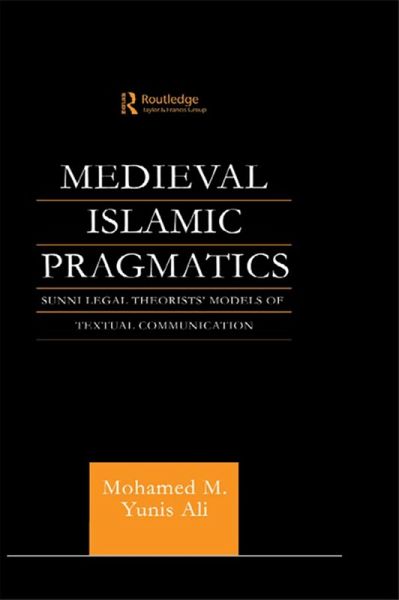
This book deals with two different pragmatic approaches to textual communication: (i) the mainstream approach followed by the 'Ash'ari s, Hanafi s and Mu'tazili s, (ii) the salafite approach followed mainly by the Hanbali s, defended and elaborated by Ibn Taymiyyah. One of the primary aims of the book is to explore and formulate several Muslim legal theorists' pragmatic theories, communicative principles and linguistic views, construct them in the form of models and set them within a general uniform framework. Another aim is to reveal a corpus of information and data which, though highly relevant to modern pragmatics, is still unknown. This study, which can be seen as an extensive introduction to 'medieval Islamic pragmatics', is the first attempt to examine the approaches followed by the Salafi s or the mainstream from a pragmatic viewpoint. There has been no attempt to explain the principles and the strategies utilised by the medieval Sunni Muslim legal theorists in their account of how communication works and how successful interpretation is achieved. Of course, a lot of work has been done on different Islamic sects and their different positions over the interpretation of the Quran and Sunnah, but these studies fall short of delving into the underlying communicative principles that motivate their differences over interpretation. The author's formulation of the Muslim legal theorists' views is enhanced by setting up a reliable theoretical foundation and by delving into their underlying philosophical principles. This involves relating the legal theorists' insights into interpretation and communication to their relevant ontological, epistemological and theological outlooks, and comparing these insights with their modern pragmatic counterparts.
Dieser Download kann aus rechtlichen Gründen nur mit Rechnungsadresse in A, B, BG, CY, CZ, D, DK, EW, E, FIN, F, GR, HR, H, IRL, I, LT, L, LR, M, NL, PL, P, R, S, SLO, SK ausgeliefert werden.