Sie sind bereits eingeloggt. Klicken Sie auf 2. tolino select Abo, um fortzufahren.
Bitte loggen Sie sich zunächst in Ihr Kundenkonto ein oder registrieren Sie sich bei bücher.de, um das eBook-Abo tolino select nutzen zu können.
As an ancient Indian poet-dramatist, Kalidasa cannot be absorbed into the homogenizing tendencies of Hindu hagiography, as has often been attempted, especially in the period after independence. From being projected as a Brahmin by birth in legends, a Vedantist and Vaishnavite in darsana (theology), and more recently, owing to Western theoretical perspectives being applied to texts separated in time and contexts, Kalidasa is critiqued for a patriarchal and casteist outlook. These various readings have privileged personal theories and validated them by reading literary texts in certain ways.…mehr
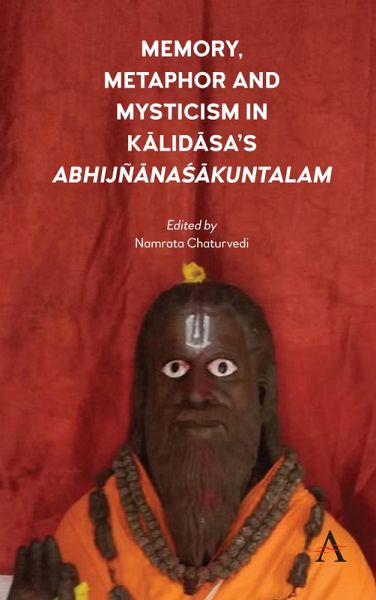
As an ancient Indian poet-dramatist, Kalidasa cannot be absorbed into the homogenizing tendencies of Hindu hagiography, as has often been attempted, especially in the period after independence. From being projected as a Brahmin by birth in legends, a Vedantist and Vaishnavite in darsana (theology), and more recently, owing to Western theoretical perspectives being applied to texts separated in time and contexts, Kalidasa is critiqued for a patriarchal and casteist outlook. These various readings have privileged personal theories and validated them by reading literary texts in certain ways. 'Memory, Metaphor and Mysticism in Kalidasa's 'AbhijñanaSakuntalam'' brings together scholars from both sides of the globe who offer possibilities for reviewing this text, not as an Oriental discovery or a cultural property, but as an ancient literary text that can be read in multiple philosophical contexts. Further, the translations of 'AbhijñanaSakuntalam' into South Asian languages like Urdu and Nepali and a classical language like Persian are also included for detailed study for understanding the impact of this text in the respective literary traditions of these languages, and to assess the actual cross-literary dialogue that this text made, without hyperboles and generalizations, given the fact that many of these translation happened just before and after independence when literary historiography and nation writing project went hand in hand in India.
Dieser Download kann aus rechtlichen Gründen nur mit Rechnungsadresse in A, D ausgeliefert werden.
Die Herstellerinformationen sind derzeit nicht verfügbar.
Autorenporträt
Namrata Chaturvedi is associate professor, School of Language, Literature and Culture Studies, SRM University, Sikkim.
Inhaltsangabe
Acknowledgments; Introduction, Namrata Chaturvedi; Section I: Metre, Structure and Dhvani; 1. 'Upam K lid sasya': What Makes K lid sa the King of Metaphor, Ramkishor Maholiya; 2. What Happens in ' akuntal ': Conceptual and Formal Symmetries, Sheldon Pollock; 3. From Separation to Unity: Resonances of Kashmir aivism in 'Abhijñ nä kuntalam', H. S. Shivaprakash and Namrata Chaturvedi; 4. ' akuntal ' and the Bible: Parallels and Resonances, Felix Wilfred; Section II: Commentaries and Criticism; 5. Love on One's Terms: Perspectives on 'G ndharva Viv ha' in 'Abhijñ nä kuntalam', Wagish Shukla; 6. 'Abhijñ nä kuntalam' in Indian Hermeneutics, Radhavallabh Tripathi; 7. The Seeker Finds His Self: Reading 'S r rthad pik ', the Advaita Commentary on 'Abhijñ nä kuntalam', Godabarisha Mishra; Section III: Varied Grammars of Love; 8. 'Not a Tale, but a Lesson': Persian Translations of K l d sa's 'Abhijñ nä kuntalam', Sunil Sharma; 9. akuntala in Hindustani: Reading select Urdu translations of 'Abhijñ nä kuntalam', Khalid Alvi; 10. Dialogue between Two 'Mah kavis': K lid sa and Laxmi Prasad Devkota's Three ' akuntal s', Gokul Sinha; Section IV: On the Stage: Personal Engagements with a Lived Tradition; 11. Staging ' akuntal ' in India: Observations and Reflections, Kamlesh Dutt Tripathi; 12. From the Stage to the Classroom: Engagement with ' akuntal ', Sreenivas Murthy; Index.
Es gelten unsere Allgemeinen Geschäftsbedingungen: www.buecher.de/agb
Impressum
www.buecher.de ist ein Internetauftritt der buecher.de internetstores GmbH
Geschäftsführung: Monica Sawhney | Roland Kölbl | Günter Hilger
Sitz der Gesellschaft: Batheyer Straße 115 - 117, 58099 Hagen
Postanschrift: Bürgermeister-Wegele-Str. 12, 86167 Augsburg
Amtsgericht Hagen HRB 13257
Steuernummer: 321/5800/1497
USt-IdNr: DE450055826