91,95 €
inkl. MwSt.
Sofort per Download lieferbar
46 °P sammeln

Andere Kunden interessierten sich auch für
") Law Relating To Theft (eBook, PDF)33,95 €
Law Relating To Theft (eBook, PDF)33,95 €") The Concept of Mens Rea in International Criminal Law (eBook, PDF)58,95 €
The Concept of Mens Rea in International Criminal Law (eBook, PDF)58,95 €") State Aid, Subsidy and Tax Incentives under EU and WTO Law (eBook, PDF)164,95 €
State Aid, Subsidy and Tax Incentives under EU and WTO Law (eBook, PDF)164,95 €") Capacity Mechanisms in EU Energy Law (eBook, PDF)89,95 €
Capacity Mechanisms in EU Energy Law (eBook, PDF)89,95 €") Application of Anti-manipulation Law to EU Wholesale Energy Markets and Its Interplay with EU Competition Law (eBook, PDF)89,95 €
Application of Anti-manipulation Law to EU Wholesale Energy Markets and Its Interplay with EU Competition Law (eBook, PDF)89,95 €") Competition Law and Regulation of the EU Electronic Communications Sector (eBook, PDF)152,95 €
Competition Law and Regulation of the EU Electronic Communications Sector (eBook, PDF)152,95 €") Posting of Workers in EU Law (eBook, PDF)86,95 €
Posting of Workers in EU Law (eBook, PDF)86,95 €

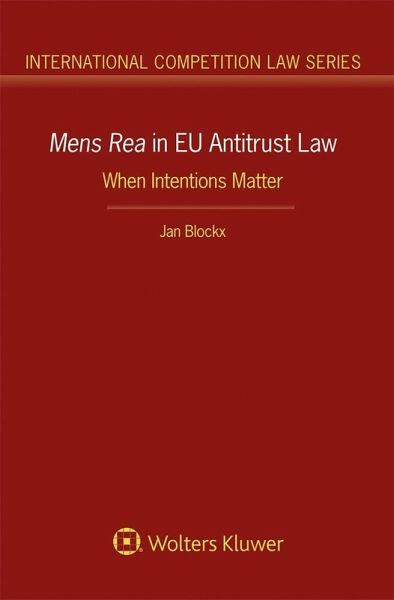
Under the purely economics-based approach to competition law, the central consideration is whether the conduct of undertakings has the effect of restricting competition or not. Such an 'objective' approach to antitrust enforcement leaves little room for subjective elements like intentions. But what happens when economic analysis reaches its limits? In this signal contribution, the author invokes the criminal law concept of mens rea, the idea of the 'guilty mind', thoroughly evaluating the normative cogency of mens rea evidence in the determination of antitrust infringements.
Delving deep into the case law, the author views the subject from the standpoint of a confluence of various areas of law, including:
The author also examines arguments both for and against the use of mens rea evidence in determining whether an antitrust infringement took place and how it should be punished.
This is the first full-length assessment of what role mens rea evidence actually plays and should play in competition law even as the tools for antitrust analysis are meant to become increasingly objective. As a thoroughly researched and systematically presented commentary and analysis of the current status of the use of mens rea in antitrust enforcement and how the practice could develop, it is sure to be welcomed by practitioners as well as by policymakers and academics.
Delving deep into the case law, the author views the subject from the standpoint of a confluence of various areas of law, including:
- the role of mens rea in the criminal law in France, Germany, and England and Wales;
- the different types of mens rea (e.g., intent, recklessness, negligence);
- mens rea in a corporate context;
- mens rea evidence in United States antitrust law;
- the notion of the 'meeting of minds' in Article 101 TFEU;
- relevance of intentions in the determination of the object of an agreement or concerted practice;
- relevance of intentions in the determination of abuse of a dominant position; and
- the role of mens rea in the determination of fines for antitrust breaches.
The author also examines arguments both for and against the use of mens rea evidence in determining whether an antitrust infringement took place and how it should be punished.
This is the first full-length assessment of what role mens rea evidence actually plays and should play in competition law even as the tools for antitrust analysis are meant to become increasingly objective. As a thoroughly researched and systematically presented commentary and analysis of the current status of the use of mens rea in antitrust enforcement and how the practice could develop, it is sure to be welcomed by practitioners as well as by policymakers and academics.
Dieser Download kann aus rechtlichen Gründen nur mit Rechnungsadresse in A, B, BG, CY, CZ, D, DK, EW, E, FIN, F, GR, HR, H, IRL, I, LT, L, LR, M, NL, PL, P, R, S, SLO, SK ausgeliefert werden.