72,95 €
72,95 €
inkl. MwSt.
Sofort per Download lieferbar

36 °P sammeln
72,95 €
Als Download kaufen
72,95 €
inkl. MwSt.
Sofort per Download lieferbar
36 °P sammeln
Jetzt verschenken
Alle Infos zum eBook verschenken
72,95 €
inkl. MwSt.
Sofort per Download lieferbar
Alle Infos zum eBook verschenken
36 °P sammeln

Andere Kunden interessierten sich auch für
") Intelligent Methods in Electrical Power Systems (eBook, PDF)160,95 €
Intelligent Methods in Electrical Power Systems (eBook, PDF)160,95 €") Recent Advances in Computational Optimization (eBook, PDF)136,95 €
Recent Advances in Computational Optimization (eBook, PDF)136,95 €") New Advancements in Swarm Algorithms: Operators and Applications (eBook, PDF)72,95 €
New Advancements in Swarm Algorithms: Operators and Applications (eBook, PDF)72,95 €") Metaheuristic Computation: A Performance Perspective (eBook, PDF)72,95 €
Metaheuristic Computation: A Performance Perspective (eBook, PDF)72,95 €") Advances in Metaheuristics Algorithms: Methods and Applications (eBook, PDF)72,95 €
Advances in Metaheuristics Algorithms: Methods and Applications (eBook, PDF)72,95 €") Recent Advances in Computational Optimization (eBook, PDF)72,95 €
Recent Advances in Computational Optimization (eBook, PDF)72,95 €") Advances of Evolutionary Computation: Methods and Operators (eBook, PDF)72,95 €
Advances of Evolutionary Computation: Methods and Operators (eBook, PDF)72,95 €






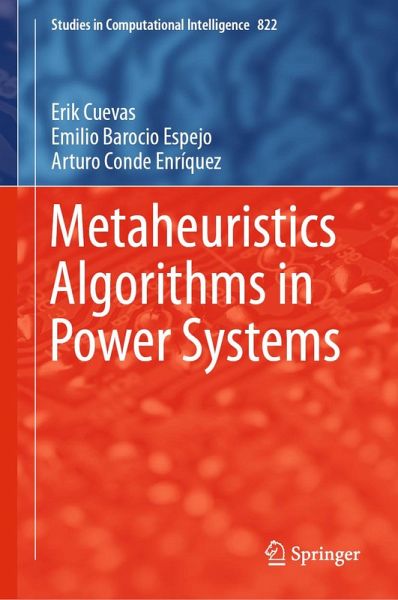
This book discusses the use of efficient metaheuristic algorithms to solve diverse power system problems, providing an overview of the various aspects of metaheuristic methods to enable readers to gain a comprehensive understanding of the field and of conducting studies on specific metaheuristic algorithms related to power-system applications. By bridging the gap between recent metaheuristic techniques and novel power system methods that benefit from the convenience of metaheuristic methods, it offers power system practitioners who are not metaheuristic computation researchers insights into the techniques, which go beyond simple theoretical tools and have been adapted to solve important problems that commonly arise. On the other hand, members of the metaheuristic computation community learn how power engineering problems can be translated into optimization tasks, and it is also of interest to engineers and application developers. Further, since each chapter can be read independently, the relevant information can be quickly found. Power systems is a multidisciplinary field that addresses the multiple approaches used for design and analysis in areas ranging from signal processing, and electronics to computational intelligence, including the current trend of metaheuristic computation.
Dieser Download kann aus rechtlichen Gründen nur mit Rechnungsadresse in A, B, BG, CY, CZ, D, DK, EW, E, FIN, F, GR, HR, H, IRL, I, LT, L, LR, M, NL, PL, P, R, S, SLO, SK ausgeliefert werden.