160,95 €
160,95 €
inkl. MwSt.
Sofort per Download lieferbar

80 °P sammeln
160,95 €
Als Download kaufen
160,95 €
inkl. MwSt.
Sofort per Download lieferbar
80 °P sammeln
Jetzt verschenken
Alle Infos zum eBook verschenken
160,95 €
inkl. MwSt.
Sofort per Download lieferbar
Alle Infos zum eBook verschenken
80 °P sammeln

Andere Kunden interessierten sich auch für
") Advances in Metal Oxides and Their Composites for Emerging Applications (eBook, ePUB)160,95 €
Advances in Metal Oxides and Their Composites for Emerging Applications (eBook, ePUB)160,95 €") Metal Oxide-Based Nanostructured Electrocatalysts for Fuel Cells, Electrolyzers, and Metal-Air Batteries (eBook, ePUB)146,95 €
Metal Oxide-Based Nanostructured Electrocatalysts for Fuel Cells, Electrolyzers, and Metal-Air Batteries (eBook, ePUB)146,95 €") Metal Oxides in Nanocomposite-Based Electrochemical Sensors for Toxic Chemicals (eBook, ePUB)149,95 €
Metal Oxides in Nanocomposite-Based Electrochemical Sensors for Toxic Chemicals (eBook, ePUB)149,95 €") Metal Oxides for Optoelectronics and Optics-Based Medical Applications (eBook, ePUB)153,95 €
Metal Oxides for Optoelectronics and Optics-Based Medical Applications (eBook, ePUB)153,95 €") Metal Oxides for Non-volatile Memory (eBook, ePUB)160,95 €
Metal Oxides for Non-volatile Memory (eBook, ePUB)160,95 €") Graphene Oxide-Metal Oxide and other Graphene Oxide-Based Composites in Photocatalysis and Electrocatalysis (eBook, ePUB)146,95 €
Graphene Oxide-Metal Oxide and other Graphene Oxide-Based Composites in Photocatalysis and Electrocatalysis (eBook, ePUB)146,95 €") Nanocomposites-Advanced Materials for Energy and Environmental Aspects (eBook, ePUB)211,95 €
Nanocomposites-Advanced Materials for Energy and Environmental Aspects (eBook, ePUB)211,95 €





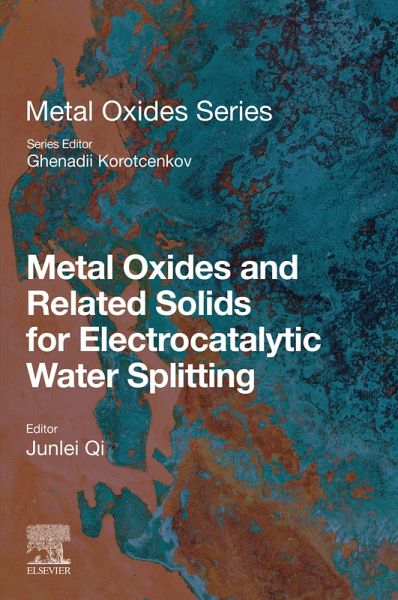
Metal Oxides and Related Solids for Electrocatalytic Water Splitting reviews the fundamentals and strategies needed to design and fabricate metal oxide-based electrocatalysts. After an introduction to the key properties of transition metal oxides, materials engineering methods to optimize the performance of metal-oxide based electrocatalysts are discussed. Strategies reviewed include defect engineering, interface engineering and doping engineering. Other sections cover important categories of metal-oxide (and related solids) based catalysts, including layered hydroxides, metal chalcogenides, metal phosphides, metal nitrides, metal borides, and more. Each chapter introduces important properties and material design strategies, including composite and morphology design. There is also an emphasis on cost-effective materials design and fabrication for optimized performance for electrocatalytic water splitting applications. Lastly, the book touches on recently developed in-situ characterization methods applied to observe and control the material synthesis process. - Introduces metal oxide-based materials for electrocatalytic water splitting applications, including their key properties, synthesis, design and fabrication strategies - Reviews the most relevant materials design strategies, including defect engineering, interface engineering, and doping engineering - Discusses the pros and cons of metal oxide-based materials for water splitting applications to aid in materials selection
Dieser Download kann aus rechtlichen Gründen nur mit Rechnungsadresse in A, B, BG, CY, CZ, D, DK, EW, E, FIN, F, GR, HR, H, IRL, I, LT, L, LR, M, NL, PL, P, R, S, SLO, SK ausgeliefert werden.