Sie sind bereits eingeloggt. Klicken Sie auf 2. tolino select Abo, um fortzufahren.
Bitte loggen Sie sich zunächst in Ihr Kundenkonto ein oder registrieren Sie sich bei bücher.de, um das eBook-Abo tolino select nutzen zu können.
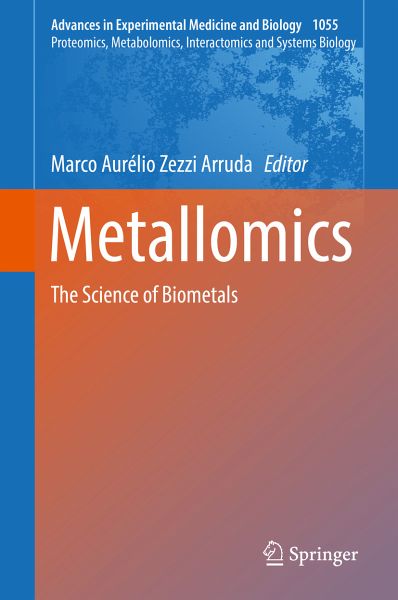
Book refers to the new omics area: Metallomics This book will show the importance of further investigation about metals and their interactions with biomolecules Metallomics is a transdisiciplinary area. As a result this book is of use to everyone from undergrads to experts in the field
This book will show the importance of further investigation about metals and their interactions with biomolecules
Metallomics is a transdisiciplinary area. As a result this book is of use to everyone from undergrads to experts in the field
Dieser Download kann aus rechtlichen Gründen nur mit Rechnungsadresse in A, B, BG, CY, CZ, D, DK, EW, E, FIN, F, GR, HR, H, IRL, I, LT, L, LR, M, NL, PL, P, R, S, SLO, SK ausgeliefert werden.
Die Herstellerinformationen sind derzeit nicht verfügbar.
Autorenporträt
Marco Aurélio Zezzi Arruda is Full Professor at the University of Campinas - Unicamp (Campinas, Brazil), Department of Analytical Chemistry, head of the Sample preparation, spectrometry and mechanization group - GEPAM, and member of the advisory board of the National Institute of Science and Technology - INCT for Bioanalitics. Additionally, he acted as invited professor at Pau University - Pau, France, and at University of Ballears Island - Palma, Mallorca, Spain. The main research lines of his research group include bioanalytical with emphasis on metallomics and proteomics, mass (ICP-MS, LA-ICP-MS, MALDI-QTOF-MS, ESI-MS, TWIMS) and atomic spectrometry (ICP OES, ETAAS, FAAS, TS-FF-AAS), sample preparation, forensic and mechanization. His current research interests include trans-disciplinary work involving speciation analysis and comparative omics of plants (i.e. soybean, sunflower, Arabidopsis Thaliana) and human body fluids (i.e. blood serum, urine, saliva) to identify possible biomarkers for transgenic species and human diseases, as well as to evaluate reactive oxygen species production, and (metallo)proteins responses under stress in a given system.
Inhaltsangabe
Chapter1: Metallomics: The Science of Biometals and Biometalloids.- Chapter2: Metallomics Applied to the Study of Neurodegenerative and Mental Diseases.- Chapter3: Environmental Metallomics.- Chapter4: Metallomics study in plants exposed to arsenic, mercury, selenium and sulphur.- Chapter5: Metallomics in Fish.- Chapter6: The use of Stable Isotopic Tracers in Metallomics Studies.- Chapter7: Bioimaging Metallomics.- Chapter8: Chemical speciation and Metallomics.- Chapter9: Advanced Nuclear and Related Techniques for Metallomics and Nanometallomics.- Chapter10: New frontiers of metallomics: elemental and species specific analysis and imaging of single-cells.
Chapter1: Metallomics: The Science of Biometals and Biometalloids.- Chapter2: Metallomics Applied to the Study of Neurodegenerative and Mental Diseases.- Chapter3: Environmental Metallomics.- Chapter4: Metallomics study in plants exposed to arsenic, mercury, selenium and sulphur.- Chapter5: Metallomics in Fish.- Chapter6: The use of Stable Isotopic Tracers in Metallomics Studies.- Chapter7: Bioimaging Metallomics.- Chapter8: Chemical speciation and Metallomics.- Chapter9: Advanced Nuclear and Related Techniques for Metallomics and Nanometallomics.- Chapter10: New frontiers of metallomics: elemental and species specific analysis and imaging of single-cells.
Es gelten unsere Allgemeinen Geschäftsbedingungen: www.buecher.de/agb
Impressum
www.buecher.de ist ein Internetauftritt der buecher.de internetstores GmbH
Geschäftsführung: Monica Sawhney | Roland Kölbl | Günter Hilger
Sitz der Gesellschaft: Batheyer Straße 115 - 117, 58099 Hagen
Postanschrift: Bürgermeister-Wegele-Str. 12, 86167 Augsburg
Amtsgericht Hagen HRB 13257
Steuernummer: 321/5800/1497
USt-IdNr: DE450055826