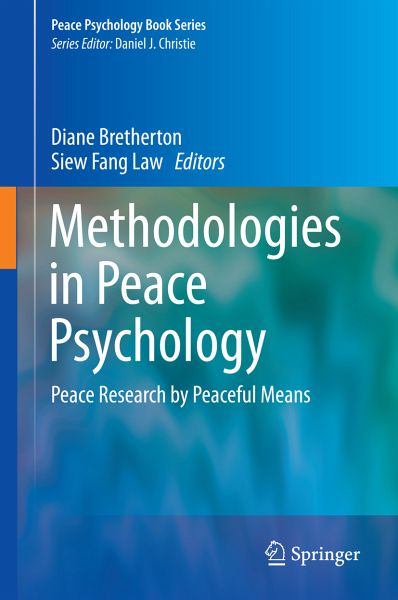
Methodologies in Peace Psychology (eBook, PDF)
Peace Research by Peaceful Means
Redaktion: Bretherton, Diane; Law, Siew Fang
40,95 €
40,95 €
inkl. MwSt.
Sofort per Download lieferbar

20 °P sammeln
40,95 €
Als Download kaufen
40,95 €
inkl. MwSt.
Sofort per Download lieferbar
20 °P sammeln
Jetzt verschenken
Alle Infos zum eBook verschenken
40,95 €
inkl. MwSt.
Sofort per Download lieferbar
Alle Infos zum eBook verschenken
20 °P sammeln

Methodologies in Peace Psychology (eBook, PDF)
Peace Research by Peaceful Means
Redaktion: Bretherton, Diane; Law, Siew Fang
- Format: PDF
- Merkliste
- Auf die Merkliste
- Bewerten Bewerten
- Teilen
- Produkt teilen
- Produkterinnerung
- Produkterinnerung

Bitte loggen Sie sich zunächst in Ihr Kundenkonto ein oder registrieren Sie sich bei
bücher.de, um das eBook-Abo tolino select nutzen zu können.
Hier können Sie sich einloggen
Sie sind bereits eingeloggt. Klicken Sie auf 2. tolino select Abo, um fortzufahren.

Bitte loggen Sie sich zunächst in Ihr Kundenkonto ein oder registrieren Sie sich bei bücher.de, um das eBook-Abo tolino select nutzen zu können.
Presents innovative methodologies and best practices for conducting psychological peace research in a wide variety of contexts
Provides ideas for some of the alternative, arts-based research methods in psychology
Offers a range of creative and sound tips on how to conduct research with people whose worldview might differ considerably from that of the researchers
- Geräte: PC
- ohne Kopierschutz
- eBook Hilfe
- Größe: 6.47MB
Andere Kunden interessierten sich auch für
Psychology of Gender Through the Lens of Culture (eBook, PDF)72,95 €
Semantics and Psychology of Spirituality (eBook, PDF)160,95 €
Current Issues in Transitional Justice (eBook, PDF)72,95 €
Interweaving Tapestries of Culture and Sexuality in the Caribbean (eBook, PDF)80,95 €
Toshio YamagishiTrust (eBook, PDF)72,95 €
The Five-Factor Model of Personality Across Cultures (eBook, PDF)112,95 €
Velizara ChervenkovaJapanese Psychotherapies (eBook, PDF)104,95 €-
-
-
Presents innovative methodologies and best practices for conducting psychological peace research in a wide variety of contexts
Provides ideas for some of the alternative, arts-based research methods in psychology
Offers a range of creative and sound tips on how to conduct research with people whose worldview might differ considerably from that of the researchers
Provides ideas for some of the alternative, arts-based research methods in psychology
Offers a range of creative and sound tips on how to conduct research with people whose worldview might differ considerably from that of the researchers
Dieser Download kann aus rechtlichen Gründen nur mit Rechnungsadresse in A, B, BG, CY, CZ, D, DK, EW, E, FIN, F, GR, HR, H, IRL, I, LT, L, LR, M, NL, PL, P, R, S, SLO, SK ausgeliefert werden.
Produktdetails
- Produktdetails
- Verlag: Springer International Publishing
- Seitenzahl: 454
- Erscheinungstermin: 3. September 2015
- Englisch
- ISBN-13: 9783319183954
- Artikelnr.: 44530097
- Verlag: Springer International Publishing
- Seitenzahl: 454
- Erscheinungstermin: 3. September 2015
- Englisch
- ISBN-13: 9783319183954
- Artikelnr.: 44530097
- Herstellerkennzeichnung Die Herstellerinformationen sind derzeit nicht verfügbar.
Diane Bretherton was the founding director of the International Conflict Resolution Centre in the Pyschology Department at the University of Melbourne and for many years chaired the Committee for the Psychological Study of Peace of the International Union of Psychological Science. She is currently an Honorary Professor in Political Science and International Relations at the University of Queensland. She is also a Visiting Professor at the Zhou En Lai School of International Relations at the University of Nankai in Tianjin, China. She has previously contributed to the Springer Series in Peace Psychology as a co-editor of Peace Psychology in Australia and is a member of the Editorial Advisory Board of the Journal of Peace and Conflict. She has conducted conflict resolution and peace building workshops in many countries in the world, her most recent project being to facilitate a dialogue between indigenous (Mapuche) and non-indigenous people in Chile. She was awarded the Morton Deutsch Award for Research in Conflict Resolution by the American Psychological Association, Washington, in 2011. She has also been made a member of the Order of Australia for theoretical contributions her discipline and for the practical prevention of violence through promoting conflict resolution in the community. Her extensive experience of supervising the research of under-graduate and post-graduate psychology students who wished to make a contribution to the prevention of violence and promotion of peace, within the Psychology Department at the University of Melbourne, informs the proposed book. Siew Fang Law is of Chinese Malaysian descent and received her education in four continents. She is a Senior Lecturer and teaches in conflict resolution and peace at Victoria University, Australia. Her doctoral education was in culture and conflict resolution at RMIT University in Melbourne, Australia. She completed her Masters of Science in Social Psychology at the University of Kent in Canterbury, UK and Bachelor of Arts in Psychology at St Marys University, Canada. Prior receiving her tenure position at Victoria University, she worked a consultant for international organizations such as UNDP and UNESCO in Southeast Asia and had taught at RMIT. She researches in cross-disciplinary issues that fall into the intersections of culture and conflict resolution, identity, post-colonialism, community development and peacebuilding. She is a nationally Accredited Mediator in Australia and a committee member of the Committee for the Psychological Study of Peace
Acknowledgement.- Contributors.- Chapter 1 Introduction: Methodologies in Peace Psychology.- Part I Research Methods in Peace Psychology.- Chapter 2 Theories Underlying Peace Research .- Chapter 3 Themes in Peace Psychology Research.- Chapter 4 Quantitative Research in Peace Psychology.- Chapter 5 Qualitative Research in Peace Psychology.- Chapter 6 Utilizing Mixed Methods for Research in Peace Psychology.- Chapter 7 Ethical Objectives and Values in Peace Psychology and Social Justice Research.- Part II Extending the Range of Methodologies.-Postcolonial Methodologies.- Chapter 8 Indigenous Paradigm Research.- Chapter 9Approaches to Postcolonial Research.- Chapter 10 Involving Participants in Data Analysis.- Participatory and Workshop Methods.- Chapter 11 Philosophies of Participation: Analectic and Consciousness Methods.- Chapter 12 Participatory Action Research as a Resource for Community Regeneration in Post-Conflict Contexts.- Chapter 13 Inquiry into Practice and Practicing Inquiry:the Intersection of Practice Intervention and Research.- Using the Creative Arts in Peace Research.- Chapter 14 Approaches to Narrative Analysis: Using Personal, Dialogical and Social Stories to Promote Peace.- Chapter 15 Challenging Structural Violence through Community Drama: Exploring Theatre as Transformative Praxis.- Chapter 16 Photovoice as Emancipatory Praxis: A Visual Methodology Towards Critical Consciousness and Social Action.- Chapter 17 Music and Peace.- Technological Innovation.- Chapter 18 Using the Internet and Social Media in Peace Psychology Research.- Part III Transforming the world.- Chapter 19 Translating Psychological Research into Policy, Advocacy and Programs in International Development.- Chapter 20Program Evaluation: Why Process Matters.- Chapter 21Writing Peace Psychology: Creating High-Impact Peace Research Scholarship.- Chapter 22 Conclusion: Peaceful Research by Peaceful Means.- List of Tables.- List of Figures.- Index.