2,13 €
inkl. MwSt.
Sofort per Download lieferbar
0 °P sammeln

Andere Kunden interessierten sich auch für
") Time Out (eBook, ePUB)2,99 €
Time Out (eBook, ePUB)2,99 €") The Life of the Spider (eBook, ePUB)1,97 €
The Life of the Spider (eBook, ePUB)1,97 €") Evidence As To Man's Place in Nature (eBook, ePUB)69,95 €
Evidence As To Man's Place in Nature (eBook, ePUB)69,95 €") Jurassic West, Second Edition (eBook, ePUB)32,95 €
Jurassic West, Second Edition (eBook, ePUB)32,95 €") Science in Arcady (eBook, ePUB)2,99 €
Science in Arcady (eBook, ePUB)2,99 €") Scotch Loch-Fishing (eBook, ePUB)0,49 €
Scotch Loch-Fishing (eBook, ePUB)0,49 €") This Phenomenal Life (eBook, ePUB)11,86 €
This Phenomenal Life (eBook, ePUB)11,86 €

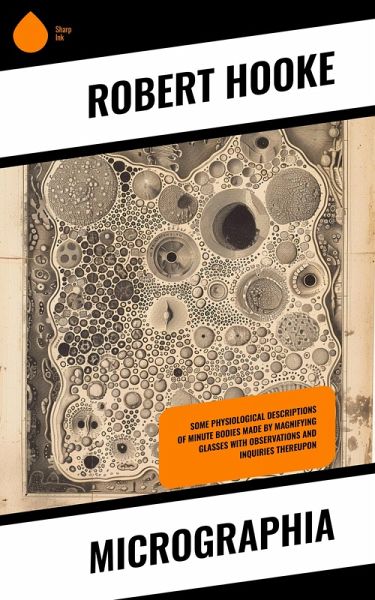
In 'Micrographia,' Robert Hooke presents a groundbreaking exploration of the microscopic world, employing exquisite engravings to illustrate the unseen marvels that challenge the limitations of human perception. Written in a style that balances meticulous scientific observation with eloquent prose, the text marries empirical inquiry with a poetic sensibility. Published in 1665, this seminal work not only serves as a foundational text in microscopy but also situates itself within the broader scientific revolution, reflecting the era's fervent quest for knowledge and understanding of the natural world. Robert Hooke, a polymath known for his contributions to various fields including physics, biology, and architecture, was profoundly influenced by the innovative spirit of the 17th century. His role as Curator of Experiments for the Royal Society of London allowed him access to cutting-edge developments in science, which fueled his curiosity and determination to unveil the mysteries of life itself. Hooke's meticulous attention to detail and passion for experimentation are vividly evident in this work, marking him as a pivotal figure in the transition to modern scientific inquiry. 'Micrographia' is a must-read for anyone intrigued by the intersections of art and science, offering not just revelations about the microscopic realm but also insights into the scientific method and the wonder of discovery. Readers will find themselves captivated by Hooke's eloquent descriptions and stunning illustrations, and inspired to appreciate the beauty embedded in the minutiae of nature.
Dieser Download kann aus rechtlichen Gründen nur mit Rechnungsadresse in A, B, BG, CY, CZ, D, DK, EW, E, FIN, F, GR, HR, H, IRL, I, LT, L, LR, M, NL, PL, P, R, S, SLO, SK ausgeliefert werden.