57,95 €
57,95 €
inkl. MwSt.
Sofort per Download lieferbar

29 °P sammeln

57,95 €
Als Download kaufen
57,95 €
inkl. MwSt.
Sofort per Download lieferbar
29 °P sammeln
Jetzt verschenken
Alle Infos zum eBook verschenken
57,95 €
inkl. MwSt.
Sofort per Download lieferbar
Alle Infos zum eBook verschenken
29 °P sammeln
- Format: ePub
- Merkliste
- Auf die Merkliste
- Bewerten Bewerten
- Teilen
- Produkt teilen
- Produkterinnerung
- Produkterinnerung

Bitte loggen Sie sich zunächst in Ihr Kundenkonto ein oder registrieren Sie sich bei
bücher.de, um das eBook-Abo tolino select nutzen zu können.
Hier können Sie sich einloggen
Sie sind bereits eingeloggt. Klicken Sie auf 2. tolino select Abo, um fortzufahren.

Bitte loggen Sie sich zunächst in Ihr Kundenkonto ein oder registrieren Sie sich bei bücher.de, um das eBook-Abo tolino select nutzen zu können.
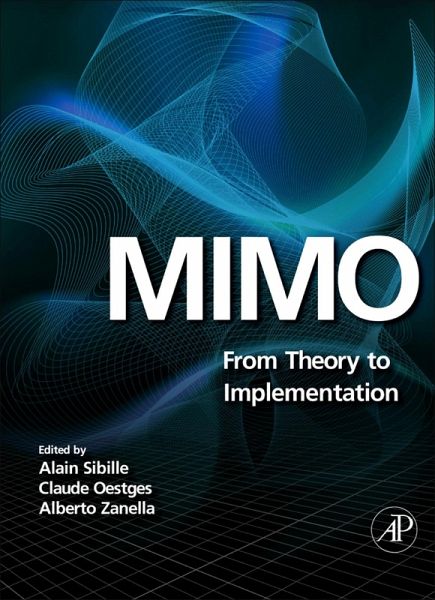
Foreword from Arogyaswami Paulraj, Professor (Emeritus), Stanford University (USA) - The first book to show how MIMO principles can be implemented in today's mobile broadband networks and components - Explains and solves some of the practical difficulties that arise in designing and implementing MIMO systems - Both theory and implementation sections are written in the context of the most recent standards: IEEE 802.11n (WiFi); IEEE 802.16 (WIMAX); 4G networks (3GPP/3GPP2, LTE)
- Geräte: eReader
- ohne Kopierschutz
- eBook Hilfe
Andere Kunden interessierten sich auch für
Symeon ChatzinotasCooperative and Cognitive Satellite Systems (eBook, ePUB)79,95 €
Richard WatsonFixed/Mobile Convergence and Beyond (eBook, ePUB)49,95 €
MIMO Power Line Communications (eBook, ePUB)81,95 €
Ian PooleBasic Radio (eBook, ePUB)28,95 €
Carl R. NassarTelecommunications Demystified (eBook, ePUB)56,95 €
Erik DahlmanCommunications Engineering e-Mega Reference (eBook, ePUB)74,95 €
Handbook of Blind Source Separation (eBook, ePUB)90,95 €-
-
-
Foreword from Arogyaswami Paulraj, Professor (Emeritus), Stanford University (USA) - The first book to show how MIMO principles can be implemented in today's mobile broadband networks and components - Explains and solves some of the practical difficulties that arise in designing and implementing MIMO systems - Both theory and implementation sections are written in the context of the most recent standards: IEEE 802.11n (WiFi); IEEE 802.16 (WIMAX); 4G networks (3GPP/3GPP2, LTE)
Dieser Download kann aus rechtlichen Gründen nur mit Rechnungsadresse in A, B, BG, CY, CZ, D, DK, EW, E, FIN, F, GR, HR, H, IRL, I, LT, L, LR, M, NL, PL, P, R, S, SLO, SK ausgeliefert werden.
Produktdetails
- Produktdetails
- Verlag: Elsevier Science & Techn.
- Seitenzahl: 384
- Erscheinungstermin: 3. Dezember 2010
- Englisch
- ISBN-13: 9780123821959
- Artikelnr.: 38149196
- Verlag: Elsevier Science & Techn.
- Seitenzahl: 384
- Erscheinungstermin: 3. Dezember 2010
- Englisch
- ISBN-13: 9780123821959
- Artikelnr.: 38149196
- Herstellerkennzeichnung Die Herstellerinformationen sind derzeit nicht verfügbar.
Claude Oestges is Associate Professor with the Institute for Information and Communication Technologies, Electronics and Applied Mathematics (Université catholique de Louvain). His research interests cover wireless and satellite communications, with a specific focus on channel characterization and modeling. He is the author or co-author of two books and more than 170 scientific papers in international journals and conference proceedings.
ForewordPrefaceAbout the Editors, Authors and ContributorsIntroductionPart I MIMO Fundamentals Chapter 1 A Short Introduction to MIMO Information Theory 1.1 The Shannon-Wiener Legacy: From 1948 to 2008 1.2 Preliminaries 1.3 Information Theoretic Aspects 1.4 Signal Processing Aspects 1.5 Wiener vs. Shannon: An Ever Closer Union Chapter 2 MIMO Propagation and Channel Modeling 2.1 Introduction 2.2 Model Classification 2.3 Parameters of the MIMO Radio Channel 2.4 CSI and Channel Randomness 2.5 What Kind of Correlation in MIMO? 2.6 MIMO Measurements 2.7 What Makes a Good Channel Model? 2.8 Examples of MIMO Radio Channel Models 2.9 Some Conclusions Acknowledgment Chapter 3 Space Time Codes and MIMO Transmission 3.1 Introduction 3.2 Diversity and Multiplexing Gain 3.3 Theory of Space-time Coding 3.4 Space-time Code 3.5 Spatial Multiplexing 3.6 Precoding 3.7 MIMO in Current and Emerging Standards 3.8 Summary Chapter 4 Interference Functions - A Mathematical Framework for MIMO Interference Networks 4.1 Multiuser Channels 4.2 A General Framework for Optimizing Interference Networks 4.3 Joint Interference Mitigation and Resource Allocation 4.4 Implementation AspectsPart II Implementation Chapter 5 Advanced Transmitter and Receiver Design 5.1 Introduction 5.2 Turbo Equalization 5.3 Turbo Equalization on Frequency-Selective MIMO Channels 5.4 Turbo Synchronization 5.5 Turbo Synchronization on Frequency-Selective MIMO Channels Chapter 6 Implementing Scalable List Detectors for MIMO-SDM in LTE 6.1 Introduction 6.2 Radius-Based Detector Algorithm 6.3 Mapping of the Radius-Based Detector 6.4 SSFE Detector 6.5 Conclusions Chapter 7 IEEE 802.11n Implementation 7.1 IEEE 802.11n PHY Layer Introduction 7.2 IEEE 802.11n Transmitter Part 7.3 IEEE 802.11n Receiver Part 7.4 Simulation Results 7.5 Conclusion Chapter 8 WiMAX Implementation 8.1 Introduction 8.2 Existing Schemes in IEEE 802.16e 8.3 MIMO Candidates for IEEE 802.16m 8.4 UL-MIMO Schemes in WiMAX Systems 8.5 Cyclic Delay Diversity (CDD) 8.6 Tile-Switched Diversity (TSD) 8.7 Performance 8.8 Potential Impacts on Architecture 8.9 Conclusions Chapter 9 LTE and LTE-Advanced 9.1 Transmission Structure 9.1.1 LTE Downlink 9.1.2 LTE Uplink 9.2 LTE MIMO Schemes 9.3 LTE-Advanced MIMO Schemes Chapter 10 Multiple Antenna Terminals 10.1 Size-Performance Trade Off 10.2 Performance of Compact Design 10.3 Compact Design Techniques - Antenna Decoupling 10.4 Compact Design Techniques - Antenna/Channel Matching 10.5 Related Issues and Future Outlook 10.6 Conclusions 10.7 Acknowledgment Chapter 11 Conclusion: MIMO Roadmaps 11.1 Systems and Roadmaps 11.2 A Bird's Eye View on Current and Future Prospects for MIMOList of SymbolsList of AcronymsReferencesIndex