72,95 €
inkl. MwSt.
Sofort per Download lieferbar
36 °P sammeln

Andere Kunden interessierten sich auch für
") Minerva's Gothics (eBook, ePUB)24,95 €
Minerva's Gothics (eBook, ePUB)24,95 €") The Gothic Ideology (eBook, PDF)73,95 €
The Gothic Ideology (eBook, PDF)73,95 €") Gothic writing 1750-1820 (eBook, PDF)19,95 €
Gothic writing 1750-1820 (eBook, PDF)19,95 €") The English Novel in History 1700-1780 (eBook, PDF)39,95 €
The English Novel in History 1700-1780 (eBook, PDF)39,95 €") Monstrous Textualities (eBook, PDF)72,95 €
Monstrous Textualities (eBook, PDF)72,95 €") Wilkie Collins, Medicine and the Gothic (eBook, PDF)15,95 €
Wilkie Collins, Medicine and the Gothic (eBook, PDF)15,95 €") Patrick McGrath (eBook, PDF)6,99 €
Patrick McGrath (eBook, PDF)6,99 €






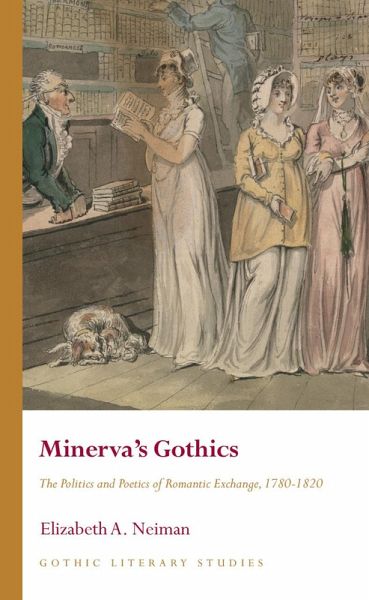
Between 1790 and 1820, William Lane's Minerva Press published an unprecedented number of circulating-library novels by obscure female authors. Because these novels catered to the day's fashion for sentimental themes and Gothic romance, they were and continue to be generally dismissed as ephemera. Recently, however, scholars interested in historicizing Romantic conceptions of genius and authorship have begun to write Minerva back into literary history. By making Minerva novels themselves the centre of the analysis, Minerva's Gothics illustrates how Romantic 'anxiety' is better conceptualized as a mutual though not entirely equitable 'exchange', a dynamic interrelationship between Minerva novels and Romantic-era politics and poetics that started in 1780, when Lane began publishing novels with some regularity. Reading Minerva novels for their shared popular conventions demonstrates that circulating-library novelists collectively recirculate, engage and modify commonplaces about women's nature, the social order and, most importantly, the very Romantic redefinitions of authorship and literature that render their novels not worth reading. By recognizing Minerva's collaborative rather than merely derivative authorial model, a forgotten pathway is restored between first-generation Romantic reactions to popular print culture and Percy Shelley's influential conceptualization of the poet in A Defence of Poetry.
Dieser Download kann aus rechtlichen Gründen nur mit Rechnungsadresse in A, D ausgeliefert werden.