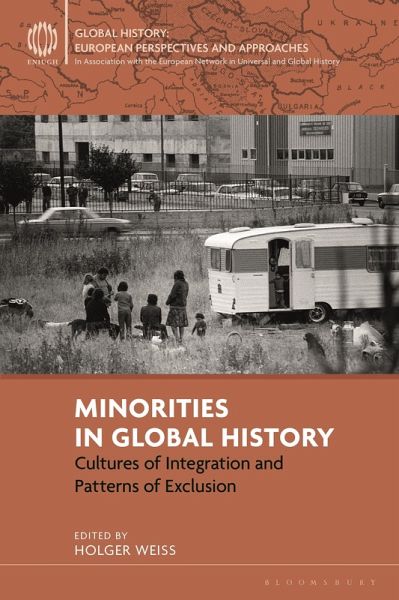
Minorities in Global History (eBook, PDF)
Cultures of Integration and Patterns of Exclusion
Redaktion: Weiss, Holger
24,95 €
24,95 €
inkl. MwSt.
Sofort per Download lieferbar

12 °P sammeln
24,95 €
Als Download kaufen
24,95 €
inkl. MwSt.
Sofort per Download lieferbar
12 °P sammeln
Jetzt verschenken
Alle Infos zum eBook verschenken
24,95 €
inkl. MwSt.
Sofort per Download lieferbar
Alle Infos zum eBook verschenken
12 °P sammeln

Minorities in Global History (eBook, PDF)
Cultures of Integration and Patterns of Exclusion
Redaktion: Weiss, Holger
- Format: PDF
- Merkliste
- Auf die Merkliste
- Bewerten Bewerten
- Teilen
- Produkt teilen
- Produkterinnerung
- Produkterinnerung

Bitte loggen Sie sich zunächst in Ihr Kundenkonto ein oder registrieren Sie sich bei
bücher.de, um das eBook-Abo tolino select nutzen zu können.
Hier können Sie sich einloggen
Sie sind bereits eingeloggt. Klicken Sie auf 2. tolino select Abo, um fortzufahren.

Bitte loggen Sie sich zunächst in Ihr Kundenkonto ein oder registrieren Sie sich bei bücher.de, um das eBook-Abo tolino select nutzen zu können.
This collection analyses the concept of minority and minorities in global history. Taking transnational, transregional and comparative approaches, it explores narratives of inclusion and exclusion both conceptually and through case studies.
Exploring examples of marginalization in Imperial Russia, early-20th century Korea, WWII China and Postcolonial Africa amongst others, the chapters in this volume seek to understand the entanglements of 'fluid minorities' and native populations in various historical settings. They explore dynamics between nation states and empires, minority-majority…mehr
- Geräte: PC
- ohne Kopierschutz
- eBook Hilfe
Andere Kunden interessierten sich auch für
Minorities in Global History (eBook, ePUB)70,95 €
Naheem JabbarHistoriography and Writing Postcolonial India (eBook, PDF)29,95 €
Nationalism in a Transnational Age (eBook, PDF)0,00 €
Erez ManelaThe Wilsonian Moment (eBook, PDF)12,95 €
Micro-Spatial Histories of Global Labour (eBook, PDF)96,95 €
Matthew FrankMaking Minorities History (eBook, PDF)51,95 €
Local Memories in a Nationalizing and Globalizing World (eBook, PDF)40,95 €-
-
-
This collection analyses the concept of minority and minorities in global history. Taking transnational, transregional and comparative approaches, it explores narratives of inclusion and exclusion both conceptually and through case studies.
Exploring examples of marginalization in Imperial Russia, early-20th century Korea, WWII China and Postcolonial Africa amongst others, the chapters in this volume seek to understand the entanglements of 'fluid minorities' and native populations in various historical settings. They explore dynamics between nation states and empires, minority-majority processes in (post)imperial and (post)Soviet contexts, fourth world perspectives and transnational minority movements. Taken together, the contributions to this collection address the exposure to and challenge of historical and contemporary treatments of marginalization, exclusion, belonging and inclusion in global history.
Produktdetails
- Produktdetails
- Verlag: Bloomsbury eBooks UK
- Seitenzahl: 280
- Erscheinungstermin: 4. April 2024
- Englisch
- ISBN-13: 9781350382220
- Artikelnr.: 69995152
- Verlag: Bloomsbury eBooks UK
- Seitenzahl: 280
- Erscheinungstermin: 4. April 2024
- Englisch
- ISBN-13: 9781350382220
- Artikelnr.: 69995152
- Herstellerkennzeichnung Die Herstellerinformationen sind derzeit nicht verfügbar.
Holger Weiss is Professor of History at Åbo Akademi University, Finland. His research focuses on Global and Atlantic history, West African environmental history, and Islamic Studies. His latest monograph is A Global Radical Waterfront: The International Propaganda Committee of Transport Workers and the International of Seamen and Harbour Workers (2021).
Introduction, Holger Weiss (Åbo Akademi University, Finland)
1. When and Why do Minorities Become Relevant? Territorialization, the
Transformation of Politics and the Ascendency of Nation and Race, Daniel
Hanglberger (Johannes Kepler University Linz, Austria)
Part I: Concepts and Contexts in Processes of Minoritization
2. The Majority as Other: The Formulation of "Peasant" Courts in Imperial
Russia, Jane Burbank (New York University, USA)
3. Chinese Citizenship and Property Rights in the Sino-Korean Borderland in
the Late-19th and Early-20th Centuries, Kwangmin Kim (University of
Colorado Boulder, USA)
4. The National Question in Finnish Communism: Leninist-Stalinist Theory
and Finland-Swedish Minority Practices, Jonas Ahlskog and Mats Wickström
(Åbo Akademi University, Finland)
5. The Chagossian Diaspora: Deportation, Exile and Resistance, Mohammad
Shameem Chitbahal (Bordeaux-Montaigne University, France)
Part II: Strategies and Activities of Minority Communities and Indigenous
Peoples
6. Imperial In-Betweens: The Portuguese Communities in Hong Kong and
Shanghai during the Second World War, Helena F.S. Lopes (Cardiff
University, UK)
7. Countering Economic Marginalization: Africanisation Strategies in
Tanzania's and Ghana's Insurance Markets before and during Decolonization,
Eva Kocher and Francis Dauda (University of Basel, Switzerland)
8. Copper and Colonialism: Metal Extraction in Northern Fennoscandia in a
Global Seventeenth Century Context, Jonas Monié Nordin (Stockholm
University, Sweden)
9. Kazakhstani Poles as Second Class Citizens: "Underground" Catholicism in
Soviet Kazachstan, Jerzy Rohozinski (Pilecki Institute, Warzaw, Poland)
10. Documenting an Ongoing Pandemic: A Sámi Reindeer Herders' Diary during
the COVID-19 Pandemic, May-Britt Öhman (Uppsala University, Sweden)
Part III: Minority Rights and their Politization
11. Minorities and European-Southeast Asian Connections: The European
Communities as an International Actor in Southeast Asia, Andreas Weiss
(Independent Scholar, Germany)
12. Universal Basic Income as a Tool Against Minority Marginalisation,
Craig Willis & David Schweikard (European Centre for Minority Issues,
Germany)
13. "Women Without a Country": Marriage, Dependent Citizenship and the
Transnational Fight for Equal Citizenship Rights in the Interwar Period,
Laura Frey (University of Basel, Switzerland)
14. Defending Rights of Woman as "a Mother, Worker and Citizen" - Women's
International Democratic Federation (WIDF) and its Work with Women in Latin
America, Yulia Gradskova (Stockholm University, Sweden)
15. Memory Politics and History Education in the Context of Shifting
Majority-Minority Power Dynamics and Competitive Victimhood in
Post-colonial Rwanda and Burundi, Denise Bentrovato (University of
Pretoria, South Africa)
1. When and Why do Minorities Become Relevant? Territorialization, the
Transformation of Politics and the Ascendency of Nation and Race, Daniel
Hanglberger (Johannes Kepler University Linz, Austria)
Part I: Concepts and Contexts in Processes of Minoritization
2. The Majority as Other: The Formulation of "Peasant" Courts in Imperial
Russia, Jane Burbank (New York University, USA)
3. Chinese Citizenship and Property Rights in the Sino-Korean Borderland in
the Late-19th and Early-20th Centuries, Kwangmin Kim (University of
Colorado Boulder, USA)
4. The National Question in Finnish Communism: Leninist-Stalinist Theory
and Finland-Swedish Minority Practices, Jonas Ahlskog and Mats Wickström
(Åbo Akademi University, Finland)
5. The Chagossian Diaspora: Deportation, Exile and Resistance, Mohammad
Shameem Chitbahal (Bordeaux-Montaigne University, France)
Part II: Strategies and Activities of Minority Communities and Indigenous
Peoples
6. Imperial In-Betweens: The Portuguese Communities in Hong Kong and
Shanghai during the Second World War, Helena F.S. Lopes (Cardiff
University, UK)
7. Countering Economic Marginalization: Africanisation Strategies in
Tanzania's and Ghana's Insurance Markets before and during Decolonization,
Eva Kocher and Francis Dauda (University of Basel, Switzerland)
8. Copper and Colonialism: Metal Extraction in Northern Fennoscandia in a
Global Seventeenth Century Context, Jonas Monié Nordin (Stockholm
University, Sweden)
9. Kazakhstani Poles as Second Class Citizens: "Underground" Catholicism in
Soviet Kazachstan, Jerzy Rohozinski (Pilecki Institute, Warzaw, Poland)
10. Documenting an Ongoing Pandemic: A Sámi Reindeer Herders' Diary during
the COVID-19 Pandemic, May-Britt Öhman (Uppsala University, Sweden)
Part III: Minority Rights and their Politization
11. Minorities and European-Southeast Asian Connections: The European
Communities as an International Actor in Southeast Asia, Andreas Weiss
(Independent Scholar, Germany)
12. Universal Basic Income as a Tool Against Minority Marginalisation,
Craig Willis & David Schweikard (European Centre for Minority Issues,
Germany)
13. "Women Without a Country": Marriage, Dependent Citizenship and the
Transnational Fight for Equal Citizenship Rights in the Interwar Period,
Laura Frey (University of Basel, Switzerland)
14. Defending Rights of Woman as "a Mother, Worker and Citizen" - Women's
International Democratic Federation (WIDF) and its Work with Women in Latin
America, Yulia Gradskova (Stockholm University, Sweden)
15. Memory Politics and History Education in the Context of Shifting
Majority-Minority Power Dynamics and Competitive Victimhood in
Post-colonial Rwanda and Burundi, Denise Bentrovato (University of
Pretoria, South Africa)
Introduction, Holger Weiss (Åbo Akademi University, Finland)
1. When and Why do Minorities Become Relevant? Territorialization, the
Transformation of Politics and the Ascendency of Nation and Race, Daniel
Hanglberger (Johannes Kepler University Linz, Austria)
Part I: Concepts and Contexts in Processes of Minoritization
2. The Majority as Other: The Formulation of "Peasant" Courts in Imperial
Russia, Jane Burbank (New York University, USA)
3. Chinese Citizenship and Property Rights in the Sino-Korean Borderland in
the Late-19th and Early-20th Centuries, Kwangmin Kim (University of
Colorado Boulder, USA)
4. The National Question in Finnish Communism: Leninist-Stalinist Theory
and Finland-Swedish Minority Practices, Jonas Ahlskog and Mats Wickström
(Åbo Akademi University, Finland)
5. The Chagossian Diaspora: Deportation, Exile and Resistance, Mohammad
Shameem Chitbahal (Bordeaux-Montaigne University, France)
Part II: Strategies and Activities of Minority Communities and Indigenous
Peoples
6. Imperial In-Betweens: The Portuguese Communities in Hong Kong and
Shanghai during the Second World War, Helena F.S. Lopes (Cardiff
University, UK)
7. Countering Economic Marginalization: Africanisation Strategies in
Tanzania's and Ghana's Insurance Markets before and during Decolonization,
Eva Kocher and Francis Dauda (University of Basel, Switzerland)
8. Copper and Colonialism: Metal Extraction in Northern Fennoscandia in a
Global Seventeenth Century Context, Jonas Monié Nordin (Stockholm
University, Sweden)
9. Kazakhstani Poles as Second Class Citizens: "Underground" Catholicism in
Soviet Kazachstan, Jerzy Rohozinski (Pilecki Institute, Warzaw, Poland)
10. Documenting an Ongoing Pandemic: A Sámi Reindeer Herders' Diary during
the COVID-19 Pandemic, May-Britt Öhman (Uppsala University, Sweden)
Part III: Minority Rights and their Politization
11. Minorities and European-Southeast Asian Connections: The European
Communities as an International Actor in Southeast Asia, Andreas Weiss
(Independent Scholar, Germany)
12. Universal Basic Income as a Tool Against Minority Marginalisation,
Craig Willis & David Schweikard (European Centre for Minority Issues,
Germany)
13. "Women Without a Country": Marriage, Dependent Citizenship and the
Transnational Fight for Equal Citizenship Rights in the Interwar Period,
Laura Frey (University of Basel, Switzerland)
14. Defending Rights of Woman as "a Mother, Worker and Citizen" - Women's
International Democratic Federation (WIDF) and its Work with Women in Latin
America, Yulia Gradskova (Stockholm University, Sweden)
15. Memory Politics and History Education in the Context of Shifting
Majority-Minority Power Dynamics and Competitive Victimhood in
Post-colonial Rwanda and Burundi, Denise Bentrovato (University of
Pretoria, South Africa)
1. When and Why do Minorities Become Relevant? Territorialization, the
Transformation of Politics and the Ascendency of Nation and Race, Daniel
Hanglberger (Johannes Kepler University Linz, Austria)
Part I: Concepts and Contexts in Processes of Minoritization
2. The Majority as Other: The Formulation of "Peasant" Courts in Imperial
Russia, Jane Burbank (New York University, USA)
3. Chinese Citizenship and Property Rights in the Sino-Korean Borderland in
the Late-19th and Early-20th Centuries, Kwangmin Kim (University of
Colorado Boulder, USA)
4. The National Question in Finnish Communism: Leninist-Stalinist Theory
and Finland-Swedish Minority Practices, Jonas Ahlskog and Mats Wickström
(Åbo Akademi University, Finland)
5. The Chagossian Diaspora: Deportation, Exile and Resistance, Mohammad
Shameem Chitbahal (Bordeaux-Montaigne University, France)
Part II: Strategies and Activities of Minority Communities and Indigenous
Peoples
6. Imperial In-Betweens: The Portuguese Communities in Hong Kong and
Shanghai during the Second World War, Helena F.S. Lopes (Cardiff
University, UK)
7. Countering Economic Marginalization: Africanisation Strategies in
Tanzania's and Ghana's Insurance Markets before and during Decolonization,
Eva Kocher and Francis Dauda (University of Basel, Switzerland)
8. Copper and Colonialism: Metal Extraction in Northern Fennoscandia in a
Global Seventeenth Century Context, Jonas Monié Nordin (Stockholm
University, Sweden)
9. Kazakhstani Poles as Second Class Citizens: "Underground" Catholicism in
Soviet Kazachstan, Jerzy Rohozinski (Pilecki Institute, Warzaw, Poland)
10. Documenting an Ongoing Pandemic: A Sámi Reindeer Herders' Diary during
the COVID-19 Pandemic, May-Britt Öhman (Uppsala University, Sweden)
Part III: Minority Rights and their Politization
11. Minorities and European-Southeast Asian Connections: The European
Communities as an International Actor in Southeast Asia, Andreas Weiss
(Independent Scholar, Germany)
12. Universal Basic Income as a Tool Against Minority Marginalisation,
Craig Willis & David Schweikard (European Centre for Minority Issues,
Germany)
13. "Women Without a Country": Marriage, Dependent Citizenship and the
Transnational Fight for Equal Citizenship Rights in the Interwar Period,
Laura Frey (University of Basel, Switzerland)
14. Defending Rights of Woman as "a Mother, Worker and Citizen" - Women's
International Democratic Federation (WIDF) and its Work with Women in Latin
America, Yulia Gradskova (Stockholm University, Sweden)
15. Memory Politics and History Education in the Context of Shifting
Majority-Minority Power Dynamics and Competitive Victimhood in
Post-colonial Rwanda and Burundi, Denise Bentrovato (University of
Pretoria, South Africa)